
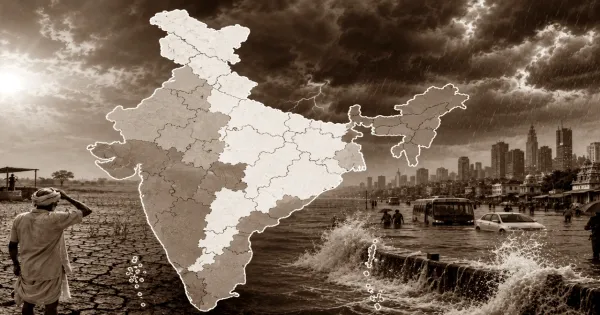

El Nino weakens the monsoon and creates drought-like conditions in many states. This has a direct impact on food production and rural economy.

Saurabh Varshney, senior journalist
Amidst the increasing effects of climate change across the world, El Nino is once again becoming a matter of concern for India. This seasonal phenomenon, resulting from an abnormal increase in the temperature of the Pacific Ocean, directly affects the Indian monsoon.
In an agricultural country like India, even a small disturbance in monsoon has a wide impact on agriculture, economy, water crisis and inflation. In such a situation, it is natural to raise the question that if the effect of El Nino deepens, then what arrangements does India have to deal with it?
Almost half of India’s agricultural area is still dependent on rain. Due to El Nino, monsoon weakens, rainfall decreases and drought-like conditions arise in many states. This has a direct impact on farmers’ income, food grain production and rural economy. Not only this, power generation, drinking water supply and industries are also affected, hence El Nino is not only a weather problem but also an economic and social challenge.
In the last few years, India has taken many important steps in this direction. The Indian Meteorological Department is now issuing more accurate and timely weather forecasts than before. The government continuously monitors the monsoon situation through satellite technology and modern scientific systems.
This helps states and farmers to prepare in advance. Efforts are being made for change in the agricultural sector also. The government is promoting drought-resistant seeds and farmers are being encouraged to grow crops that require less water. Many efforts are also being made towards water conservation.
‘The government is paying special attention to programs like Jal Shakti Abhiyan, revitalization of ponds, rain water harvesting and groundwater conservation. Many states have also increased community participation to strengthen water management at the local level. It is important to understand that water is going to be the biggest challenge in the future.
Even today, irrigation facilities are limited in many rural areas. Water conservation schemes do not go beyond paper. Many times there is a lack of timely delivery of correct information to the farmers. The biggest challenge is that climate change is now becoming more uncertain and serious than ever before.
Natural phenomena like El Nino give us the message that the future cannot be safe without maintaining a balance between development and environment. India will have to focus not just on relief plans but on long-term strategy. The need of the hour is to make water conservation, scientific farming, green energy and environmental protection a national priority.
If the central and state governments, scientific institutions, farmers and common citizens take responsibility together, then India can strongly face challenges like El Nino. The crisis is big, but preparedness and collective efforts can be even bigger. Changes in the world weather system have the greatest impact on agriculture.
In an agricultural country like India, monsoon is not just a season but is the basis of livelihood of crores of farmers and food security of the country. In such a situation, when ‘El Nino’ situation is created due to increase in sea temperature in the Pacific Ocean, then its direct effect is visible on the Indian monsoon and crops. This is why El Nino is considered a serious warning for Indian agriculture.
Generally, there is less rainfall in India during El Nino. Due to weakening of monsoon, there is shortage of water in the fields and Kharif crops are most affected. Crops like paddy, maize, soybean, pulses and sugarcane depend on adequate rainfall. When it does not rain on time, sowing is delayed, production decreases and farmers’ costs increase.
Drought like situation arises in many areas. The impact of El Nino on rice cultivation is considered particularly serious. Paddy requires more water, but with less rainfall the fields start drying up and production falls drastically. Similarly, pulses and oilseed crops are also affected by weak monsoon. It also affects animal husbandry, because the availability of fodder reduces.
El Nino is not a problem limited only to agriculture, but it also affects the country’s economy. When agricultural production decreases, food prices start increasing. This increases inflation and puts financial burden on the general public. Due to decrease in the income of farmers, the purchasing power of rural markets also weakens. (These are the personal views of the author)

Comments are closed.