

In her new CNN Original Series “Kara Swisher Wants to Live Forever,” veteran tech journalist Kara Swisher went hunting for the science behind the global longevity boom. One of her sharpest stops was South Korea, where everyday habits, not expensive biotech, appear to be driving some of the world’s biggest gains in lifespan.
Americans once sat near the developed-world average on life expectancy, but they no longer do. U.S. life expectancy reached 79.0 years in 2024, but the average across comparable wealthy countries was 82.7, a gap of about 3.7 years, according to the Peterson-KFF Health System Tracker.
The Organization for Economic Co-operation and Development’s Health at a Glance 2025 report places the U.S. behind every major peer including Japan, Switzerland and South Korea, all of which crossed the 80-year threshold years ago.
The clearest contrast starts in the cafeteria. When Swisher visited a Seoul school at lunchtime, students were eating lettuce wraps, radish-and-chive salad, kimchi and seasonal fruit, not the kind of meal her own young children would willingly choose, she told CNN.
Korean children are given free school lunches throughout their schooling, and the menus are deliberately designed for both nutrition and education, school nutritionist Yeonju Kim said in the documentary.
The U.S. picture is starkly different. A 2023 report from the U.S. Centers for Disease Control and Prevention found nearly half of children aged 1 to 5 do not eat a vegetable every day, and a third do not eat fruit daily.
The problem follows children into adulthood. A 2025 study in the European Journal of Clinical Nutrition, drawing on more than 31,000 American adults in the National Health and Nutrition Examination Survey, found 47% had poor-quality diets, measured against the American Heart Association’s primary diet score, which rewards plates heavy on fruits, vegetables, whole grains, lean proteins and healthy fats while penalizing processed foods.
Diets that hit those marks, including the Mediterranean and MIND eating patterns, are linked to both longer life and slower cognitive decline. MIND stands for the Mediterranean-DASH Intervention for Neurodegenerative Delay. The benefits are barely noticeable day to day but compound dramatically over decades.
Activity is the second pillar. In studies of South Korean “SuperAgers,” older adults whose cognitive performance matches that of people decades younger, the most influential factors are regular exercise, strong social ties and taking on new, challenging activities, said Dr. Geon-Ha Kim, a neuroscientist at Ewha Womans University Medical Center in Seoul.
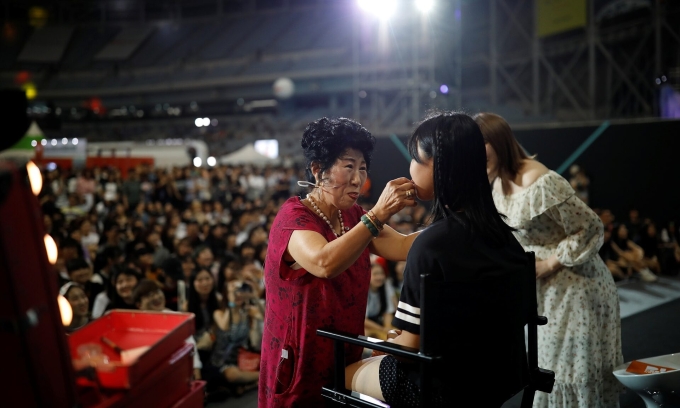
For a more personal lesson, Swisher sat down with Park Mak-rye, the 79-year-old social media star better known as “Korea Grandma,” who posts cooking recipes, skin-care routines and exercise videos to a large online following. Those habits, plus a tight circle of friends, are what keep her going, she said.
Park Mak-rye, a 70-year-old YouTuber, puts on makeup on a volunteer at a makeup show during DIA Festival in Seoul, South Korea. Photo by Reuters |
“I’m with friends laughing all day. There’s no room for sickness,” Park said.
The data backs her up. A July 2025 meta-analysis of 85 studies covering nearly 8 million people, led by the University of Queensland and published in the British Journal of Sports Medicine, found that adults who maintained vigorous physical activity through adulthood lowered their risk of an early death by up to 40%.
A 2023 study in Nature Human Behaviour found that lonely and socially isolated people face a 32% higher risk of dying early from any cause. A separate study by University College London researchers, published in the journal Innovation in Aging, suggested that taking part in arts and cultural activities at least weekly may slow biological aging by about 4%, an effect comparable to regular exercise.
Another major factor contrasting South Korea and the U.S.’s longetivity is how the system is built around treatment or prevention.
“No one wants to pay for prevention,” said Dr. Karen Studer, chair of the Department of Preventive Medicine at Loma Linda University School of Medicine in California.
Under the current American system, she told CNNphysicians are paid to treat disease: insurers will reimburse thousands of dollars for a cardiac bypass but very little for the office visit that might have prevented the underlying heart disease in the first place.
In South Korea, by contrast, dropping by a doctor for a sniffle or a stiff back is routine, Shin said. That habit is far easier to sustain in a country where care is affordable.
In an email to CNNStuder said people can be more proactive about their own health. She recommended keeping vaccinations and screenings current, exercising regularly including strength training, eating more plants, getting enough sleep, managing stress and cutting back on or quitting vaping, tobacco and alcohol.
Comments are closed.