
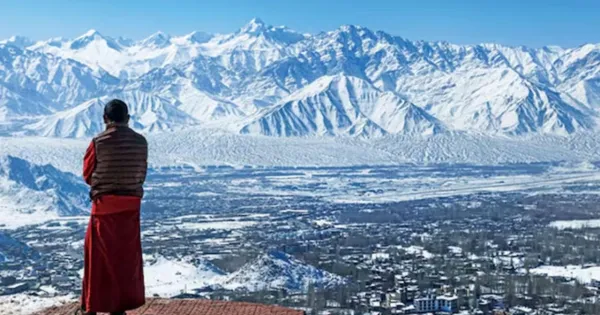
Are the citizens of Ladakh unhappy with the increasing number of tourists? Know the major concerns of local people

Suresh S. Duggar/Jammu. It is true that Ladakh has become one of the most popular tourist destinations in India. Snow-capped mountains, blue lakes, Buddhist monasteries and exciting road trips attract millions of tourists every year. There has been unprecedented growth in the tourism sector in the last few years, which has benefited the local economy. The income of people associated with hotels, guest houses, taxis, restaurants and handicrafts has increased. Despite this, many citizens of Ladakh are expressing concern about the ever increasing number of tourists. They believe that uncontrolled tourism is putting serious pressure on the environment, culture and resources of this sensitive Himalayan region.
Water availability is a big challenge
Ladakh is an arid and high altitude region, where natural resources are limited. Availability of water is already a big challenge here. During summer when the number of tourists suddenly increases, water consumption in hotels, cafes and other tourist establishments increases manifold. Local people say that this deepens the water crisis in many areas. The situation is becoming more serious due to the shrinking of glaciers due to climate change. In such a situation, increasing water demand from tourism has become a matter of concern for local communities.
Concerns about cultural identity
Concerns are also increasing regarding the cultural identity of Ladakh. The region is known for its distinct Buddhist culture, traditional lifestyle and social values. A section of local citizens feel that the influence of outside culture is increasing rapidly due to large-scale tourism. Many times there are complaints of tourists not respecting local traditions and religious places. This creates cultural dissatisfaction and people feel that their heritage is gradually weakening.
Environmental pollution is a big problem
Environmental pollution has also emerged as a big problem. With the increasing number of tourists, plastic waste, bottles, packaging materials and other wastes have increased rapidly. Disposal of waste is not easy in a sensitive ecosystem like Ladakh. Piles of garbage have started appearing around many popular tourist places. Local environmental activists say that if effective steps are not taken in time, the natural beauty and biodiversity of the area may be damaged.
Traffic pressure on roads during tourist season
Traffic pressure is also causing problems for the citizens. The number of vehicles on the roads increases significantly during the tourist season. Traffic jams are seen in Leh and surrounding areas, which was rare till a few years ago. The large number of private vehicles and motorcycles coming in is also increasing air pollution and noise pollution. Local people believe that this is having a negative impact on their peaceful and traditional life.
However, it is also true that tourism has become an important pillar of Ladakh’s economy. Thousands of families are directly and indirectly dependent on it. Therefore, local people are not against tourism, rather they are demanding its balanced and responsible development. Their objective is to ensure that economic benefits are maintained along with environmental protection and protection of cultural heritage.
Rising land and housing prices are an important issue.
Rising land and housing prices are also an important issue. Due to the expansion of tourism industry, demand for hotels, resorts and commercial establishments has increased. Due to this the prices of land have increased rapidly. It has become more difficult than ever for local youth and middle-class families to buy or build housing. Many citizens believe that the economic benefits of tourism are not distributed equally and that the benefits accrue mainly to a few business groups.
Moreover, the citizens of Ladakh have been demanding “sustainable tourism” for a long time. He says that tourism should be developed in such a way that it does not put excessive pressure on local resources. Many social organizations and environmental groups have advocated controlling the number of tourists, strengthening waste management, promoting water conservation, and implementing eco-friendly tourism policies.
Overall, the main reason for the displeasure of the citizens of Ladakh is not the increasing number of tourists, but the challenges posed by uncontrolled tourism. If the government, local administration, tourism industry and tourists work together responsibly, a balance can be established between tourism and the environment. This balance will be the key to the sustainable and secure future of Ladakh.

Comments are closed.