
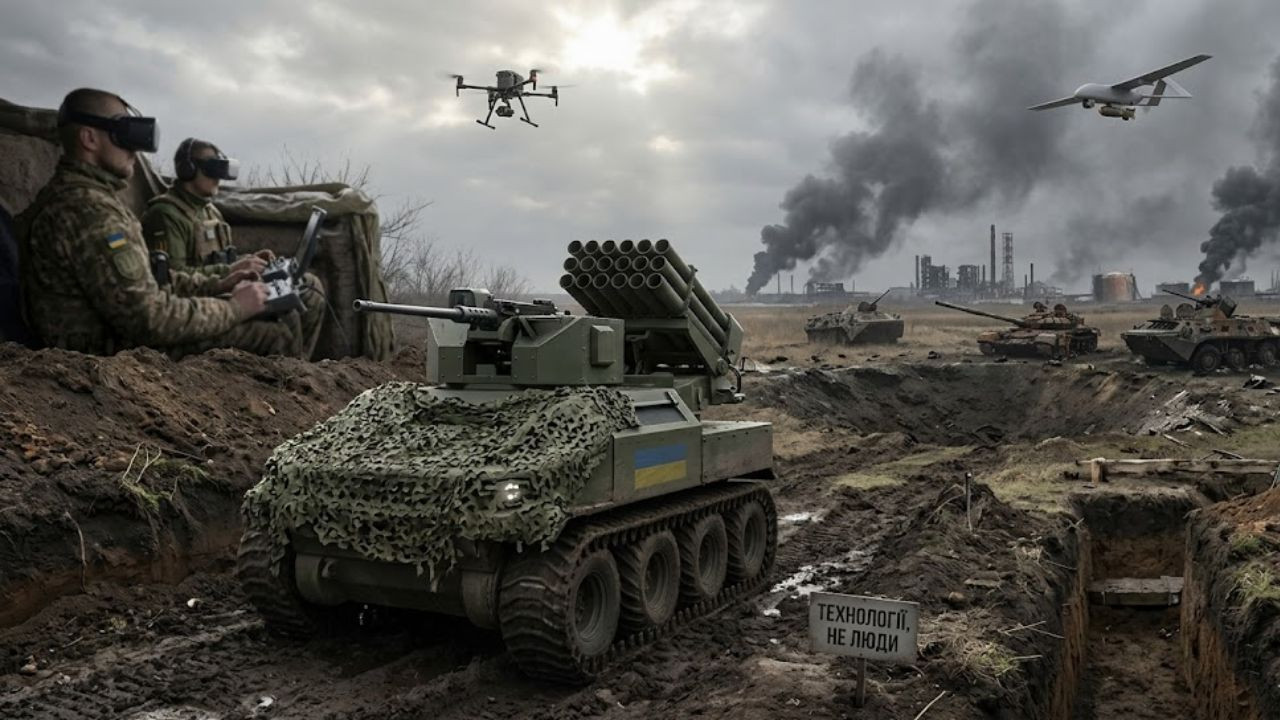
Machines are replacing humans in war! Ukraine is targeting Russia with drones and robots

New Delhi: The ongoing war between Ukraine and Russia is now moving from a traditional war to a technology-based conflict. The direct presence of soldiers on the battlefield is decreasing and being replaced by drones, robotic vehicles and remote control systems. The situation is such that in many military operations, Russian targets are being attacked without a single Ukrainian soldier landing on the ground.
According to CNN report, the Ukrainian army is now using such robots and drones which do not need food, water or rest. Commanders are now monitoring and conducting attacks through screens, livestreams and drone feeds rather than leading troops on the front. This change appears to be completely changing the nature of war.
Attacks taking place without soldiers
According to the report, multiple robotic vehicles equipped with explosives can target Russian targets in a single operation. During these operations, no Ukrainian soldiers are directly present in the war zone. Reconnaissance drones flying overhead monitor the entire operation, while operators sitting in control centers operate the machines remotely.
Lack of human resources increased dependence on technology
Ukraine has rapidly increased the use of unmanned systems amid a long-term shortage of troops and uncertainty over Western support. Drones, robotic vehicles and remote control weapons platforms have now become an important part of Ukraine’s military strategy. Through these technologies, Ukraine is trying to maintain its technological edge against the Russian army.
Claim of capture only by robots and drones
In April, Ukrainian President Volodymyr Zelenskyy claimed that the Ukrainian military captured a Russian base for the first time only with the help of robots and drones. He also said that since the beginning of the year, unmanned systems have completed 22,000 missions.
Russian soldiers gave "silent death" Name of
According to Ukrainian soldiers, captured Russian soldiers used these robotic bomb carriers "silent death" Let’s call by saying. It is said that these machines move so silently that Russian soldiers often realize their presence only when they have reached a distance of just 10 meters from the explosion area.
Commanders’ opinion on the changing nature of war
Deputy Commander Bar, who previously fought door-to-door in eastern Ukraine, said, "At that time I could not even think of such a thing. But I realize that if such equipment had been available at that time, more of my friends would have been saved."
On the increasing role of technology in war, he said, "Earlier, war was more manly in some way or the other. There your skills mattered – how good was your training, how disciplined you were, etc. Now technology decides everything. Now turning back is not possible."
Increased emphasis on technology after heavy losses
Ukraine has suffered huge losses in terms of manpower during the war that has continued for more than four years. This challenge has become even bigger for a less populated country. For this reason, the Kiev administration has paid special attention to increasing drone production and improving the capability of unmanned systems.
Target to cause casualties of 35 thousand Russian soldiers every month
Ukrainian officials say that their goal is to reduce the casualties on Russian soldiers by about 35,000 every month and this goal has been achieved this year. Through this strategy, Ukraine wants to put additional pressure on Russia so that it has to recruit more soldiers from its urban population and middle class.
New estimate of Russia’s military losses
According to estimates released on Wednesday by Britain’s intelligence agency GCHQ, Russia’s total military death toll has reached around 5 lakh.
Robots are becoming the new face of war
Technology that was once considered new on the battlefield has now become a normal part of Ukrainian military operations. The use of robots is increasing in tasks like evacuating injured soldiers, delivering supplies to the front lines and carrying out attacks. This change shows how rapidly the nature of one of Europe’s largest conflicts is changing.

Comments are closed.