
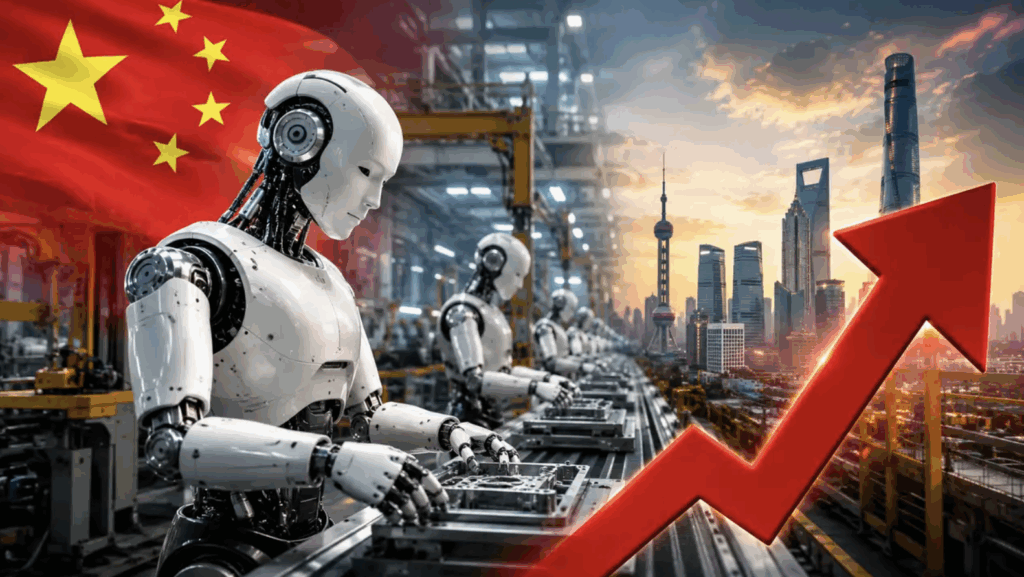

China may be preparing for one of the biggest labor transformations in modern history. Facing a rapidly shrinking workforce, an aging population, and declining birth rates, the country is increasingly turning to humanoid robots as a potential solution. According to a recent Barclays report, China could deploy up to 24 million humanoid robots by 2035, helping offset nearly 60% of a projected workforce decline of 37 million people over the next decade.
The prediction highlights how robotics is moving from a futuristic concept to an economic necessity for the world’s second-largest economy.
China’s Demographic Challenge Is Growing
China’s population crisis has become one of its biggest long-term economic concerns. Birth rates have fallen to historic lows, while the share of elderly citizens continues to rise. As a result, the country’s working-age population is shrinking steadily, creating labor shortages across manufacturing, logistics, healthcare, and services.
Barclays estimates that China’s labor force could contract by 37 million workers by 2035 if current demographic trends continue. Such a decline would place significant pressure on manufacturing, which contributes roughly a quarter of China’s economy.
Unlike previous decades, China can no longer rely on a continuously expanding workforce to fuel economic growth.
Humanoid Robots As The New Workforce
To counter this challenge, Barclays projects that China could install as many as 24 million humanoid robots by 2035. These robots would effectively compensate for around 60% of the expected labor shortfall. Under the bank’s optimistic scenario, humanoids would represent nearly 4% of China’s workforce.
The first wave of deployment is expected in factories, warehouses, logistics centers, and industrial facilities where repetitive tasks dominate. Unlike traditional industrial robots that require specialized environments, humanoid robots are designed to operate in spaces already built for humans.
This makes adoption potentially faster and more economical across existing infrastructure.
Beyond Factories: Caring For An Aging Society
China’s ambitions extend beyond manufacturing.
Researchers and companies are developing humanoid robots capable of assisting with household chores, elderly care, laundry, cleaning, and meal preparation. The goal is to support a rapidly aging population while easing pressure on caregivers and healthcare systems.
However, experts caution that home environments remain far more complex than factories. While robots perform well in controlled settings, they still struggle with unpredictable situations commonly found in homes.
China Is Building A Global Robotics Ecosystem
China is not merely adopting robots—it is building the entire supply chain.
The country already dominates much of the global humanoid robotics ecosystem, from robot manufacturing to components such as robotic hands, sensors, batteries, and AI systems. Government support, private investment, and rapid commercialization have helped Chinese companies scale faster than many international competitors.
Some analysts compare China’s current robotics push to its earlier rise in electric vehicles, where state support and industrial scale enabled global leadership.
Will Robots Replace Humans?
Not everyone believes robots will eliminate jobs.
Chinese officials and industry leaders argue that humanoids are more likely to supplement human labor than replace it entirely. They are expected to take over repetitive, dangerous, or physically demanding work while humans focus on supervision, creativity, and higher-value activities.
History also suggests that technological revolutions often create new categories of employment even as older roles disappear. Barclays notes that demographic decline may make automation a necessity rather than a choice for many economies.
As labor shortages intensify, China may become the world’s largest real-world experiment in how humans and humanoid robots can coexist in the workplace.
Summary
China plans to use humanoid robots to address a projected shortage of 37 million workers by 2035. Barclays estimates up to 24 million humanoids could offset 60% of the decline, particularly in manufacturing, logistics, and elderly care. Driven by aging demographics and falling birth rates, China is rapidly building a robotics ecosystem that could reshape labor markets and global industry.
Image Source
Comments are closed.