
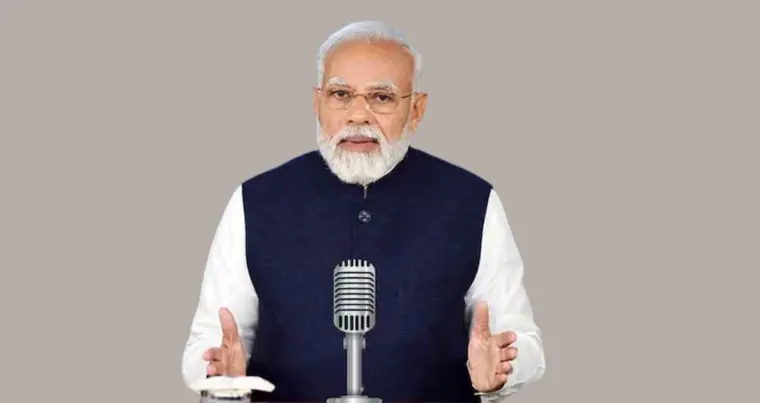

In the 134th episode of Mann Ki Baat, Prime Minister Narendra Modi praised the Manorama river cleaning campaign of Akash Gupta of Basti. He also discussed the achievements of the players, precautions in extreme heat, variety of mango and Indian cultural heritage.
New Delhi: Prime Minister Narendra Modi, while interacting with the countrymen in the 134th episode of his monthly radio program ‘Mann Ki Baat’, discussed various topics like sports, environmental protection, Indian cultural heritage, agriculture and social participation. In the program he mentioned many inspirational personalities and initiatives and encouraged citizens to participate in positive change.
The Prime Minister particularly praised Akash Gupta, a youth from Basti district of Uttar Pradesh, who started a campaign to clean the Manorama River in his village. Apart from this, he also mentioned the achievements of national level athletes, health precautions during scorching heat, traditional drinks of India, diverse varieties of mango and historical heritages recently brought back from abroad.
Congratulations to the players of the National Athletics Competition
At the beginning of the program, the Prime Minister mentioned the National Senior Athletics Federation competition organized in Ranchi, the capital of Jharkhand. He said that hundreds of players from across the country participated in this competition and many new national records were created.
The Prime Minister particularly praised the achievements of players like Gurindervir Singh, Animesh Kujur, Vishal TK, Tejaswin Shankar, Dev Meena and Kuldeep Kumar. He said that the consistent performance in Indian athletics indicates that the country’s youth are ready to compete on the global stage.
His conversation with Gurinderveer Singh and Animesh Kujur was also telecast during the programme. Praising the healthy competition between the two players, the Prime Minister said that such efforts set a new standard of excellence in sports.
Emphasis on health safety in scorching heat
In view of the rising temperatures and heat wave conditions in many parts of the country, the Prime Minister appealed to the citizens to take health precautions.
He advised people to drink adequate amount of water, avoid strong sunlight and follow the guidelines issued by government agencies. He said that there are many effective measures to protect against heat in India’s traditional lifestyle and food.
According to the Prime Minister, during the summer season, traditional beverages not only cool the body but are also beneficial for health.
Mentioned the traditional drinks of India
In his address, Prime Minister Modi discussed traditional drinks popular in different parts of the country.
He mentioned drinks like Aam Panna of North India, Lassi of Punjab and Haryana, Buttermilk of Rajasthan and Gujarat, Sattu Sharbat of Bihar and Eastern Uttar Pradesh, Kokum Sharbat of Konkan region and Panakam, Neer Mor and Sambaram of South India.
He said that these drinks are not just beverages to provide relief from the heat but also represent India’s cultural diversity and local traditions.
Mango said to be the identity of India’s summer
While discussing the summer season, the Prime Minister also made special mention of India’s popular fruit mango. He said that almost every region of the country is known for its specific mango variety.
He mentioned famous mangoes like Alphonso of Maharashtra, Kesar of Gujarat, Dussehri and Langra of Uttar Pradesh, Jardalu of Bihar, Himsagar of West Bengal and Banganpalli, Totapuri and Malgova of South India.
The Prime Minister said that Indian mangoes are now making their mark in the international markets and the country’s farmers are making a significant contribution to the global agricultural economy.
Chola period heritage returned from Netherlands
During the program the Prime Minister also mentioned about his recent visit to Netherlands. He said that in a special ceremony organized there, ancient copper plates related to the Chola Empire were handed back to India.
He said that these copper plates are very important from the historical point of view and they provide information about the administrative system of the Chola dynasty, maritime power and relations with the countries of South-East Asia.
The Prime Minister described this as an important achievement in the direction of preserving the cultural heritage of India.
Government’s focus on Indian heritage conservation
Prime Minister Modi said that preserving the historical and cultural heritage of the country is one of the priorities of the government.
Referring to ‘Gyan Bharatam Abhiyan’, he said that recently rare copper plates have been discovered in Malhar region of Chhattisgarh. It is believed that these are related to the ancient Panduvanshi reign and can make an important contribution in the study of Indian history.
Basti’s Akash Gupta became a source of inspiration
The most inspiring part of the program was the story of young Akash Gupta from Basti district of Uttar Pradesh. The Prime Minister said that Akash was worried after seeing the deteriorating condition of the Manorama River in his village.
The river which he had seen clean and lively in his childhood had become polluted with plastic and garbage over time. Instead of getting frustrated with the situation, Akash decided to initiate change.
He joined his friends and started a river cleaning campaign. Despite limited resources, the group started regularly removing plastic, water hyacinth and other waste from the river.
Positive change seen through public participation
The Prime Minister said that on several occasions the youth took out 50 to 60 kg of garbage from the river in a day. Gradually a large part of Manorama river became clearly visible.
The impact of this initiative was not only limited to cleaning the river, but also increased awareness about environment and cleanliness among the people nearby.
The Prime Minister said that the efforts of Akash Gupta and his colleagues prove that merely complaining is not enough for positive change, but taking initiative is necessary.
Society can change through citizen participation
At the end of his address, the Prime Minister emphasized that active participation of citizens is extremely important in the development of the country and environmental protection.
He said that common citizens of the country are doing inspiring work in fields like sports, culture, agriculture, environment and social development. Such efforts not only bring change at the local level, but also provide positive direction to the entire society.
According to the Prime Minister, India’s biggest strength is its public participation and this strength will enable the country to face future challenges.

Comments are closed.