
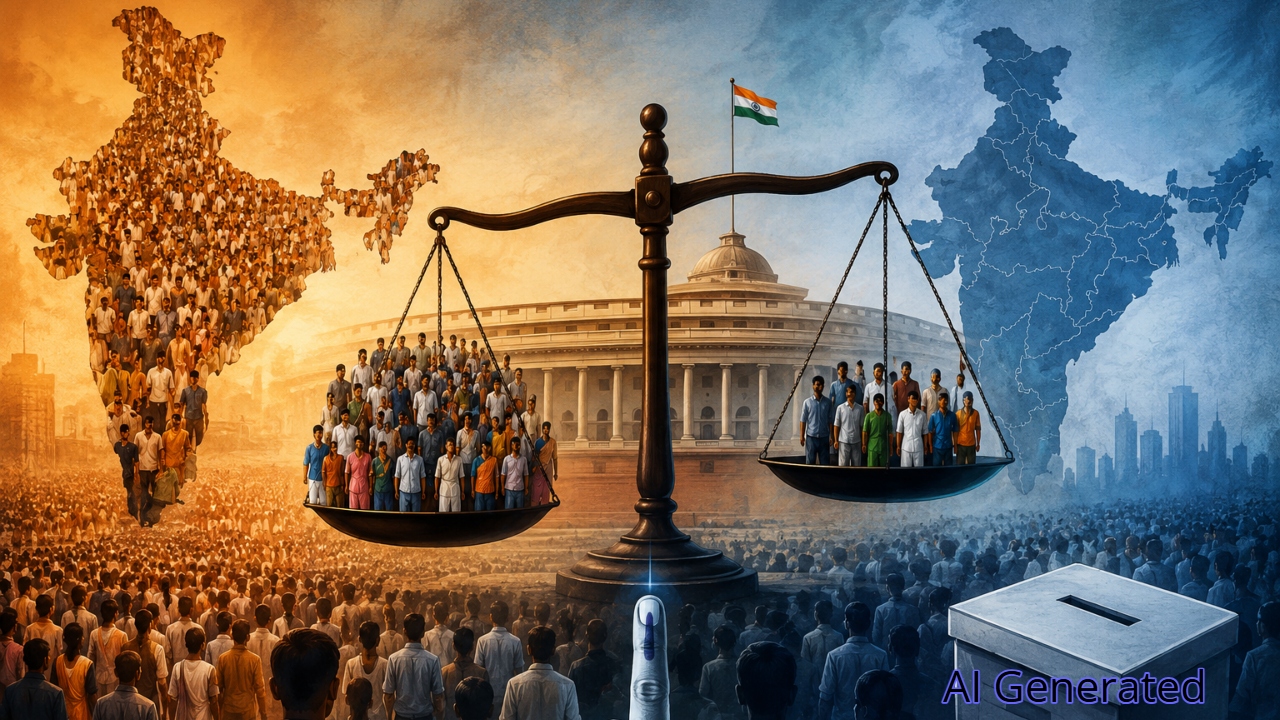
Caste Census: The more the population, the more the share? Will the 2029 elections be a fight of Representation vs Population?

Since the census process started across the country for the first time since 2011, a new debate is rapidly taking shape in Indian politics. In fact, the process of 2026-27 census, counting of caste data and subsequent possible delimitation is not only being considered as an administrative exercise, but it is also being considered as the basis of the upcoming political balance of power. The question is whether population should be the basis of representation in Parliament or should the success of development and population control of those states also be given importance? This debate can become a big issue of national politics in the coming years in the form of “Representation vs Population”.
what about parliament increased Did the debate reach the seats?
The slogan “Whoever has the population, his share” has been associated with the politics of social justice and reservation for a long time. But now this debate seems to be reaching parliamentary representation. Under Articles 81 and 82 of the Constitution, the principle of distribution of Lok Sabha seats in proportion to the population was laid down. On this basis, more populous states like Uttar Pradesh, Bihar, Madhya Pradesh and Rajasthan argue that their seats in Parliament should also increase according to their population. According to the Delimitation Commission 2008, at present elections for 543 seats of the Lok Sabha are held once every five years. Presently the number of seats is based on the 1971 census.
Why can delimitation bring political earthquake?
The distribution of seats in India was first banned in 1976 through the 42nd Constitutional Amendment. Its objective was to ensure that states adopting family planning do not suffer political loss. Later, through the 84th Constitutional Amendment (2001), this ban was extended till the first census to be held after 2026. This means that after the census of 2027, the way can be opened for starting the constitutional process of delimitation. It should also be mentioned here that the 84th Constitutional Amendment had extended the ban on redistribution of seats till the first census to be held after 2026.
Will the South have to pay the price of population control?
The concern is that states like Tamil Nadu, Kerala, Karnataka, Andhra Pradesh and Telangana have controlled population growth by investing in family planning, education and health services for decades. If the redistribution of seats is done only on the basis of population, then the proportional influence of these states in the Parliament may decrease.
Many leaders of South India have earlier expressed apprehension that this may reduce their influence in national politics, while the states of North India may gain in seats. Southern states fear that if delimitation is done on the basis of new population, states like Uttar Pradesh and Bihar may get more seats. However, Union Home Minister Amit Shah had said in the statement given in the Lok Sabha that there will be no reduction in seats in South Indian provinces. There will be an increase in it, but it is certain that on average there will be some loss.
Is this the beginning of Mandal politics?
The recommendations of the Mandal Commission in 1990 permanently changed Indian politics. Now many political analysts believe that the combination of caste census and delimitation can bring about a similar big political change. The government has announced that caste data will also be included in the 2027 census. This will be the first time since 1931 that comprehensive caste data will be collected across the country.
If these figures are made public then the pressure on the question of social representation may increase on political parties. Then not only caste, but also regional representation will become a part of the electoral debate.
Can elections become Representation vs Population?
Leadership, welfare schemes and development models will be the center of national politics till 2024. But the picture may change by 2029. If census data comes out, new debate begins on caste composition and the process of delimitation moves forward, then political parties will have to clarify what should be the basis of representation in democracy? Will it be population, social justice, regional balance or a combination of all three?
Not only census, it will also decide political direction
The 2027 census will not be just a collection of data. The debate related to caste calculation, delimitation and parliamentary representation can decide the direction of politics of the coming decade. On one hand there will be the democratic principle of “One Person, One Vote, One Value”, while on the other hand there will be a demand to maintain political balance based on population control and development model. In such a situation, it would not be wrong to say that the 2029 Lok Sabha elections can go beyond the fight of development vs opposition and turn into the biggest political debate of “Representation vs Population”.
this time The question of economic justice will arise.
RJD’s national spokesperson Professor Naval Kishore Yadav believes that the upcoming census will not only be limited to revealing the figures of population and political representation, but can also give rise to a new debate on the socio-economic inequalities of the country. According to him, this time the discussion will not only be about “Representation vs Population”, but it will also be seen how much wealth and resources each class has in the country.
Naval Kishore Yadav says that census data can make it clear how deep the economic inequality is between different communities and social classes. In such a situation, the pressure will increase on the governments to bring new policies and welfare schemes for the poor, Dalits, backward and low income group people. He argues that the increasing economic inequality is becoming a big challenge for the country, hence the debate on not only political participation but also economic participation should come into focus.
RJD believes that after the census, issues like equitable distribution of resources, social security and economic empowerment can become major topics of national politics. The party will emphasize that the poor and deprived sections should be ensured their real share in the country’s resources.

Comments are closed.