
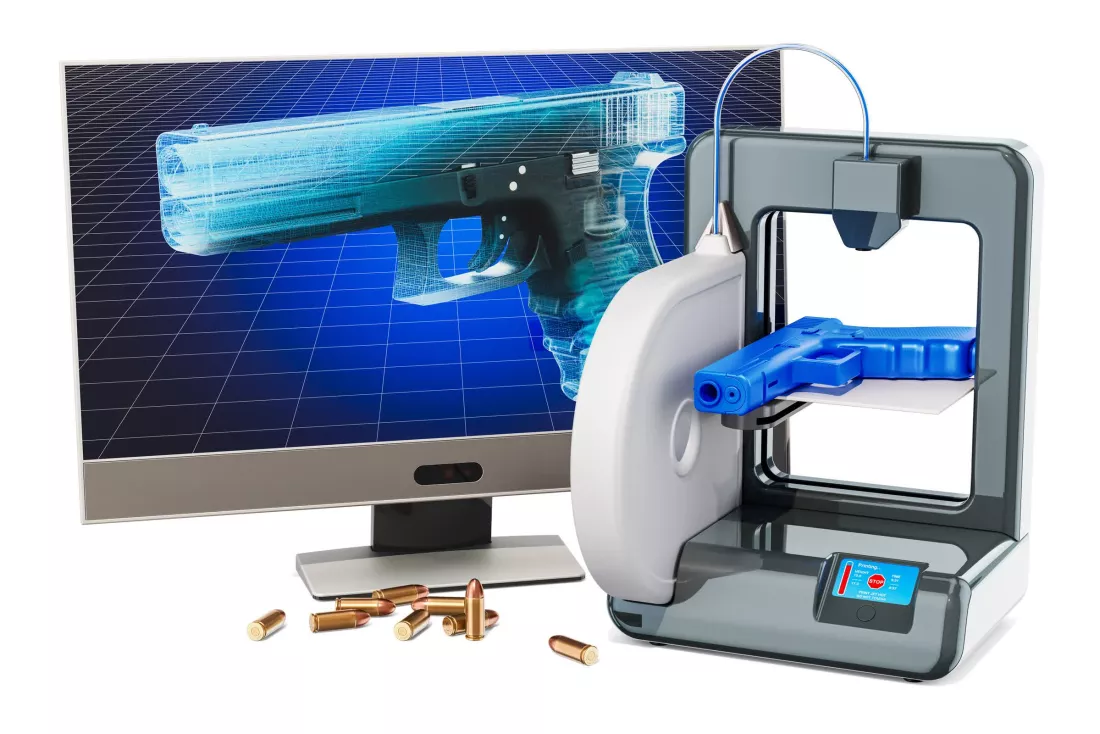

California lawmakers are moving ahead with one of the strongest efforts yet to regulate 3D printers in response to the spread of untraceable, 3D-printed guns.
Assembly Bill 2047, called the California Firearm Printing Prevention Act, passed the California Assembly by a 58-19 vote and now heads to the state Senate.
The bill targets consumer 3D printers before a weapon can be made. If it becomes law, manufacturers would need to build “firearm blocking technology” into consumer printers sold in California.
The proposal would require printers to inspect digital design files before printing begins. That includes STL files, CAD files, and other forms of geometric code used in 3D printing workflows. Printers would run those files through a firearm detection system designed to identify gun blueprints, gun parts, and illegal conversion devices.
If the software flags a file, the printer must block the print job.
California’s Department of Justice, or another state agency, would create the technical rules behind the system. The agency would have until January 1, 2028, to publish standards for detection software and control systems.
Printer makers would then need to certify each printer model they plan to sell in California. Those self-attestations would be due by July 1, 2028. The state would publish a public list of compliant and non-compliant printers by September 1, 2028. Starting March 1, 2029, companies could no longer sell non-compliant printers in the state.
The bill carries strong penalties. Sellers that offer non-compliant printers could face civil fines of up to $25,000 for each violation.
The Debate Over New Rules for 3D-Printed Guns
The proposal also creates criminal penalties for people who knowingly bypass the required software to make firearms. It would make it a misdemeanor to disable, remove, or work around the blocking system with the intent to manufacture guns. It would also ban the distribution of modified printers altered for that purpose.
Supporters say the bill addresses a growing problem tied to ghost guns. These weapons often lack serial numbers and can be hard for law enforcement to trace.
Gun control group Everytown for Gun Safety says police recoveries of 3D-printed crime guns across 20 cities have increased by nearly 1,000 percent over the past five years. The group argues that falling printer costs and better hardware now make it easier for illegal operations to produce firearms from downloaded files.
Critics see the proposal very differently.
The Electronic Frontier Foundation has described the bill as “censorware.” Opponents argue that mandatory file inspection could change how consumer 3D printers work and limit user control over hardware and software.
Some developers warn that the bill could create pressure for closed systems that rely on manufacturer-approved software. They also fear it could hurt open-source firmware projects such as Marlin and Klipper, which many hobbyists and advanced users depend on.
Privacy concerns sit at the center of the debate as well.
California’s Proposed 3D Printer Regulations Spark Privacy and Technical Debate
Critics argue that reliable file screening may push manufacturers toward cloud-based inspection systems. That could mean users send design files through external services before printing. For many makers, engineers, and small workshops, that raises questions about design privacy and intellectual property.
There is also a technical challenge. Gun components do not always look unique inside a CAD model. Some parts can resemble ordinary mechanical pieces used in tools, robotics, or industrial equipment.
Because of that overlap, critics say false positives are likely. A printer could block a harmless design that only happens to share features with a firearm component.
California’s proposal differs from another recent state effort.
Colorado passed HB26-1144 after debate over how the law might affect digital gun files. Early versions raised concerns that possession of certain files, combined with intent to manufacture or distribute prohibited items, could become a crime.
The final version took a different route. Instead of focusing on file possession, Colorado’s law targets the knowing production of potentially functional firearms or components through 3D printing.
California’s bill moves in the opposite direction. Rather than regulate what people possess or produce after the fact, it aims to control the printer itself before anything gets made.
The debate now shifts to the California Senate, where lawmakers will weigh public safety claims against concerns about software freedom, privacy, and the future of consumer 3D printing.

Comments are closed.