
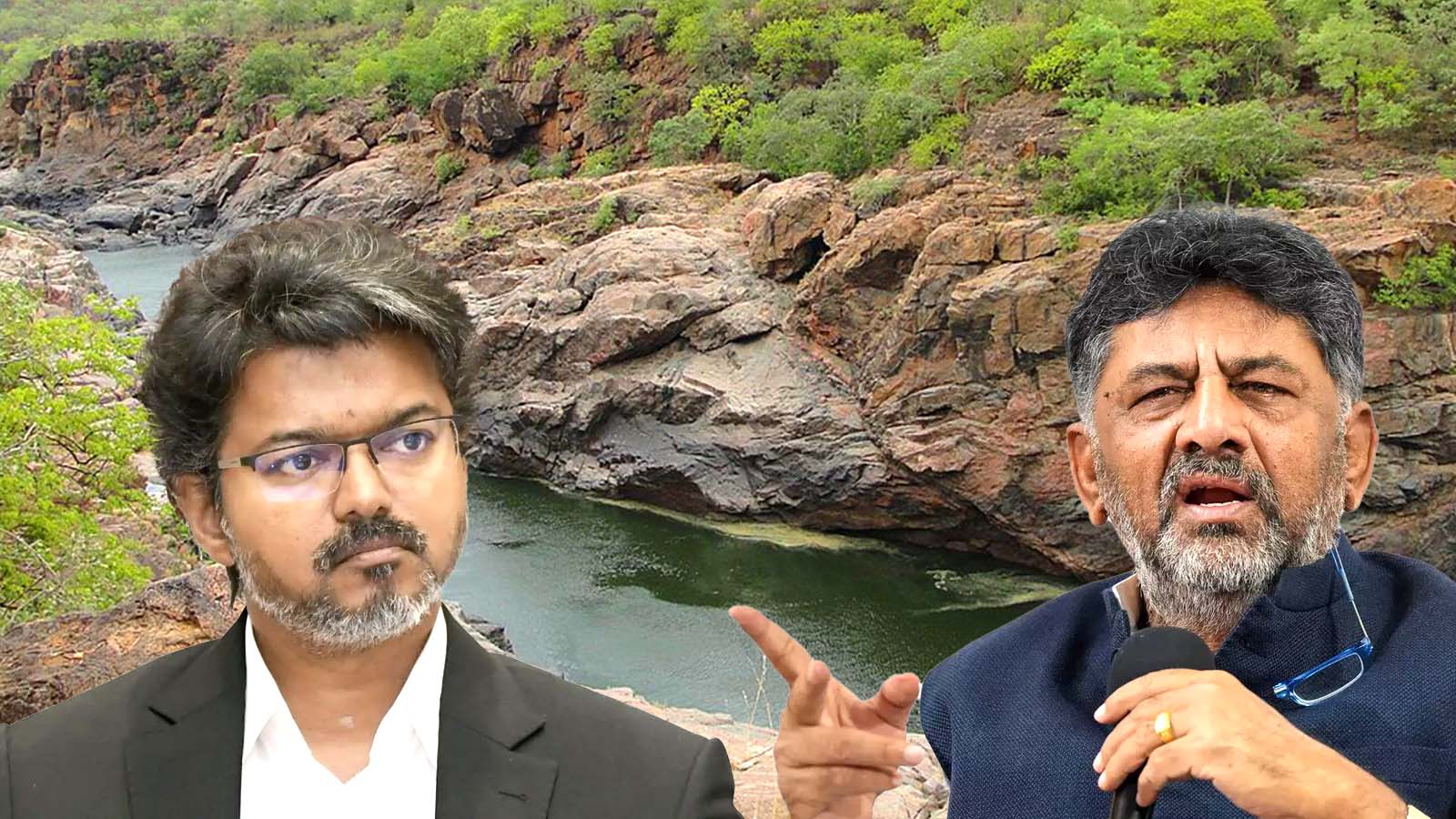

As DK Shivakumar prepares to take oath as Karnataka’s Chief Minister on Wednesday (June 3), one of his most ambitious and closely associated projects, the Mekedatu balancing reservoir project, has once again come under the spotlight. Shivakumar, who hails from Kanakapura and has represented the constituency for decades, has been the project’s strongest political advocate and administrative driving force.
Also read: Reject Karnataka’s DPR for Mekedatu project, TN CM Vijay tells PM Modi
As Karnataka’s Deputy Chief Minister and Water Resources Minister, he consistently projected the Rs 9,000-crore project as central to Bengaluru’s long-term water security and an important part of his political legacy.
On the other side of the border, the project is equally sensitive for Tamil Nadu Chief Minister C Joseph Vijay, who is confronting the contentious Cauvery issue for the first time as chief minister, even as Karnataka pushes aggressively for the project’s approval. In fact, last week, there were protests at the Karnataka-Tamil Nadu border near Hosur, where even traffic was disrupted.
Mekedatu project
Located at Mekedatu in Ramanagara district, at the confluence of the Cauvery and Arkavathi rivers, the project proposes constructing a balancing reservoir to supply 4.75 TMC of drinking water to Bengaluru, regulate river flows, and generate hydroelectric power.
However, despite being conceived primarily as a drinking-water project, it has evolved into what many describe as the “second Cauvery dispute” due to Tamil Nadu’s strong opposition.
Also read: Mekedatu dam row: TN CM Vijay directs officials to expedite legal steps
The project is currently in the pre-construction stage. Karnataka has submitted a revised Detailed Project Report (DPR), and the Supreme Court has cleared a significant legal hurdle by dismissing Tamil Nadu’s review petitions.
Karnataka’s stand
While presenting the DPR, Shivakumar maintained that Tamil Nadu had no legal grounds to oppose the project, arguing that it falls entirely within Karnataka’s territory and uses water allocated to the state under existing arrangements.
Karnataka has also argued that the reservoir would benefit Tamil Nadu by storing excess monsoon water that would otherwise flow into the sea.
To minimise legal and political friction, Shivakumar has repeatedly emphasised that the project is meant exclusively for drinking water purposes and that no additional irrigation benefits would be created.
Personal connection
He has often highlighted his personal connection to the project, noting that his family’s ancestral land in Kanakapura would be submerged by the reservoir, a sacrifice he says is necessary for the larger public good.
Also read: Karnataka seeks to take on TN with revised Mekedatu dam plan
In January 2022, he led the high-profile 139-km “Walk for Water” or Mekedatu Padayatra from Kanakapura to Bengaluru, turning the project into a symbol of Karnataka’s rights and Bengaluru’s future water needs.
Tamil Nadu’s opposition
Tamil Nadu, however, remains firmly opposed. Recently, Vijay expressed surprise that the Ministry of Jal Shakti and the Central Water Commission were considering Karnataka’s proposal without adequately addressing Tamil Nadu’s objections.
During his visit to Delhi, he urged Prime Minister Narendra Modi to direct authorities to reject the DPR, arguing that the project violates both the final award of the Cauvery Water Disputes Tribunal and the Supreme Court’s 2018 judgment.
Also read: Explained: Why is Tamil Nadu strongly opposing Mekedatu dam?
Vijay said recent announcements regarding a proposed bhoomi puja for the project and statements by Shivakumar had caused concern among lakhs of farmers in Tamil Nadu who depend on Cauvery waters.
TN’s concerns
According to Tamil Nadu, the Mekedatu reservoir was never among the projects permitted under the Tribunal’s final award. Since the Cauvery basin was already classified as a deficit basin and available water had been allocated among the riparian states, Tamil Nadu argues that there is no scope for creating a new large storage reservoir.
The state fears that the project would effectively give Karnataka greater control over river flows and could adversely affect water availability in the Cauvery delta, threatening agricultural livelihoods.
Tamil Nadu has consistently maintained that any new project across the Cauvery or its tributaries, beyond those specifically approved by the Tribunal and upheld by the Supreme Court, would amount to interference with binding judicial orders.
Farmers’ protest
On May 31, members of the Tamil Nadu Cauvery Farmers Association, led by its general secretary P R Pandian, marched towards the Karnataka border at the Jujuvadi checkpost near Hosur in Krishnagiri district in protest against the Mekedatu project.
Pandian also demanded that contempt proceedings be initiated against Shivakumar over remarks he allegedly made on the project, arguing that they were contrary to the Supreme Court’s verdict on the Cauvery water-sharing dispute and the proposed Mekedatu reservoir.
Mekedatu timeline
The Mekedatu proposal has a long history. Karnataka formally proposed the project in 2013 to address Bengaluru’s growing drinking water demands. The Supreme Court’s 2018 Cauvery verdict, which allocated Karnataka an additional 4.75 TMC of water, strengthened the state’s legal position.
Also read: Why there’s a flurry of action in Mekedatu project again
In November 2025, the apex court held that Tamil Nadu’s challenge was premature and allowed the Central Water Commission and the Cauvery Water Management Authority to examine the DPR. Karnataka subsequently moved ahead with finalising the revised project report, and on May 26, the Supreme Court dismissed Tamil Nadu’s review petition seeking to halt the project.
Despite these legal gains, the project still faces major hurdles. It requires clearances from the Cauvery Water Management Authority, the Ministry of Environment, Forest and Climate Change, and other regulatory agencies. Environmental concerns remain significant as the reservoir would submerge nearly 5,000 hectares of forest land within the Cauvery Wildlife Sanctuary.
Crucial moment
The project now arrives at a politically sensitive moment. Both Karnataka and Tamil Nadu have relatively new chief ministers at the helm. While Shivakumar has been deeply involved with every aspect of the project for years, Vijay is navigating the issue as a first-time Chief Minister.
The dynamics are further complicated by the fact that Congress governs Karnataka, while Tamil Nadu’s government includes several Congress leaders as part of its ruling coalition.
How the two leaders choose to engage with one another on the Mekedatu issue could shape not only the future of the project but also the next chapter of Karnataka-Tamil Nadu relations over the Cauvery waters.

Comments are closed.