
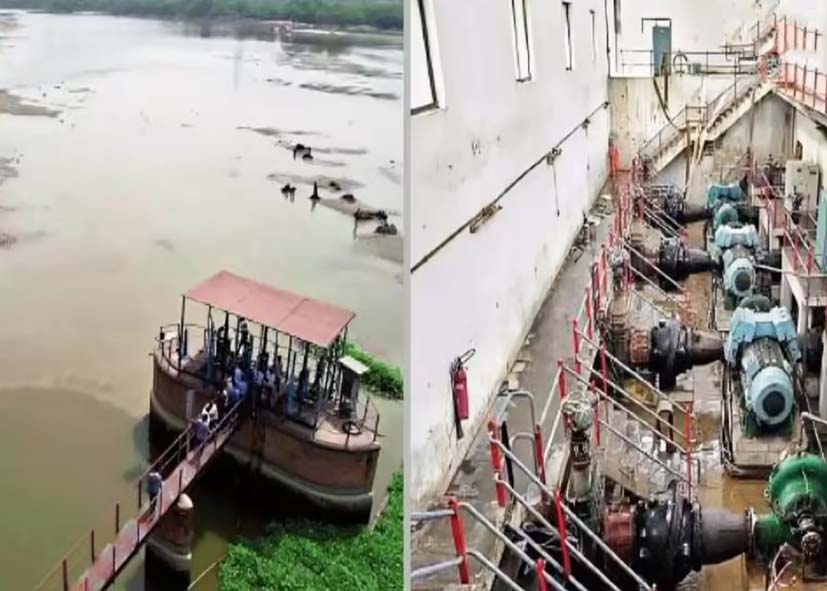
Water will be distributed in Delhi according to population and need, government will conduct scientific study

To permanently solve the water problem in the capital Delhi, the Delhi government is preparing to make major changes in the water distribution system. The government aims to develop such a balanced and effective system, so that no area of the city faces water shortage. Under the proposed plan, it will be determined as to which area water should be supplied in what quantity and for how long. For this, the population, water demand, pipeline network and existing supply system of different areas will be assessed. The government believes that in the present system, some areas get relatively more water, while in many areas people do not get adequate water supply. Through the new system, water distribution will be made more scientific and balanced, so that better utilization of available water resources can be ensured.
Water Minister Parvesh Sahib Singh Verma said that in the present system, water distribution at many places is not in proportion to the population. He said that despite relatively less population, some areas are getting more water supply, while more populated areas are getting less water than required. To remove this imbalance, DJB is working on a new plan, so that each area can be provided water according to its population and requirement. According to the Water Minister, the demand for water in Delhi is continuously increasing every year, while the available water resources are limited. The situation becomes more challenging especially during summer. The capital requires about 1,250 MGD (million gallons per day) of water during peak summer season, while the current production capacity is around 1,000 MGD. That means there remains a gap of about 250 MGD between demand and availability.
According to the minister, the objective of this study is to prepare such a balanced and effective water distribution system, so that no area faces water shortage. Under the new system, there is a plan to ensure water supply based on the actual need and population of each area. He said that at present water distribution is unbalanced in some areas, due to which in some places sufficient water is available and in others people have to face shortage. To overcome this problem, a comprehensive assessment of water supply networks and resources will be done. Meanwhile, Delhi’s water supply has also been affected due to decreasing water level in Yamuna River. The minister said that due to less water in Yamuna in the last few days, there has been a decrease of about 100 MGD (million gallons per day) in the water production of the capital. This has further increased the challenge of water management.
Steps being taken to stop wastage of water
In this sequence, DJB is working on several projects to reduce non-revenue water (NRW) i.e. water loss caused due to leakage, theft and technical flaws in the water distribution network. The government is considering the possibility of converting the DSB (Delhi Sub-Branch) canal from the existing open canal system to a closed pipeline based system. According to officials, a large amount of water is wasted in the current open canal system due to leakage, evaporation and other reasons. According to the information, about 40 to 45 percent water is being lost in the existing DSB canal system, which is a big challenge for water management. The government is evaluating technological options to reduce this loss and increase the efficiency of water supply. Responsibility has been entrusted to Indian Institute of Technology Roorkee for detailed study in this regard.
More complaints in 13 assemblies
Regarding the water problem in the capital, the Delhi government has said that out of 70 assembly constituencies, maximum complaints are being received from only 12-13 areas. According to Water Minister Parvesh, the main reason for water crisis in these areas is relatively less water supply. The minister said that the assembly constituencies from where more complaints of water shortage are being received include Gokalpur, Sultanpur, Uttam Nagar, Ghonda, Burari, Vikaspuri, Okhla, Deoli, Kirari, Badarpur, Sangam Vihar, Mustafabad and Karawal Nagar. He said that the government is working on a special plan to improve water supply in these areas. Under this, steps like review of water distribution system, allocation of water according to population and removing technical flaws in the network are being taken.
Old pipelines will be replaced in Delhi
According to the minister, the total water distribution network of Delhi is about 16,634 km long. Of these, about 5,500 km of pipelines are more than 30 years old. Over time, these pipelines have become prone to leakages, breakages and technical deficiencies, resulting in large quantities of treated water being wasted before it reaches consumers. He said that there is also a greater possibility of external pollutants entering old pipelines, which can affect the water quality in many areas. This is why these pipelines will be replaced in a phased manner to make the water supply system modern and more safe.
Promote dual piping system
The Water Minister said that about 1,000 MGD (million gallons per day) water is supplied daily in Delhi, out of which about 800 MGD water is returned as sewage. Under the new scheme of the government, treated sewage water will be reused. For this, a separate pipeline network will be developed, through which treated water will be made available for non-potable purposes like toilet flushing, gardening, landscaping, construction works and vehicle washing.
At the same time, fresh and clean drinking water will be kept safe only for drinking, cooking and other domestic uses. This will reduce unnecessary consumption of drinking water and make more efficient use of available water resources possible. According to the minister, this system will be implemented in a phased manner. Initially dual piping system will be installed in government buildings and public institutions. After this, depending on the need and practicality, it can be expanded to other areas also.
Follow the LALLURAM.COM MP channel on WhatsApp

Comments are closed.