
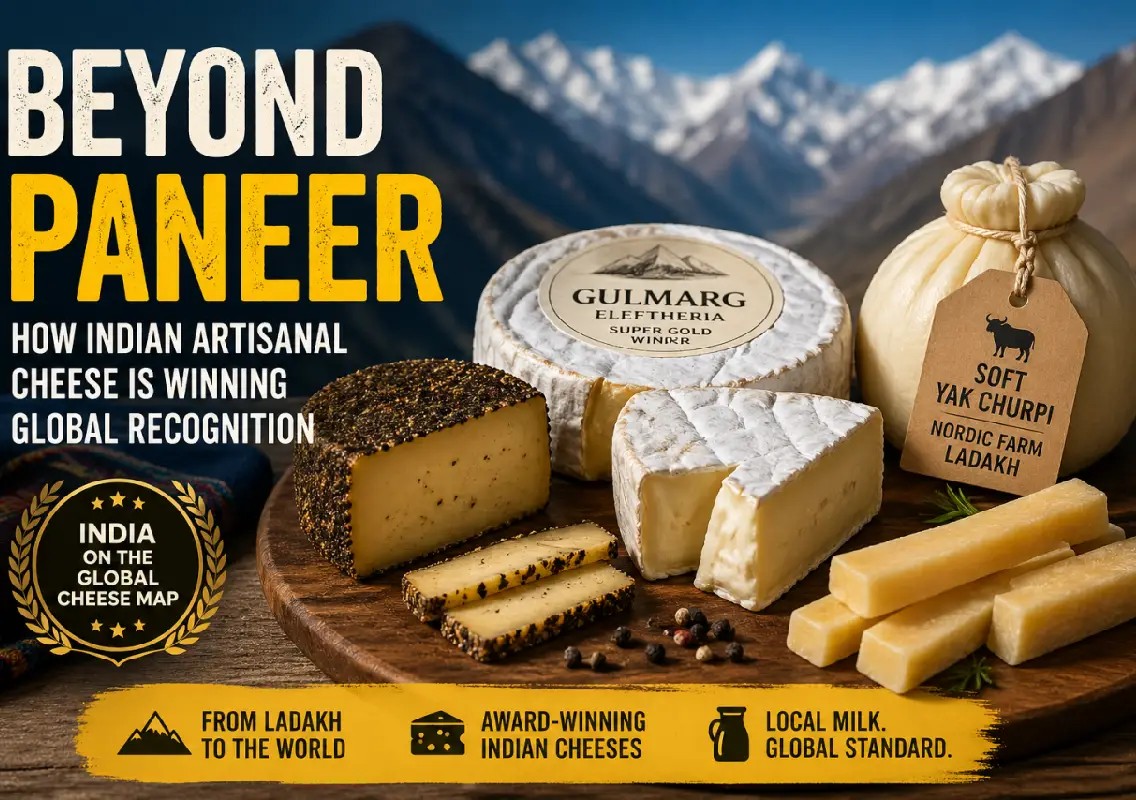

When most Indians think of cheese, paneer or processed cheese slices often come to mind. Yet, hidden across the country’s mountains, villages and historic trade centres is a rich tradition of indigenous cheeses that tell stories of survival, culture and craftsmanship.
Long before imported cheddar and mozzarella became popular, communities across India had developed their own methods of preserving milk, adapting to local climates and lifestyles.
Chhurpi: The Himalayan survival food
In the high-altitude regions of Sikkim, Darjeeling, Arunachal Pradesh and neighbouring Himalayan areas, chhurpi has been a staple for generations.
Made from yak or cow’s milk, chhurpi comes in soft and hard varieties. The hardened version is dried until it becomes dense enough to be chewed for hours, making it a valuable source of nutrition for herders and travellers navigating remote mountain terrain.
Its smoky, slightly tangy flavour reflects traditional preparation methods that have remained largely unchanged for centuries.
Kalari: Jammu’s beloved cheese snack
In Jammu’s Udhampur and Chenani regions, kalari remains one of the area’s most iconic foods.
Traditionally prepared by Gujjar and Bakerwal communities, the cheese is lightly fermented and shaped into discs. When cooked on a hot griddle, it develops a crisp outer layer while becoming soft and stretchy inside.
Often served inside kulchas with chutney, kalari has become a popular street food while retaining its pastoral roots.
Bandel cheese and Bengal’s colonial past
One of India’s most distinctive cheeses, Bandel cheese traces its origins to Portuguese settlements along West Bengal’s Hooghly River.
Made from cow’s milk and often smoked over wood fires, the small, salty cheese is known for its dense texture and strong flavour. Once found mainly in Anglo-Indian and Bengali Christian households, Bandel cheese is now enjoying renewed interest among chefs and food enthusiasts.
A heritage worth preserving
Other regional varieties, including Goa’s delicate Topli cheese, highlight how communities adapted cheesemaking techniques to local ingredients and climatic conditions.
As interest in artisanal foods and food tourism grows, these traditional cheeses are gaining recognition as an important part of India’s culinary heritage.
Far from lacking a cheese culture, India has nurtured diverse and unique cheesemaking traditions for centuries—many of which are only now being rediscovered by a new generation of food lovers.

Comments are closed.