
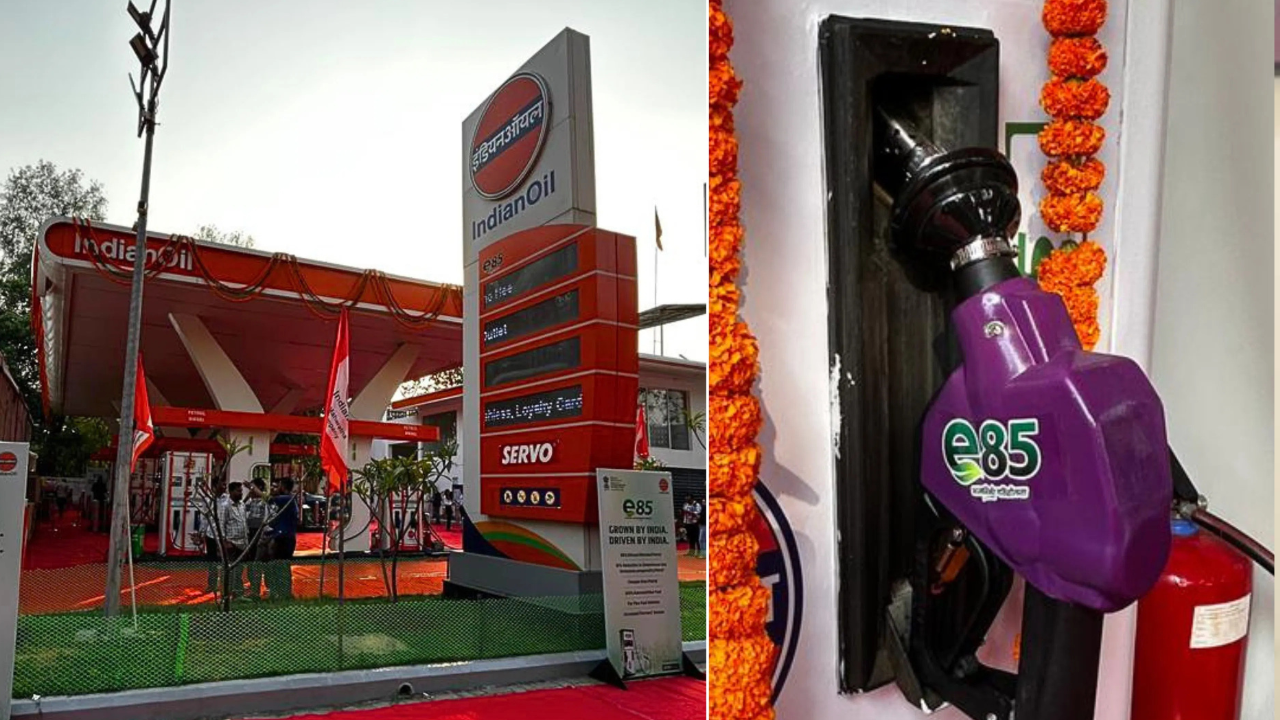

On the occasion of World Environment Day on 5th June 2026 at Pusa Road, Delhi Indian OilThe country’s first E85 fuel pump was launched at the pump of E85 fuel is made from a mixture of 85 percent ethanol and 15 percent gasoline. E85 currently costs ₹82.12 per liter in Delhi, which is about ₹20 cheaper than E20 petrol. It seems that the central government intends to go ahead and introduce E85 across the country in the future.
E85 How does it work??
E85 cannot be used in normal gasoline engines. Specially for this “Flex-Fuel Vehicles” (FFV) are required. Since ethanol has a higher octane value than gasoline, the engine can run at a higher compression ratio. However, due to the lower energy density of ethanol, the mileage of vehicles using E85 may decrease somewhat.
Flex Fuel: To open in the country by 2027 for cheaper fuel than petrol…
What is the government’s purpose behind this??
India imports about 85 percent of its crude oil requirements. This leads to huge expenditure of foreign exchange. Since ethanol can be produced domestically from sugarcane, corn and other agricultural products, the government’s main objective is to reduce dependence on imported fuels, increase energy security and provide additional markets to farmers. Also, this can be an effort to reduce carbon emissions from vehicles.
E85 of benefits
- Cheaper fuel than petrol.
- Reduction in cost of crude oil imports.
- New demand for sugarcane and maize farmers.
- Potential reduction in carbon emissions and pollution.
- Promoting energy self-sufficiency of the country.
E85 of Disadvantages
- A special flex-fuel engine is required to use E85.
- Ethanol has lower energy efficiency and therefore lower mileage.
- Risk of damage to the engine, fuel lines and rubber seals if E85 is mistakenly filled in a regular petrol vehicle.
- Huge investment is needed to build infrastructure across the country
Now your car will also ask for alcohol! It will run on alcohol, not petrol-diesel…
Impact on water crisis in India
One of the biggest concerns regarding E85 is water consumption. Most of India’s ethanol is produced from sugarcane, and sugarcane is considered a highly water-intensive crop. If demand for ethanol increases significantly, agriculture may require more water. Maharashtra, Karnataka and parts of North India are already facing water scarcity. Hence, water management and use of alternative raw materials will be very important while increasing ethanol production.
Impact on the automobile industry
E85 is expected to bring major technological changes to the Indian auto industry. Automakers will have to develop flex-fuel engines, ethanol-resistant fuel systems, new injectors and improved ECU technology. This will increase research and development costs. On the other hand, a new market for flex-fuel vehicles will be created. This can be a huge business opportunity especially for bike and car manufacturers.
Overall, E85 is an important step in India’s energy policy, but its success will depend on water management, vehicle technology and the sustainability of ethanol production.

Comments are closed.