
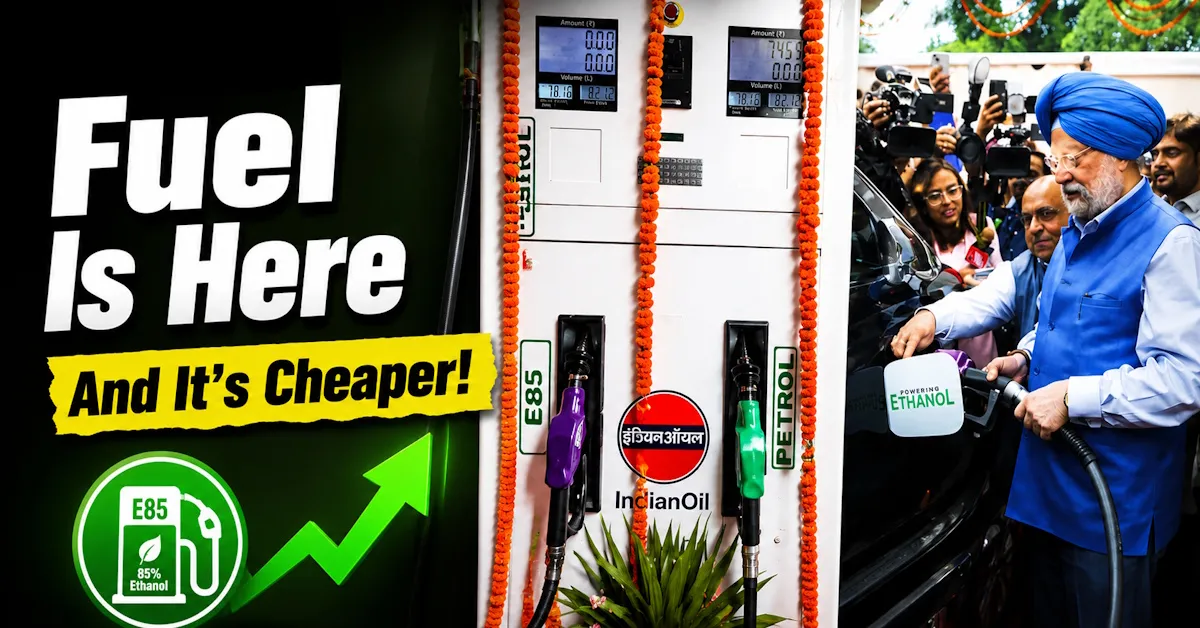

The newly launched E85 fuel pump, as per the government of India, is an example of the push which the country is making towards cleaner and more sustainable transportation solutions. For those who may not be aware, E85 fuel contains up to 85 percent ethanol and only 15 percent petrol. This is a lot higher than the currently available E20 fuel, which contains 20 percent ethanol and 80 percent petrol.
Currently, the government is aggressively promoting ethanol-blended fuels in the country because it is a part of the strategy to reduce crude oil imports. The government has highlighted that it will also help in lowering fuel costs and support domestic agriculture. As ethanol is primarily produced from sugarcane, maize, and agricultural waste, it is a renewable and locally sourced fuel which helps in saving forex reserves.
As stated above, the biggest highlight of E85 fuel is its pricing advantage. This E85 fuel has been launched at Rs 82.12. On the other hand, the standard E20 petrol has been priced at Rs 102.12. According to the government of India, the price difference will play a major role in encouraging consumers to shift towards flex-fuel vehicles in the coming years.
For daily commuters, commercial operators, and fleet owners, fuel expenses form a significant portion of ownership costs. So, a reduction of around Rs 20 per litre will turn into huge savings over the course of a year.

As the name suggests, E85 fuel is a blend which consists of up to 85 percent ethanol and 15 percent petrol. Ethanol is an alcohol-based renewable fuel which is primarily produced from sugarcane, maize, corn, and agricultural waste. So, unlike conventional petrol, ethanol can be produced domestically. As a result, it helps reduce India’s dependence on imported crude oil.
Presently, E20 fuel has become the standard fuel available across India. This means that regular petrol sold at fuel stations contains 20 percent ethanol and 80 percent petrol. And now, with E85, this concept goes further, and the ethanol content has become 85 percent. Due to this higher ethanol concentration, specially designed flex-fuel vehicles will be required to use E85 safely and efficiently.

One of the biggest advantages of ethanol is that it burns cleaner than petrol. As a result, vehicles running on E85 produce lower carbon emissions compared to conventional petrol-powered vehicles. Ethanol is also considered a renewable fuel because it is produced from crops that can be grown repeatedly. On the other hand, fossil fuels take millions of years to form.
However, because ethanol contains less energy per litre than petrol, it has to be highlighted that the fuel economy of many vehicles gets reduced. So, to compensate for this, flex-fuel vehicles come equipped with specially calibrated engine management systems, fuel injectors, fuel pumps, and fuel lines that are designed to handle higher ethanol concentrations.
It has to be noted that currently, there are no mass-market flex-fuel vehicles available for sale in India. However, manufacturers including Hero MotoCorp, Maruti Suzuki, and Toyota have already showcased products which are capable of running on higher ethanol blends. As more E85 fuel stations become operational and flex-fuel vehicles become common, E85 could slowly become one of the most important alternative fuels in India.
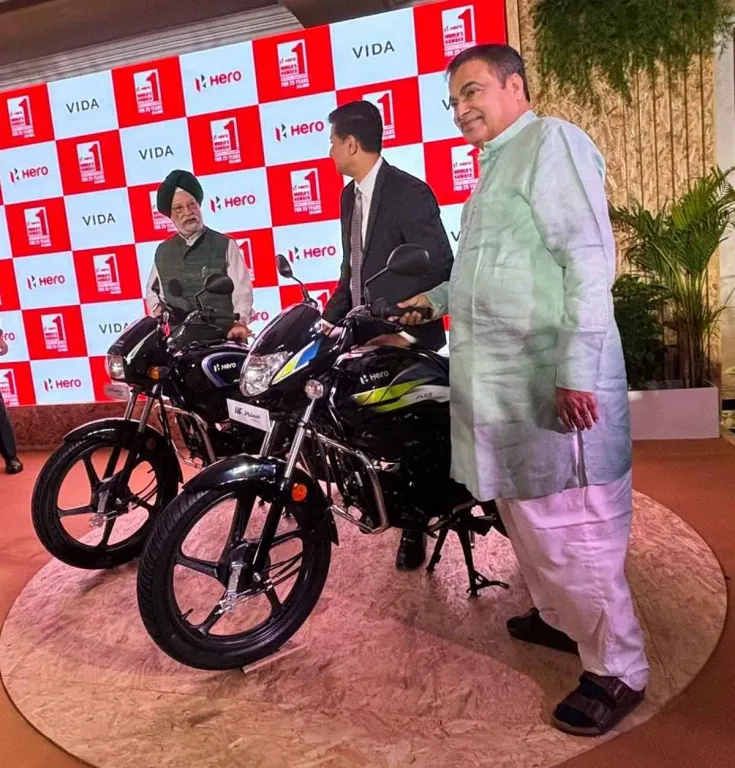
Recently, Hero MotoCorp launched the flex-fuel versions of the Splendor and HF Deluxe motorcycles. These bikes can operate on ethanol blends ranging from E20 all the way up to E85. Apart from these, Maruti Suzuki and Toyota have also been actively working on flex-fuel technology for the Indian market.

The country’s largest carmaker, Maruti Suzuki, has also showcased the WagonR flex-fuel in India. This hatchback comes equipped with the time-tested K12N, 1.2-litre, four-cylinder engine. However, it has been given a number of components which make it compatible with higher blends of ethanol fuel. These upgrades include fuel injectors and fuel pumps, new fuel lines, and a newly calibrated ECU. It also gets an ethanol sensor which can detect the level of ethanol in the fuel.
Comments are closed.