
‘Modi Wants Youth to Make Reels, Not Ask Questions’: Rahul Gandhi Praises Teen Who Flagged CBSE Controversy

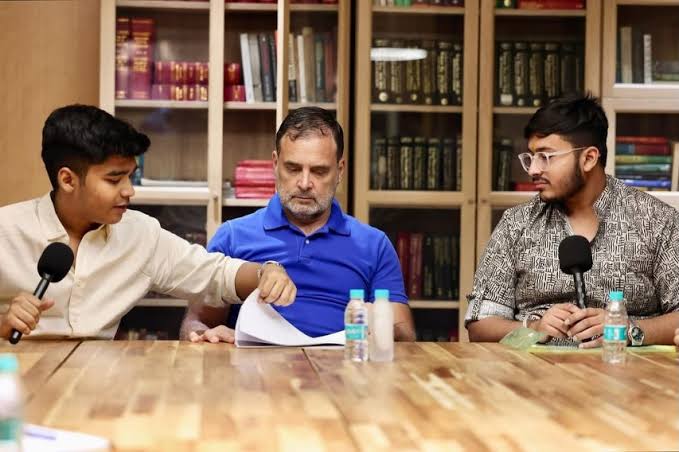
Congress leader Rahul Gandhi has praised 18-year-old student Sarthak Sidhant and his associate Nisarga Adhikary for uncovering alleged irregularities in the CBSE’s On-Screen Marking (OSM) system, calling their efforts an example of the power of informed and courageous youth.
Sharing a video of his interaction with Sarthak on social media, Gandhi said the teenager demonstrated exceptional determination by questioning the system and pursuing answers despite his young age.
Rahul Gandhi Hails Student’s Courage
The Leader of Opposition described Sarthak as a young citizen whose courage, principles and commitment to truth stand out.
“Sarthak is only 18 years old, but in terms of mindset, courage and values, he is second to none,” Gandhi said.
The Congress leader also praised Sarthak and Nisarga Adhikary for independently investigating issues linked to the CBSE evaluation system.
According to Gandhi, their work exposed concerns that even major institutions and investigative agencies had failed to bring into public focus.
‘Youth Must Question the System’
Using the controversy to highlight the importance of critical thinking, Gandhi said young people should be encouraged to ask questions and hold institutions accountable.
“Questioning is the foundation of democracy. Young people should not be discouraged from seeking answers,” he said.
Gandhi argued that India’s future depends on a generation that is informed, aware and willing to challenge problems rather than ignore them.
Criticism of Government
The Congress MP also criticised Prime Minister Narendra Modi’s approach toward young people, claiming that the government does not encourage questioning and independent thinking.
“India’s youth have enormous potential. They should be empowered to ask questions, investigate issues and participate in strengthening institutions,” Gandhi said.
His remarks come amid an ongoing political debate over alleged irregularities in the CBSE’s digital evaluation system.
Meeting With Sarthak Sidhant
Rahul Gandhi met Sarthak and his family earlier this week and later shared photographs from the interaction.
During the discussion, Gandhi reportedly asked the student about the methods he used to gather information related to the alleged discrepancies in the OSM process.
The Congress leader commended the teenager for conducting detailed research and presenting his findings publicly.
Presentation Before Parliamentary Panel
Sarthak Sidhant recently appeared before a parliamentary committee and made a presentation regarding concerns linked to the CBSE’s On-Screen Marking system.
His findings have attracted significant public attention and intensified scrutiny of the evaluation process.
The issue has also sparked wider discussions on transparency, accountability and the use of technology in examination systems.
What Is the CBSE OSM Controversy?
The controversy revolves around CBSE’s transition from traditional paper-based evaluation to a digital On-Screen Marking (OSM) system for Class 12 examinations.
Concerns emerged after some students claimed that scanned answer sheets made available to them appeared different from their original handwriting, raising questions about possible answer-sheet mismatches and evaluation errors.
The issue has since become a political flashpoint, with opposition parties demanding greater transparency and accountability.
Political Fallout
The controversy has already led to administrative action, with two senior CBSE officials reportedly removed from their positions.
However, opposition leaders argue that the steps taken so far are insufficient.
Rahul Gandhi has demanded a broader investigation into the matter and called for accountability at higher levels.
Growing Debate Over Education Reforms
The OSM controversy has triggered a wider debate on the future of digital evaluation systems in India.
Education experts, students and parents have raised concerns about transparency, data integrity and the need for stronger safeguards when implementing technology-driven examination processes.
As discussions continue, the case has become a symbol of growing youth participation in public issues and the demand for greater accountability within educational institutions.
Comments are closed.