
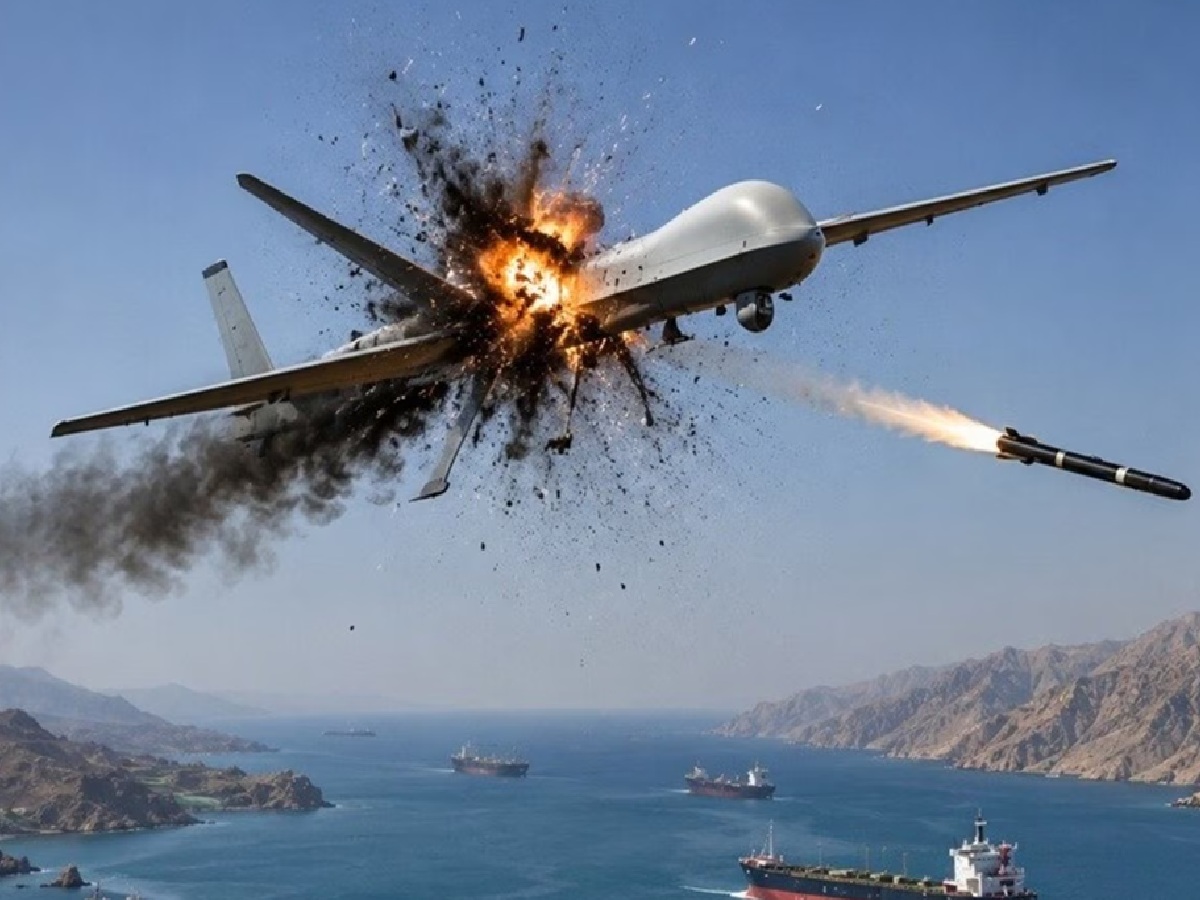
America shot down Iranian drone in the Strait of Hormuz, Pakistan’s Home Minister suddenly reached Tehran amid panic

The long-running tension in the Middle East has once again reached a very dangerous point. Despite the ceasefire declared between America and Iran, a sensational incident of military confrontation between the two superpowers has come to light, which has increased the concern of the entire world. The US Army has shot down two dangerous Iranian fighter drones in a missile attack hovering over the Strait of Hormuz, which is considered very important and sensitive strategically. Washington claims that these drones had become a major and direct threat to international maritime traffic and merchant ships. After this military action, the spark of war has flared up in the Gulf countries. Meanwhile, Pakistan’s Home Minister Mohsin Naqvi, who is handling the mediation between the two countries, has hurriedly reached Iran’s capital Tehran on a very secret and emergency mission.
America-Iran war reaches 100th day, huge pressure on President Donald Trump
On Sunday, the devastating war between America and Iran completed 100 days, but at the moment there is no end in sight. Global efforts to convert the temporary ceasefire between the two countries into a permanent and peaceful agreement are being derailed again and again. This 100-day long conflict has broken the back of the global market and created huge volatility in crude oil prices. On the domestic front too, the war has put immense political and diplomatic pressure on President Donald Trump just ahead of the US midterm elections. At such a critical time, this sudden visit of Pakistani Home Minister Mohsin Naqvi to Tehran is being seen as a big sign of new international diplomatic efforts.
Naqvi in Supreme Leader Khamenei’s court with ‘secret message’ from General Asim Munir
Pakistan currently remains the main center of backchannel diplomacy to avoid direct war between America and Iran. Pakistan Army Chief Field Marshal Asim Munir recently hosted a round of secret one-on-one talks between top officials of Iran and the US in Islamabad. Now Mohsin Naqvi has reached Tehran to take forward this dialogue and end the communication gap between the two nuclear-armed or superpowers. He has taken with him a very special and confidential message from Pakistani Army Chief Asim Munir to Iran’s Supreme Leader Mojtaba Khamenei. On reaching Tehran, Naqvi said in a very brief conversation with the media, "I think the message I bring is very important and decisive for the peace of the Middle East at this time."
Iran fired missiles at allies, enraged America and Gulf countries
In fact, this latest dispute started on Saturday when Tehran fired several ballistic missiles one after the other at America’s very close and strong Gulf ally countries Bahrain and Kuwait. This unexpected missile attack spread great anger throughout the Gulf region and the very delicate ceasefire between the two countries on April 8 was completely endangered. In response to this, America targeted Iranian drones in the Strait of Hormuz. On the other hand, Iran’s Foreign Ministry has issued a strong statement calling this recent US drone attack a blatant and gross violation of international air and maritime rules and has strongly condemned this hostile and provocative behavior of Washington on the global stage.
Iran adamant on freezing assets worth $24 billion, puts a big condition before Trump
Mohsen Rezai, chief military advisor to Iran’s supreme leader, has made it clear in an exclusive interview given to the American media network CNN that the ongoing peace talks with America have come to a complete standstill at the moment. He said that if this impasse has to be ended, then President Donald Trump himself will have to step forward and take a big step. Along with this, Iran has reiterated another big condition that Iran’s assets worth about $24 billion, frozen (confiscated) in international banks by the US, should be immediately and unconditionally restored. On the other hand, according to the news coming from Washington, instead of returning this huge fund to Iran, the US administration is making a big plan to use it as compensation and compensation for the huge losses caused by Iranian missile attacks in Gulf countries, due to which this whole matter has become more complicated.

Comments are closed.