
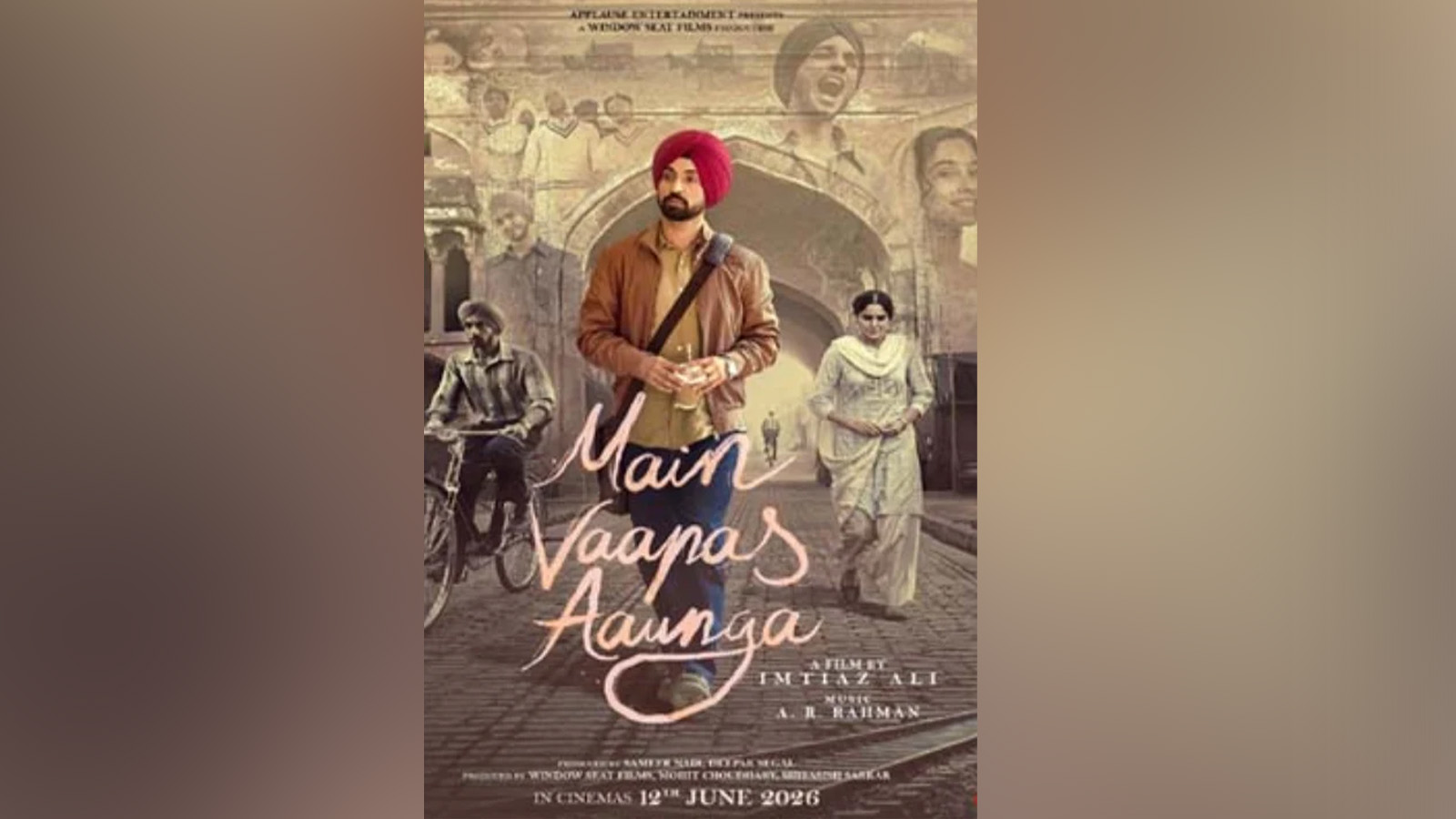
Main Vaapas Aaunga: Imtiaz Ali reaches back to Partition to say what Hindi cinema might be unable to in 2026

As it turns out, Partition is now the safest address in Hindi cinema if you’re a filmmaker making a film about politics, about bigotry, and about the Hindu-Muslim wound the present government keeps raking up. To set this in the present day would mean inviting forms of censorship that could range from a notice to a ban. But that isn’t the case if you reach back to 1947, where the bloodshed is settled history and nobody can accuse you of inventing it.
Sriram Raghavan did it last year with Ikkis, sending Dharmendra back to Sargodha after a lifetime, crafting a film that is essentially an indictment against the cruelty of war and the real price of bigotry. Now Imtiaz Ali sends an old man to the same town and uses the journey to say almost everything a Hindi film in 2026 is otherwise forbidden to say.
Also read: Backrooms review: Kane Parsons builds the year’s most convincing horror maze
Main Vaapas Aaunga is Ali’s first film since the irresistible Chamkila and it reunites him with that film’s leading man, Diljit Dosanjh. Written with Nayanika Mahtani, it opens on a 95-year-old man (Naseeruddin Shah) in Chandigarh, half-undone by a stroke, his speech reduced to fragments. The only person who can read those fragments is his grandson Nirvair (Dosanjh), back from London with a job, a girlfriend and a tangle of his own unfinished feelings left behind. The grandfather has one demand that the family cannot grant. He wants to go home to Sargodha, the town he was born in, the town that has sat inside Pakistan since the year a line was drawn through Punjab and the subcontinent set itself on fire.
Through the old man’s slurred insistence, Nirvair excavates a secret the family has kept buried for nearly eight decades. It is here that the film switches back into flashback and it falls back into an undivided Punjab, where a younger version of the man (Vedang Raina) is in love with a girl named Jia (Sharvari Wagh). Their courtship runs on stolen glances and the assumption that two people from different faiths had about the world letting them keep each other.
Except that the Radcliffe Line decides otherwise. He crosses into India carrying a promise he will spend the rest of his life failing to keep: that he will return to her. The title is that promise.
No blame game
Ali has always kept his distance from the politics of the wide shot and he keeps it here. There is no nation in this film, only people. So the violence arrives not from one community but from history behaving like an indifferent machine.
He is careful, almost insistent, that no single side carries the blame. Muslims who pillaged, Sikhs who answered in kind, the beheadings, the women abandoned to the cruelty of men: everyone’s hands are in it. What he is really arguing is that the wound was never treated, only hidden, and that buried trauma does not stay buried. It mutates. It passes down. It leaves a generation unequipped for the prejudice waiting for them now.
The film is also gorgeously an Imtiaz Ali musical, and his oldest collaboration carries it. AR Rahman and lyricist Irshad Kamil have been making longing audible for Ali for the better part of two decades, and the 12-song soundtrack here is some of their richest work together.
Rahman drags his synthetic, globe-trotting sound into the dust of rural Punjab. The two do not always sit easily, but the friction is the point: you can hear a clinical composer and a bleeding region negotiating in real time, and what they reach for is ultimately lovely.
No demarcation among displaced
More than anything else, Naseeruddin Shah is the reason to see Main Waapas Aaunga. From a bed he barely moves in, he turns what might have been a creaky framing device into something close to unbearable: an old man reaching out of the screen by the sheer force of his eyes. Dosanjh, settling deeper into his partnership with Ali, is the audience’s way in, though the script too often flattens him into the man whose job is to explain the grandfather, and the Partition, to everyone in the room. Raina is sincere but a little weightless, never quite a young man you believe will harden into Naseeruddin Shah. Sharvari has the old Imtiaz heroine’s spark, but her chemistry with Raina never quite makes the argument for the film’s romance the way it did in Love Aaj Kal, another Ali film with a flashback romance.
Also read: The Rs in Bharathiraja’s life: How the filmmaker’s heroines went on to become screen icons
And then, in the final act, Ali does the bravest thing in the film. As the refugees of 1947 pour across the frame, he lets the montage slip its leash and folds in footage of Gaza, of Rohingyas, of bodies and bundles and children moving along another border in another decade. The cut is unmistakable. He is telling you that the displaced are the displaced, that 1947 was never a closed chapter but a rehearsal, and that the people in the seats, and the government they put there, are implicated in what is unfolding now. In an industry this frightened, it plays as an act of defiance smuggled past the gatekeepers.
The film around these moments is not always equal to them. It wanders through its first half, finds its feet only after the interval, and now and again swaps its subtext for a speech. But its heart is rarely in doubt, and at a moment when so much of our cinema is busy feeding the fire, Main Vaapas Aaunga is trying, stubbornly, to put a little of it out. That alone makes it worth the walk back.

Comments are closed.