

Virendra Pandit
New Delhi: With US President Donald Trump claiming, once again, that Washington has reached a “great settlement” with Tehran—although Iran denied it!—and a fall in crude oil prices, Indian benchmark indices took a positive global sentiment clue and jumped nearly 2 percent on Friday, the media reported.
Trump, as his Friday statements have often been moving the markets, said that only the finalization of the deal document remains. It will be signed over the next few days, and the Strait of Hormuz will reopen, he added.
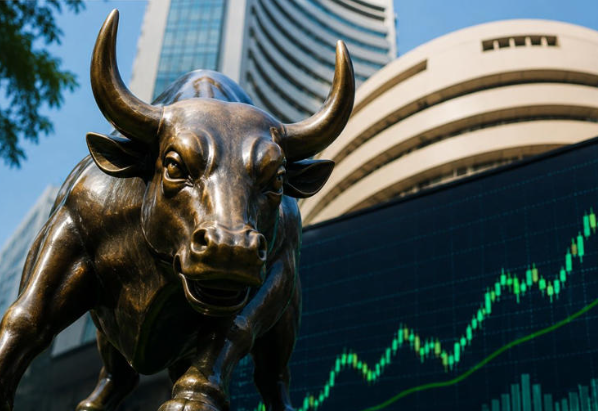
Reacting positively, Sensex jumped 1695.40 points (2.30 percent) to close at 75527.95 while Nifty soared 461.30 points (1.99 percent) to close at 23622.90.
Shriram Finance, InterGlobe Aviation, and Bajaj Finance were the top gainers in the Nifty50 index. In the broader markets, the Nifty MidCap and the Nifty SmallCap were trading 2.01 per cent and 2.46 per cent higher, respectively. Sector-wise, the Nifty Private Bank, the Nifty PSU Bank, and the Nifty Realty outperformed, while the Nifty IT underperformed.
crude prices
Market sentiments were also affected by a likely fall in crude oil prices. Hopes of a peace deal between the United States (US) and Iran saw crude oil prices fall nearly 4 per cent on Friday to around USD 87 a barrel (bbl). If the deal were to materialize, analysts see Brent oil prices heading lower.
Fitch Ratings’ base case Brent oil price of USD 87 a bbl on average for 2026, for instance, reflects the agency’s assumption that the Strait of Hormuz will reopen around July-end, implying an effective five-month closure.
As per Fitch Ratings’ estimates, Brent crude oil is likely to average USD 100-110/bbl in May-July, before falling to USD 80/bbl in August, and to about USD 70/bbl from September.
The effective closure of the Strait of Hormuz by Iran, Fitch said, has blocked the transit of 15 million barrels per day (bpd) of crude oil and 5 million barrels of oil equivalent (mmboed) products per day, accounting for 20 per cent of global oil consumption.
Half of the oil volumes transported through the Strait of Hormuz before the war, Fitch said, were exports from Saudi Arabia and the UAE. The remainder, it noted, were oil exports from Iraq, Kuwait and Iran itself. China and India were the destinations for half of the exported volumes.
From around USD 70 per bbl (pre-West Asia war) in February 2026, Brent crude prices jumped nearly 79 per cent to around USD 125/bbl as the developments in West Asia unfolded and have remained volatile since. Hopes of an end to the war triggered a fall to below USD 100/bbl mark.
Chinese demand
Experts at Rabobank International, too, have lowered their forecast for crude oil prices for 2026. This, they said, was more on account of a drop in demand from China.
Seaborne crude imports in China, they said fell to 6.7 mbd in May — the lowest monthly print in a decade, down 3.5 mbd year-on-year (YoY) and 4.4 mbd below the first-quarter 2026 average of roughly 11.1 mbd, according to media reports.
Both Chinese state-owned and private refiners, they said in a recent note, have curtailed refinery runs in response to weak, sometimes negative product margins, uncertain crude availability, on top of the elevated input costs from higher crude oil prices.

Comments are closed.