
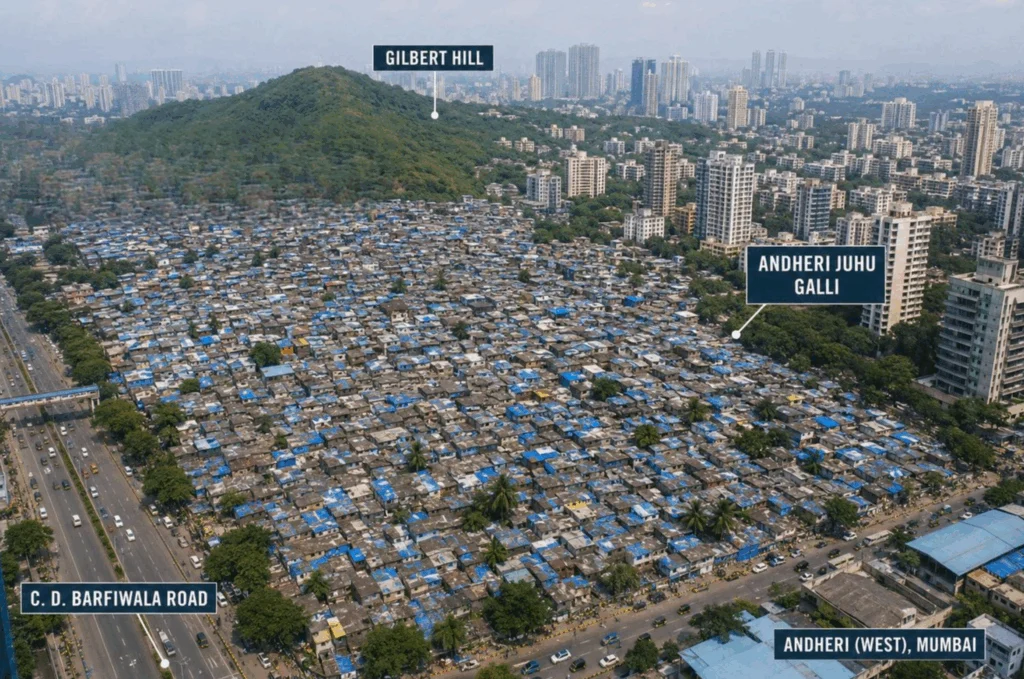
Reliance Enters Mumbai’s Slum Redevelopment Space, Commits ₹700 Crore To Rehabilitate Juhu Lane-Gilbert Hill Residents

Mukesh Ambani’s Reliance Industries has stepped into a sector long dominated by specialist real estate developers. A consortium led by Reliance 4IR Realty Private Ltd has won the bid to redevelop a 101.4-acre slum cluster in western Mumbai, marking the conglomerate’s entry into a space where rival Adani Group is already redeveloping Asia’s biggest slum, Dharavi. Reliance Industries, through its real estate arm Reliance 4IR Realty Development Limited, and Mahadev Realtors Juhu Pvt Ltd won the bid to redevelop the Juhu Lane-Gilbert Hill slum cluster in Andheri West.
The company has reportedly agreed to pay approximately ₹700 crore to the Slum Rehabilitation Authority as part of a major redevelopment initiative that aims to provide new homes to eligible residents while transforming key urban areas. The tender also attracted bids from metals giant JSW Group and conglomerate Shapoorji Pallonji Group, but Reliance’s consortium emerged successful.
“Along with a 100 acre plot in Andheri (West) around Gilbert Hill, SRA is set to launch 19 projects under the state govt’s recently introduced slum cluster redevelopment scheme. All these projects will have land parcels of more than 50 acres and house thousands of slum tenants.”~Chaitanya Marpakwar
What The ₹700 Crore Actually Covers: Transit Rent And Performance Guarantees
The ₹700 crore compensation is not a one-time payment, but rather part of the tender’s financial obligations. Successful bidders must secure pending transit rent for slum dwellers and commit to approximately ₹700 crore in transit rent for the next two years with the Slum Rehabilitation Authority, as part of the tender conditions. In addition, a further one year’s transit rent is required to be deposited in the form of post-dated cheques with the SRA, ensuring uninterrupted rental support to eligible residents during the rehabilitation and construction period.
The contract was awarded on the basis of the percentage of the ready reckoner rate for land that bidders agreed to pay the SRA as a premium, with the floor fixed at 10 per cent. Reliance and Mahadev Realtors outbid competitors like JSW Realty and Shapoorji Pallonji with a 35.10% premium over the ready reckoner rate. Over and above this, the successful bidder is required to submit a performance guarantee amounting to ₹100 crore with the Slum Rehabilitation Authority.
“Accelerating Inclusive Redevelopment with Technology-Driven Urban Growth. Chaired a meeting of the Slum Rehabilitation Authority. Large land parcels will be developed in a planned manner, benefiting nearly 6 to 7 lakh slum dwellers.” ~Devendra Fadnavis
Scale Of The Project: Over 28,000 Homes For Existing Residents
The Juhu Lane-Gilbert Hill site is not a small or simple plot. At present, the site houses 13,634 slum tenements along with some SRA buildings, a private hospital, a police station, a civic market, a retail market, educational institutions and government offices. The stretch runs from Juhu Lane near CD Barfiwala Road up to JP Road near Hansraj Morarji Public School.
The Juhu Galli Cluster Redevelopment Project is among the largest and first-ever slum cluster redevelopment initiatives ever undertaken in Mumbai and is expected to result in the construction of more than 28,000 rehabilitation homes for eligible slum dwellers. The project has been undertaken under the State Government’s Cluster Redevelopment Policy, aimed at unlocking large slum clusters that have remained difficult to redevelop.
The scale of the redevelopment is indicative of the government’s move under the new slum cluster redevelopment policy introduced in 2025 to modernise Mumbai’s congested slum areas and provide safe housing for residents. Under the SRA model, eligible families will receive newly constructed homes free of cost, while the developer gains rights to commercially develop a portion of the land.
“In a significant development for Mumbai’s slum redevelopment landscape, a Reliance-led consortium has secured one of the city’s largest slum rehabilitation projects, with the Maharashtra government pushing forward multiple cluster redevelopment schemes across the metropolitan region.”~United News of India
What This Means For Reliance And For Mumbai’s Housing Future:
The Slum Rehabilitation Authority said: “The successful bidding process demonstrates the growing interest of India’s leading corporate houses in partnering with the government to address Mumbai’s housing challenges through large-scale redevelopment initiatives.”
The development marks Reliance’s entry into a sector that has long attracted some of India’s biggest real estate developers due to the dual opportunity of urban renewal and large-scale property development. According to reports, Reliance has been selected to undertake the rehabilitation of slum residents living in specific areas covered under the project. Mumbai faces a severe shortage of affordable, organised housing, and large-scale projects of this nature are seen as critical to addressing that gap over the coming decade.
The project will now move through planning, approvals, rehabilitation, and construction phases before residents can be relocated into new homes. Large-scale slum redevelopment projects typically take several years to complete due to their complexity and the need to coordinate with multiple stakeholders. For Reliance, the initiative represents a strategic diversification into urban redevelopment. For Mumbai residents, it could pave the way for better housing and improved living conditions while contributing to the city’s long-term transformation.
Reliance’s entry into slum redevelopment, along with Adani’s ongoing Dharavi project, signals a broader shift: India’s largest conglomerates are increasingly viewing urban housing renewal as a legitimate avenue for long-term real estate value creation, backed by government policy aimed at unlocking some of Mumbai’s most valuable yet underdeveloped land parcels.

Comments are closed.