
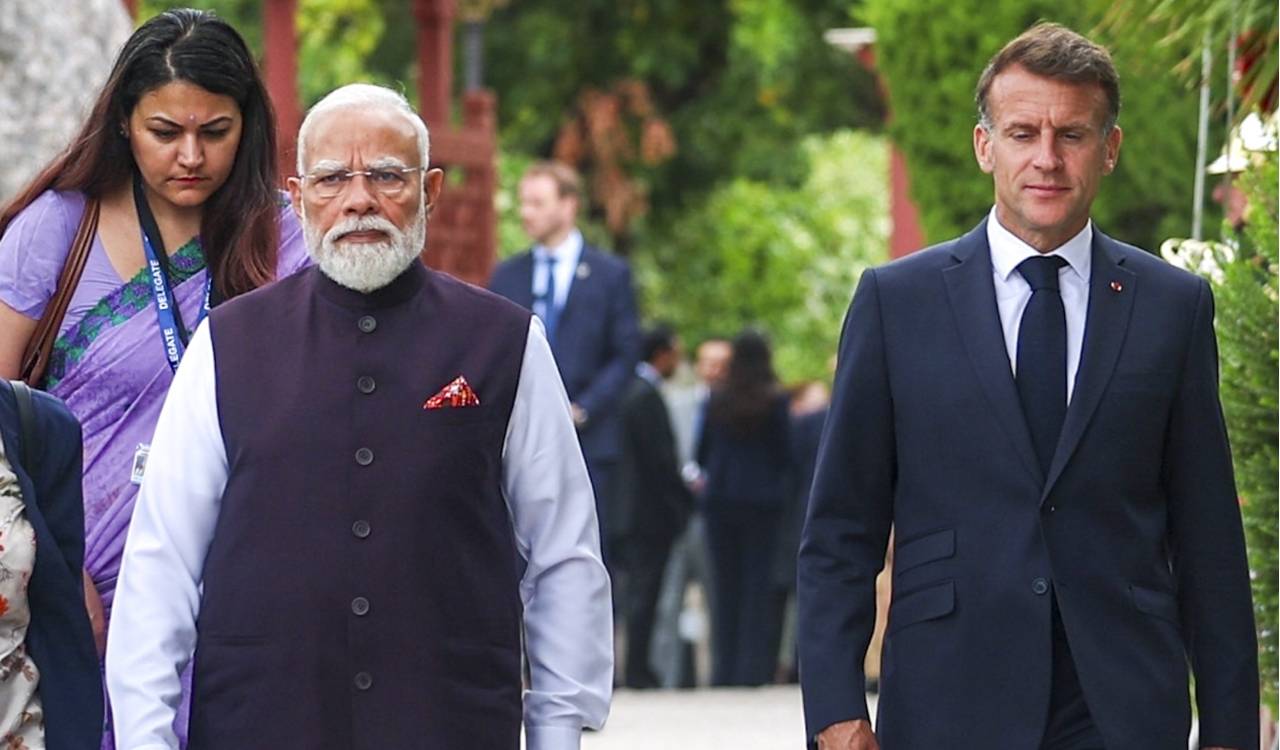

India and France have set a five-year target to double bilateral trade to USD 32 billion, unveiled an innovation roadmap and AI framework, and signed 13 agreements spanning defence, nuclear energy, technology, and payments after talks between Prime Minister Narendra Modi and President Emmanuel Macron in Nice.
Published Date – 14 June 2026, 11:10 PM
Nice (France): India and France on Sunday set a five-year target to double their annual bilateral trade from the current USD 16 billion and unveiled an innovation roadmap and a joint artificial intelligence framework to expand ties in critical sectors following talks between Prime Minister Narendra Modi and President Emmanuel Macron.
The talks between the two leaders yielded 13 outcomes, including a high-speed railway cooperation declaration, a security pact for classified data, and an agreement to expand India’s UPI payment network to the Paris and Nice airports.
Modi landed in this Mediterranean French city on Saturday night as part of his week-long tour of France and Slovakia.
Foreign Secretary Vikram Misri said the Modi-Macron discussions covered the entire range of bilateral relations, including civil nuclear energy, defence, security, space, trade and investment, technology, innovation, education, mobility and people-to-people ties.
In the meeting, India’s plan to procure 114 Rafale fighter jets from French defence major Dassault Aviation figured with Misri asserting that the underlying focus was on having “maximum local content” in joint defence projects.
Misri said talks between the two countries on the Rafale jet programme have advanced, adding PM Modi has been pushing for taking forward the “Make-in-India concept” as well as to follow “co-development, co-design, co-production” framework for defence projects.
“There were talks on Rafale and other issues in today’s discussions but I will say the underlying theme was that in case of any defence platform we will move forward on the basis that there should be maximum local content, local manufacturing and our cooperation should be designed keeping this in mind,” he said.
The talks between Modi and Macron focused heavily on shoring up ties in technology and innovation, with PM Modi emphasising the need for a human-centric approach to scientific advancement.
“A key focus of the discussions was also on strengthening and diversifying bilateral ties in the fields of economic growth, technology and innovation. This is especially relevant in view of the conclusion of negotiations earlier this year on the India-EU free trade agreement,” Misri said.
The two sides also deliberated extensively on expanding cooperation in the civil nuclear energy sector, including with regard to the project in Jaitapur.
“The discussion has primarily been carried on between EDF, Electricity de France and the Nuclear Power Corporation of India Limited on both the technical aspects of this project and the very important financial aspects of the project.”
Misri said there was a “rich vein” of discussions opened on the aspect of small modular reactors and advanced modular reactors.
“There was a discussion on nuclear cooperation. And the prime minister in particular underlined the recent developments on the Indian front in terms of the enactment of the Shanti legislation in India,”Misri said.
“With that in view, the field is open for French nuclear companies to start looking at direct participation in the Indian nuclear sector or do so in participation with Indian private sector companies, whether in conventional nuclear power reactors or in the more advanced small modular reactors,”he said.
The foreign secretary also touched upon the expansion of UPI in France.
“I understand that in the next few days, in the coming week, UPI is going to be available at Charles de Gaulle Airport in Paris and interestingly enough right here at the airport in Nice,” he said.
External Affairs Ministry spokesperson Randhir Jaiswal said the India-France Innovation Roadmap 2030 seeks to deepen cooperation in critical and emerging technologies as well as startup and incubator ecosystems besides promoting academic mobility and industry-academia linkages.
The two sides also announced creation of a high-level mechanism for realising the goal of doubling bilateral trade in the next five years. The current volume of bilateral trade is approximately USD 16 billion. A separate dialogue mechanism for economic security was also announced.
The creation of the joint Artificial Intelligence (AI) Working Group is aimed at AI governance and supports joint research and development, capacity building, and industry exchanges.
The two sides also decided to expand the use of UPI (Unified Payments Interface) at Paris airport and Nice that will strengthen India’s digital public infrastructure footprint in Europe.
The move is also expected to help Indian tourists, students, diaspora community and business travellers.
Following the Modi-Macron meeting, the two sides also announced establishment of a National Centre of Excellence for Skilling in Aeronautics and Allied Sectors at Kanpur.
The centre will supports skilling, institutional linkages and research in aviation and aerospace sectors. It is also expected to strengthen workforce for manufacturing and MRO (Maintenance, Repair, and Operations) sectors.
The rest of the outcomes were largely aimed at boosting cooperation in various aspects of innovation and digital space.
Misri noted the setting up of a high-level mechanism to double bilateral trade, the establishment of a dialogue on economic security, the adoption of an innovation roadmap 2030, signing of 19 agreements between institutions in the innovation ecosystem of both countries and the creation of a joint working group focusing on artificial intelligence as major highlights.
“The two leaders also discussed how to enhance the mobility of talent and the exchange of students from the two countries and also expanding mutual recognition of educational qualifications,” he said.
“The prime minister in this context invited French universities to open campuses in India under the new education policy and welcomed President Macron’s commitment,” he said.

Comments are closed.