
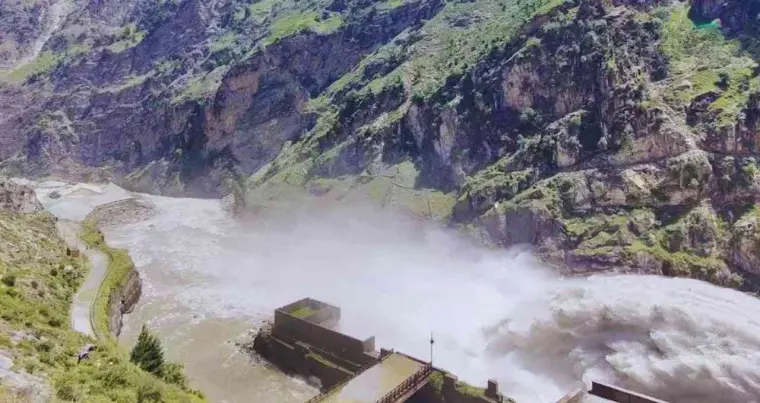

The Central Government has intensified preparations to take forward the proposed Chenab-Beas Tunnel Project in Himachal Pradesh. Under the project, a target has been set to generate 432 MW hydropower using Chandra river water. For this, a state-of-the-art tunnel and underground power house will be developed.
Shimla: Preparations have intensified for the proposed Chenab-Beas Tunnel Project in Lahaul-Spiti and Manali region of Himachal Pradesh. Under this ambitious hydropower project of the Central Government, a target of producing 432 MW electricity has been set by using the water resources of Chandra River. The project is considered important in terms of energy production, water management and regional development.
Big hydropower project to be developed in Himalayan region
The Chenab-Beas Tunnel Project will be developed in the area connecting Lahaul-Spiti and Kullu districts of Himachal Pradesh. The main objective of the project is to increase clean energy production by making better use of water resources.
Under the plan, a barrage will be constructed on the Chandra river, from where water will be diverted to another part through a tunnel. This water flow will be used to generate electricity. The project will be completely based on modern technology and will make extensive use of underground structures.
Target of 432 MW power production
The proposed power house will be built underground, in which four units of 108-108 MW capacity will be installed. Overall, a target of producing 432 MW power has been set from the project.
According to experts, this project will further strengthen the hydropower potential of Himachal Pradesh. The National Grid will also benefit from the expansion of energy infrastructure in the region and increase in power generation.
Barrage will be built near Atal Tunnel area
The barrage of the project is proposed on Chandra river near Koksar area of Lahaul valley. The exit point of the tunnel will be near Madhi area of Manali.
Under this scheme, about 8.7 km long tunnel will be built, through which controlled use of river water will be done. There is a plan to use modern technology like Tunnel Boring Machine (TBM) for tunnel construction.
New infrastructure will be developed for construction works
New roads will also be constructed to ensure movement of heavy machinery and equipment during the construction of the project. Link roads will be developed from Koksar area to the project site so that the construction work can be conducted smoothly.
Apart from this, installation of underground transformer cavern and modern sub-station with 220 KV capacity is also proposed, which will help in effective distribution of the generated electricity.
Emphasis on use of local resources
It is planned to use the stones and debris generated during the project construction as construction material. With this, efforts will be made to reduce the construction cost as well as limit the environmental impact.
Experts believe that the project will increase employment opportunities at the local level and will also give impetus to regional economic activities. Himachal Pradesh has been a major center of hydropower production for a long time and this project is considered an important step towards further strengthening that potential.
Important initiative for energy and water management
The Central Government believes that such projects will play an important role in the future from the point of view of better utilization of water resources and energy security. After the completion of the project, the efficiency of water management is also expected to increase along with increasing the power generation capacity in the area.
In the coming years, this project can be included in the major energy projects of Himachal Pradesh and can give a new direction to the hydropower sector of the state.

Comments are closed.