

119
New Delhi:
India’s latest effort to revive a deep-sea natural gas pipeline connecting Oman with Gujarat is being driven by growing concerns over energy security and the vulnerability of maritime routes through the Strait of Hormuz. Yet the proposal itself is far from new.
The idea of linking India directly to Gulf gas reserves through an undersea pipeline has existed for more than three decades. It has survived changes of government, shifts in global energy markets, advances in offshore engineering and repeated assessments of its commercial viability. Every time it has resurfaced, it has been presented as a potentially transformative project. Every time, however, it has ultimately stalled.
Now, amid heightened geopolitical tensions in West Asia and increasing concerns over the security of maritime energy supplies, the proposal has once again returned to the spotlight.
Retired officials associated with the project told Read that its origins can be traced to the expanding energy relationship between India and Oman during the 1980s.
The initiative gained momentum during Prime Minister P.V. Narasimha Rao’s visit to Oman in March 1993. Official Omani records show that India and Oman signed a Memorandum of Understanding concerning natural gas supplies and rights of passage for a pipeline transporting gas to India.
The seriousness of the project was further reflected in two Omani Royal Decrees issued in September 1994. Royal Decree 97/94 ratified the memorandum signed on March 13, 1993, while Royal Decree 98/94 authorised the signing of a Basic Conditions Agreement governing gas supplies between Oman and India.
According to retired executives familiar with the project, these agreements demonstrated that the proposal had moved well beyond a conceptual stage and entered the realm of formal government-to-government arrangements.
Hydrographic surveys and seabed studies were subsequently commissioned to determine the feasibility of laying a pipeline across the Arabian Sea.
The project also featured in Parliament. In a reply tabled in the Lok Sabha in February 2009, the Ministry of Petroleum and Natural Gas stated that India and Oman had signed an agreement in 1994 for the supply of 56.6 million standard cubic metres of gas per day through a pipeline linking the two countries.
The ministry further noted that GAIL and Oman Oil Company had undertaken feasibility studies for what became known as the Oman-India Deepwater Gas Pipeline Project.
Despite these developments, the project never moved to the construction phase.
The parliamentary reply cited two principal reasons: uncertainty over the technical feasibility of constructing and operating a pipeline in ultra-deep waters, and concerns regarding the adequacy of long-term gas reserves required to sustain the project.
However, officials involved with earlier studies say those explanations only tell part of the story.
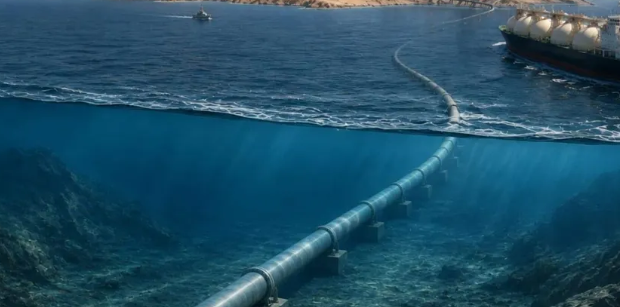
The proposed route would rank among the most technically demanding pipeline projects ever attempted. Current concepts envision a pipeline stretching approximately 2,000 kilometres from Oman’s coast to Gujarat and descending to depths of nearly 3,450 metres below sea level.
At such depths, the structure would be exposed to extreme external pressure. The pipeline would have to be designed not only for efficient gas transmission but also to withstand immense compressive forces from the surrounding ocean. Greater depth requires thicker and stronger steel construction, significantly increasing complexity and cost.
Although offshore energy infrastructure today operates at depths approaching 3,000 metres, the Oman-India project would push the boundaries of large-scale gas transmission technology.
Technical studies conducted over the years have generally concluded that the project is feasible, but exceptionally challenging.
The route itself presents additional obstacles.
“One of the most difficult stretches lies across the Owen Fracture Zone, a tectonic boundary separating the Arabian and Indian plates. The region contains active faults, complex seabed conditions and steep underwater terrain,” a retired official involved in the project during the 1990s told Read.
He added that engineers had identified unstable sediment formations and fault systems requiring specialised design solutions and long-term monitoring.
The pipeline would also cross parts of the Indus Fan—one of the world’s largest submarine sediment systems—where deep channels, unstable geological formations and seabed movement complicate both installation and long-term operations.
Even after construction, maintenance would remain a formidable challenge.
Industry experts point out that repairing infrastructure located several kilometres below the ocean surface is vastly different from maintaining onshore pipelines. Any major intervention would require specialised deepwater vessels, remotely operated vehicles and sophisticated subsea technologies.
Technical assessments suggest that certain categories of repair equipment would themselves require modification for operations at the depths envisioned for the project.
Cost has been another recurring hurdle.
Recent estimates place the project’s capital expenditure between US$4.7 billion and US$4.8 billion, although final costs could vary depending on route selection, engineering specifications and financing arrangements.
Analysts have repeatedly questioned whether a fixed pipeline could consistently compete with imported liquefied natural gas, particularly during periods of low LNG prices.
Unlike a purely commercial venture, the Oman pipeline would need to justify not only construction expenses but decades of operational and maintenance costs. It would require long-term supply contracts, assured demand and substantial commitments from multiple stakeholders.
The proposal resurfaced again during the late 2000s as advances in offshore engineering improved confidence in deepwater construction technologies. The same 2009 parliamentary reply referred to renewed interest in a Middle East-India deepwater pipeline and further efforts by GAIL and its partners to refine the concept.
Yet once again, the project failed to progress beyond the planning stage.
The latest revival differs in one crucial respect: the argument has shifted from economics to strategy.
India imports a substantial portion of its energy requirements, much of which travels through the Strait of Hormuz—one of the world’s most critical energy chokepoints. Any prolonged disruption in the region could have significant implications for energy-importing nations.
Supporters of the Oman pipeline argue that a fixed subsea connection would provide an additional layer of energy security while diversifying India’s gas-import infrastructure.
Some proposals have also envisaged future connections involving other Gulf producers, including the UAE and Qatar. Whether such ambitions materialise remains uncertain.
For more than three decades, the project has repeatedly resurfaced whenever strategic or energy-security concerns have intensified. Every revival has been accompanied by optimism regarding technological progress and changing geopolitical realities. Every revival has also encountered the same fundamental questions surrounding economics, engineering complexity and long-term viability.
According to a retired executive who participated in earlier assessments, the project will ultimately be judged by one question: how beneficial will it be for India two or three decades from now?
“Advances in deepwater technology have reduced some of the barriers that existed in the 1990s, while energy security concerns have acquired new urgency. Yet until financing, supply commitments and construction contracts are secured, the Oman-India pipeline remains what it has been for much of the last thirty years—one of the most ambitious energy infrastructure projects India has never built,” he said.

Comments are closed.