
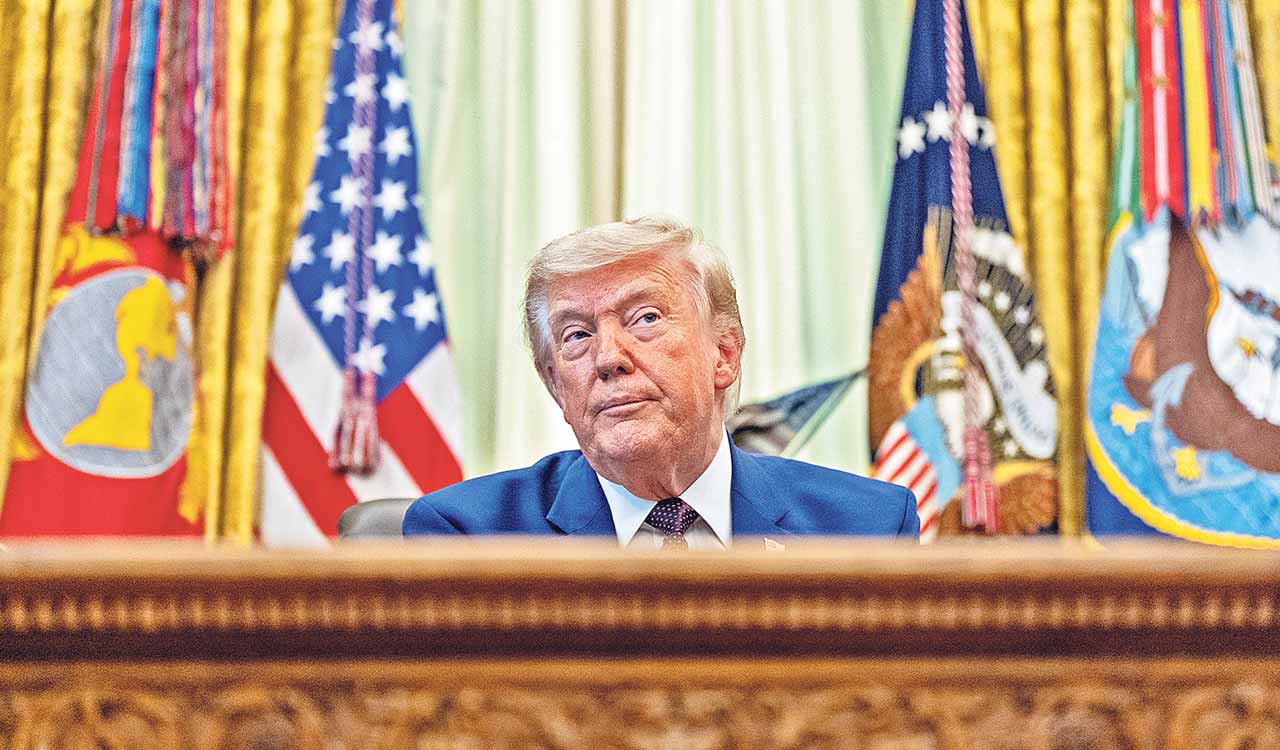

Market volatility, rising energy prices, and shifting US foreign policy priorities reflect the growing importance of geoeconomics in global affairs
Published Date – 15 June 2026, 12:17 AM
By Sanjay Turi
It is interesting to note that the US-Iran ceasefire negotiations have recently witnessed a major shift in priorities of the peace proposals. The earlier peace proposal primarily focused on the safe passage of ships through the Strait of Hormuz and Iran’s denuclearisation efforts, but the recent peace proposal has incorporated the extension of the Abraham Accords among the US allies.
Additionally, President Trump has suggested that Iran should also join this accord to recognise Israel, which possibly makes the entire peace proposal logically irrelevant, as this suggestion goes against the foundational political principles of the Iranian regime. Many scholars believe that this proposal reflects President Trump’s reluctance to end the war prematurely, as this war is benefiting the US directly or indirectly.
Political Economy
While the global economy is experiencing a significant slowdown post-Iran war, the net worth of a few individuals globally, particularly American business tycoons, continues to increase. In recent times, it is often alleged that American business tycoons associated with President Trump, directly or indirectly, have experienced exponential increases in their profits or net worth.
In fact, the personal wealth of President Trump himself has risen significantly, nearly tripling from $2.3 billion to $6.5 billion over the last few years. In addition to this, President Trump’s unilateral decisions on the Iran was have not only made the consequences of this war much more uncertain but also made the global economy highly vulnerable. This phenomenon partially reminds us of the Marxist Theory of international politics, in which Marx gives primacy to domestic political economy over geopolitics.
Although the discipline of international political economy traces its origin to Adam Smith’s Wealth of Nations and the Ricardian theory of comparative advantage, Marx strongly criticises Smith’s and Ricardo’s ideas of political economy. As Marx’s criticism focuses primarily on the domestic context of capitalism and not much on the external dimensions of capitalism, he argues that policies inspired by Adam Smith and David Ricardo bring wealth to the few rather than to the nation as a whole.
Inflationary Pressures
With the skyrocketing energy prices across the globe post the Hormuz blockade, the US market is also experiencing an increase in inflationary pressures on almost every good and service. This is exactly what Marx argues, that the market, inspired by Adam Smith and Ricardo, will benefit only the bourgeoisie class or a few individuals.
President Trump, being a businessman first, always looks for profit, completely ignoring all aspects of the catastrophe he has been creating in recent times, be it his role in Gaza, Ukraine or the Persian Gulf. Trump’s capitalistic approach to war has been so influential that the profits generated by the war outcomes are highly concentrated among the few individuals who have backed Donald Trump throughout his political career.
Ever since the Iran was began almost a hundred days ago, President Trump has repeatedly announced progress towards a peace agreement, signalling an end to this war. Each time he announces that this war is nearing an end, the market reacts very differently: crude oil prices drop sharply, and stock markets worldwide see a bullish trend.
Before the situation can stabilise, he makes another announcement that raises fresh uncertainty. As a result, markets rebound, triggering significant volatility in stock prices and energy markets. It is reported that billions of dollars are put into the futures and options markets before each of President Trump’s war-related announcements.
Impact on Markets
Recently, when the US and Iran were about to reach an agreement, the US attacked Iran’s surveillance facilities on Qeshm Island and near Sirik and also shot down two Iranian attack drones over the Strait of Hormuz. In response, Iran launched a massive drone and missile strike at US bases in Bahrain and Kuwait. This retaliation renewed hostilities, drastically reducing the possibility of the proposed ceasefire agreement.
Such messages from President Trump have led observers to wonder whether he is attempting to influence stock prices for personal gain, given that markets often move significantly in response to major news developments.
In this context, the sophist Thrasymachus’ famous statement, mentioned by Plato in his book ‘Republic’, that ‘might is right’ has gained significant attention, as the US, under the leadership of Trump, is doing the same. The world is watching these developments, but there is hardly any country that dares to stand against the mighty US.
Contrary to historical patterns in which the US had a history of giving geopolitics a front seat, the US under the Trump administration has given geoeconomics a front seat instead. The Trump administration’s recent unilateral exit from various global organisations, the discontinuation of foreign aid (USAID) to developing countries, and the weaponisation of tariff imposition on its trading partners are the clearest examples of the US’ recent foreign policy shift from geopolitics to geoeconomics.
In this context, it would not be wrong to assume that President Trump, by handling war with such a casual and material interests, has possibly altered the true, historical nature of geopolitics during his tenure. Last but not least, the damage to the rules-based international order caused by his materialistic tendencies is possibly irreversible, and the burden of repairing this damage does not lie solely on American citizens but on every global citizen and organisation that believes in the idea of a rules-based international order.
(The author is a Doctoral candidate at the Centre for West Asian Studies (CWAS), School of International Studies(SIS), Jawaharlal Nehru University, New Delhi)

Comments are closed.