
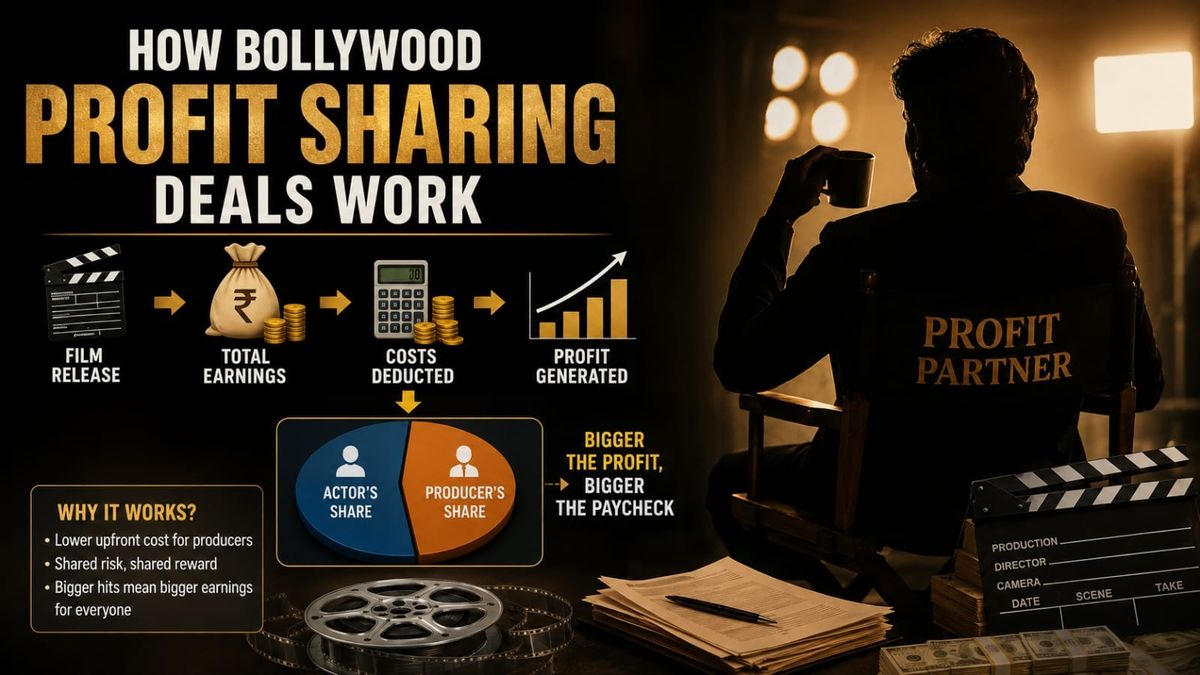
Explainer: How do film stars earn even after leaving the fees of Rs 100 crore? Understand the whole game of Bollywood’s Profit-Sharing deal

How Bollywood Profit Sharing Deals Work: There was a time in the Bollywood industry when big stars used to take their full fees after signing films. Even if the film flops, there was no impact on his earnings. But in the last few years, the business model of the Hindi film industry has changed rapidly. Now many superstars prefer to share in the film’s earnings instead of taking huge fixed fees even before the film’s release. This model is called profit-sharing or back-end deal. In such a situation, the artist’s income depends on the film business. This is the reason why today many big actors earn many times more than their fees after release. Let us understand in simple language how this entire system works.
What is a profit-sharing deal?
Let us tell you the meaning of profit-sharing in simple words. Actually, under this deal no actor takes the full fee at the time of signing the film. He takes his share in the earnings after the release of the film as per the agreement. In such a situation, the more the film earns, the more profit the artist makes. There are two types of systems in this model. The first is a hybrid deal, according to this, the actor takes some fixed fees and the rest of the earnings are given to him on the performance of the film or the percentage of profit that has been mentioned in the agreement. The second one is pure profit deal. In this, the artist does not take any fee upfront and gets compensation entirely according to the profit of the film. If the film becomes a superhit, its earnings become record high.
How are film earnings calculated?
The earning of any film comes in many parts. First of all the cost of making the film is added. This includes shooting, locations, technical team, artist salaries, sets, VFX and post-production. After this the expenses of promotion and marketing are added. When these two are combined, the total expense of the movie is prepared. This money is recovered from the money that comes from box office, OTT, satellite and music rights after the release. When the total earning exceeds the total expenditure of the film, then the amount left is considered as the real earning of the film. Out of this profit, the money is shared between the artists and producers as per the pre-decided percentage.
Why do big Bollywood actors like this model?
In the last few years, the credit for making the profit-sharing model famous goes to the big stars. According to media reports, big Bollywood actors prefer to take a share in the earnings of many of their films instead of taking fixed fees. The advantage of this model is that if the film is a blockbuster, then the actor’s earnings are much more than the fees. For example, if an actor, instead of taking a fixed fee of Rs 80 crores, takes part in the profits of the film and the film does a business of Rs 1000 crores, then his earnings can be higher. This is the reason why today big stars see their films not only as acting projects but also as business.
What benefit do producers get from this?
Not only actors but also producers take advantage of this model. The fees of a big star often form a major part of the film’s budget. Many times the actor’s fee alone reaches Rs 80 to 100 crores. When a star adopts the profit-sharing model, the producer does not have to pay such a huge amount in the beginning. This reduces the initial budget of the film. Due to low cost, the producer recovers the money by selling OTT, music and satellite rights of the film. This reduces the risk of the film to a great extent.
There is no benefit every time, there can be loss also
Let us tell you that profit-sharing, as good a model as it sounds, is not that beneficial. If people do not like the film and it performs poorly at the box office, then the actor suffers a loss. This is the biggest risk of this model. In fixed fee, the actor gets payment in advance. But in profit-sharing, his earnings completely depend on the success of the film. That means an actor can earn crores of profits from a superhit film, but he may have to suffer huge losses from a flop film. Therefore, such agreements are often adopted by only those stars who have full confidence in the earnings of their films.
How did OTT change the game?
The increasing craze of digital platforms has further strengthened this model. Earlier, the biggest source of income used to be only cinema halls, but now OTT, satellite and digital rights have also become a source of big income. Today, bonus clauses related to digital viewership are also included in many deals. If a film garners more viewership than agreed on the OTT platform, then the producer gets extra payment. In many cases, a share of this extra earning is also given to the actor. This means that now the success of a film is not limited to theaters only. Digital performance is also playing an important role in increasing the income of the artist.
Profit-sharing model may become common in the future
Profit-sharing deal has completely changed the business model of Bollywood. This system does not leave the responsibility of the film’s success and flop only on the producer, but also connects the lead actor with him. Big stars are no longer just fee-taking artists, but have also become film business partners. This is the reason why today many big projects in Bollywood are being made on the basis of profit sharing instead of fixed fees. This model may be seen becoming more famous in the coming time, because both the actor and the producer are expected to get their respective profits from it.
Also read: Explainer: Who is the next superstar of Bollywood after Salman, Shahrukh, Aamir? Is the golden era of Bollywood over?

Comments are closed.