

Amar Pal Singh, senior journalist
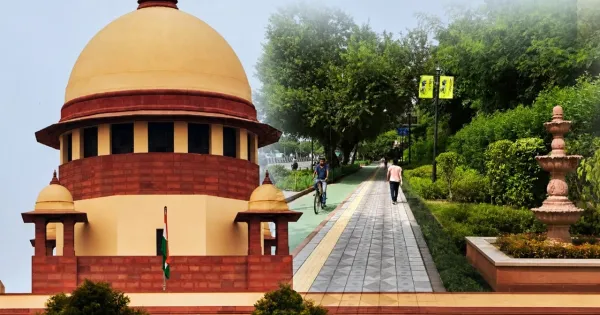
The Supreme Court of the country has given a decision which is not only a legal decision but also raises deep questions on our development thinking. The Supreme Court has said that walking safely on the footpath is a fundamental right of every citizen and the rights of pedestrians on the roads are more important than those of motor vehicles. The court’s observation that man had learned to walk long before the wheel came into existence is not only a historical fact but also a serious commentary on our urban and rural development policies.
The verdict came during the hearing of a tragic road accident in which a father lost his five-year-old son. The court did not limit the matter to just compensation, but linked the right to walk to Articles 19 and 21 of the Constitution and established it as a fundamental right. This decision is important because the country’s development in the last few decades has been almost entirely centered around motor vehicles.
Flyovers were built in cities, wide roads were constructed and expressways were built, but the need for safe footpaths for pedestrians was continuously ignored, while a large population of the country still walks for their daily needs. The poor, labourers, elderly, women, children, disabled and residents of small towns travel the most on foot, but it seems as if the roads have been reserved only for vehicles. The court is absolutely right in saying that initially it was a kind of ‘elite influence’.
Even when vehicles were only with the affluent class, pedestrians did not get importance and as the number of vehicles increased, they established a monopoly on the roads. Today the situation is such that in many cities there are no footpaths and where they exist, encroachment, parking, carts and shops have almost destroyed them. This decision gives many important messages. The biggest thing is that now footpath is not a matter of government mercy or convenience, but a question of civil rights.
The court has also made clear the responsibilities of municipal corporations, development authorities, municipalities and gram panchayats. They can no longer make the excuse of lack of resources or priority. If there is a road, there should also be safe passage for pedestrians. After this decision, citizens have also got the right to approach the court if the footpaths are missing, dilapidated or encroached upon.
If this decision is implemented seriously, it will have far-reaching benefits. Road accidents will reduce, children will be able to go to school more safely, movement of the elderly and women will become easier and public places will become more accessible to the disabled. Also, the culture of walking will be promoted. However, the big question is of implementation.
In most of the small cities and towns of the country, footpaths are minimal and even where they are built, they are vulnerable to encroachment. In such a situation, municipal bodies should conduct surveys of footpaths, run campaigns to remove encroachments and make footpaths mandatory in new road projects. Special priority should be given to the safety of pedestrians around schools, hospitals and markets.
In fact, any civilized society is not identified by its wide roads and flyovers, but by the safety and respect with which the weakest person can walk there. The Supreme Court has given clear constitutional direction. Now it is the responsibility of the governments to take this historic decision out of the papers and implement it on the ground. After all, the first right on the road belongs to the citizen who is walking on his own two legs, and not to the vehicle running on wheels.

Comments are closed.