
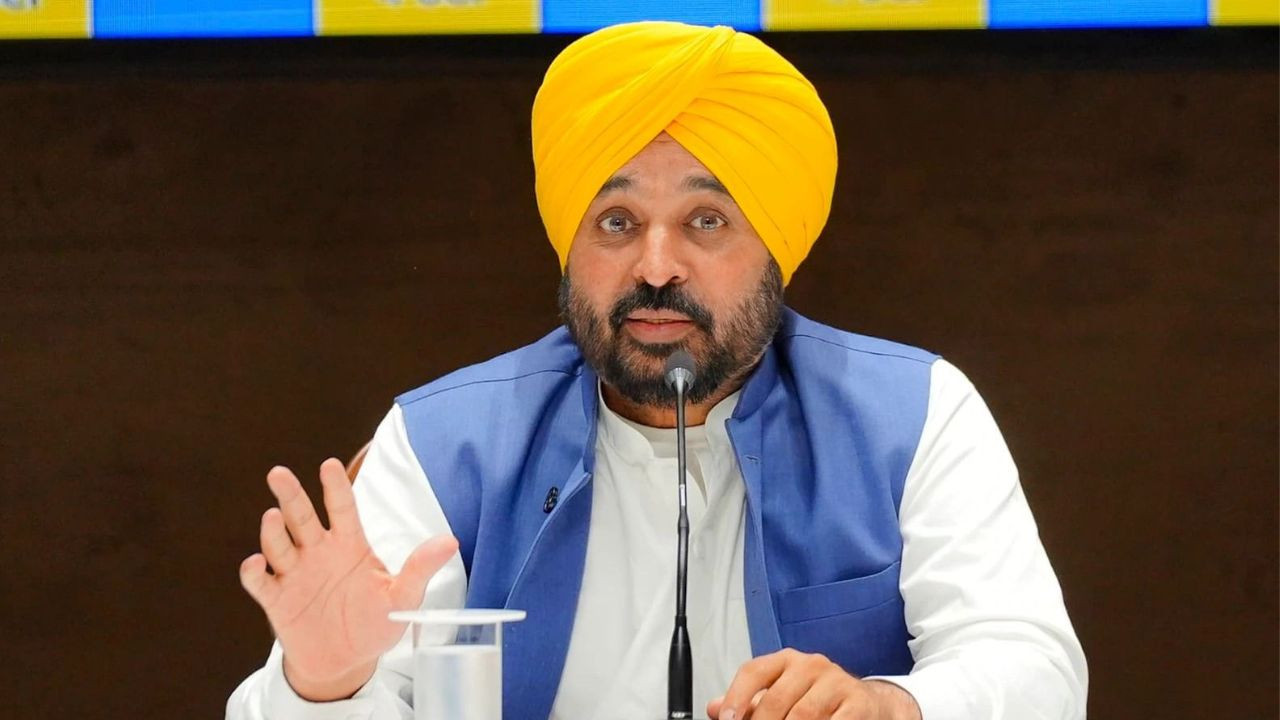
Higher education should remain a path to opportunities, not a burden on families: Chief Minister Bhagwant Singh Mann

Chandigarh: Punjab Chief Minister Bhagwant Singh Mann has strongly opposed the proposed ‘Developed India Education Act Bill, 2025′ (Higher Education Bill). They warned that the legislation could make higher education more expensive, reduce opportunities for students from ordinary families, and undermine states’ ability to meet local educational needs. In a letter to Union Education Minister Dharmendra Pradhan, Chief Minister Bhagwant Singh Mann has appealed to the Center to reconsider the bill and conduct wider consultations before implementing reforms that could impact the higher education sector in a big way.
Chief Minister Bhagwant Singh Mann gave a big statement
Citing that crores of parents across the country have pinned their hopes and dreams on the education of their children, Chief Minister Bhagwant Singh Mann said that higher education should be a path of opportunities for the child of a farmer, laborer or shopkeeper, and not a financial burden on the families. He claimed that India’s progress depends on making higher education more accessible and affordable through greater investment in universities, infrastructure, faculty and research, rather than on measures that drive up costs and centralize the decision-making process.
In his letter, Chief Minister Bhagwant Singh Mann wrote that he is writing not only as the Chief Minister of Punjab but also as a representative of crores of parents across India whose biggest expectations are related to the education of their children. He said, "Every family wants their child to receive quality education, stand on their own feet, get respectable employment and contribute to the progress of the country. That is why education is not just an administrative subject, it is a question related to the bright future of India."
The Chief Minister said, "I initially hoped that the proposed law would strengthen the quality, accountability and global competitiveness of higher education institutions. However, after studying the Bill closely, I have a serious concern that it seeks to centralize most of the important decisions related to higher education, which will have far-reaching implications for students, teachers, universities and state governments."
Expressing his first major concern, Chief Minister Bhagwant Singh Mann said that the bill seems to be more focused on centralization of power rather than improving the quality of education. He said, "The success of any education system depends on how effectively it understands the needs of students, teachers and local communities. In a country as vast and diverse as India, every state faces different social, economic and educational challenges."
The Chief Minister said it was natural to expect that any law regarding higher education would focus on quality, research, innovation, employability and global competitiveness. However, after studying the Bill, it seems that its main objective is to concentrate policy making powers, standards, rules, recognition systems and appellate powers in the hands of the Central Government. He said, "Education is a subject in the concurrent list of the Constitution. Therefore, while minimum national standards may be necessary, states should have the freedom to develop systems according to their circumstances and needs. Unfortunately, this Bill appears to disturb that constitutional balance."
CM Mann is worried about crores of students
Chief Minister Bhagwant Singh Mann further said that his concern is not only about the rights of the states, but also about the future of crores of students. He said, "Every state of India is facing different challenges. Someone is dealing with unemployment, someone is grappling with skill development, industrial needs or migration. Border states like Punjab face even more complex realities."
The Chief Minister further said that the State Governments develop curricula, skill programmes, industrial partnerships and employment-oriented initiatives as per local needs through universities and colleges. He said, "If most of the decisions on education are taken by institutions sitting in Delhi, the states will gradually lose their ability to understand local realities and formulate solutions accordingly. As a result, higher education is in danger of becoming centralized and losing its practical importance."
Drawing attention to the dangers of increasing centralization, Chief Minister Bhagwant Singh Mann cited the functioning of central institutions like the National Testing Agency (NTA). He said, "In recent years, serious questions have been raised regarding examination management, transparency and credibility. When central institutions themselves are grappling with such challenges, it is right to ask whether further centralization of higher education is really the right direction."
The Chief Minister stressed that greater cooperation between the Center and the states is the better way forward. “Successful models developed by different states should be shared across the country. The decision-making process should be more participatory and collaborative. Unfortunately, this bill seems to be going in the opposite direction,” he said.
Chief Minister Bhagwant Singh Mann also expressed concern that the proposed law could make higher education more expensive. He asked, “An important question arose before me while studying the Bill. If most of the powers are concentrated in the Central Government, if the role of State Governments becomes increasingly limited and if Central regulatory control over State Universities and Colleges increases, then where will the financial resources required for the operation and development of these institutions come from?”
The Chief Minister indicated that the Bill does not provide any satisfactory answer to this question. He said, “If decision-making powers are centralized, while there is no guarantee of necessary financial support, there will inevitably be pressure on universities to increase revenues. This may lead to increase in fees, increased dependence on self-financed courses and also increased dependence on private investment.”
Chief Minister Bhagwant Singh Mann warned that the burden of such a model would fall most heavily on the middle class, lower-middle class and poor families. “Higher education should be a vehicle of opportunity. It should not become a privilege available only to those who can afford it,” he said.
The Chief Minister also expressed concerns about the gradual privatization of higher education. “After studying the bill, it appears that India’s higher education system may gradually be pushed towards a model where government institutions will be weakened and dependence on the private sector will continue to increase,” he said.
He warned that if complete centralization of policy making, regulations and control is carried out without any clear financial responsibility, public universities will be forced to depend on private institutions and private capital. “Such a change will have a direct impact on millions of students whose parents continue to make huge sacrifices to get them educated in colleges and universities,” he said.
Chief Minister Bhagwant Singh Mann stressed that in a country like India, higher education should be strengthened as a right rather than limited by economic constraints.
The Chief Minister appealed to the Central Government to withdraw the present form of this Bill and conduct a comprehensive review of it. “India does not need a law that further centralizes higher education. We need a framework that allows universities and colleges to more effectively connect with the needs of their regions, industries, societies and youth,” he said.
Chief Minister Bhagwant Singh Mann said that most of the institutions of higher education are established, run and financially supported by the state governments. Therefore, reforms should move in a direction that provides more powers, more flexibility and more responsibility to the states. “States should be empowered to develop educational systems tailored to the aspirations and needs of their youth. At the same time, the central government should focus on increasing investment in higher education rather than increasing regulatory control,” he said.
Referring to the objectives of the National Education Policy-2020, the Chief Minister said that a target has been set to increase the gross enrollment ratio in higher education to 50 percent by the year 2035. “To achieve that goal, universities, colleges, research institutes and technical institutes need more resources, stronger infrastructure, modern laboratories, quality faculty and necessary research funds. They do not need additional layers of control,” he said.
Chief Minister Bhagwant Singh Mann said that if the central government really wants to make India a developed nation, it should give priority to educational investment rather than administrative centralization. He said, “Universities should be given resources, autonomy and opportunities instead of giving additional control. This is not just a question of Centre-state relations. This is a question of crores of students, their families and the future of India.”
The Chief Minister said that India’s progress depends on realizing the dreams of common families. He said, “When a farmer’s son becomes an engineer, when a laborer’s daughter becomes a doctor and when a small shopkeeper’s child becomes a scientist, then India moves forward. Our education system should make it easier to realize such dreams, not more difficult.”
Reiterating his appeal, Chief Minister Bhagwant Singh Mann demanded the Central Government to withdraw the bill and replace it with a framework that would make education more accessible, affordable, of high quality and in line with the needs of the states. He concluded his speech by saying, “Countries do not become great by controlling education. Countries become great by investing in education.”

Comments are closed.