

The lines will stretch about 303.5 km and link Noi Bai International Airport, Hanoi Station and major urban districts.
A consortium of Vinhomes and VinSpeed, both part of Vingroup, Vietnam’s largest private conglomerate controlled by Vuong, will serve as the engineering, procurement and construction (EPC) contractor for all five.
(From R) Prime Minister Le Minh Hung, Hanoi People’s Committee Chairman Vu Dai Thang and Vingroup chairman Pham Nhat Vuong at the groundbreaking ceremony for five metro lines in Hanoi on June 22, 2026. Photo courtesy of Hanoi People’s Committee |
VinSpeed, founded in 2025, is already building the Ben Thanh-Can Gio line in Ho Chi Minh City and broke ground in April on a high-speed line connecting Hanoi with the Ha Long Bay region.
The five Hanoi metro lines vary widely in scale.
The longest, Line 8, will run about 91 km from the Hoa Lac technology hub through Mai Dich and Ring Road 3 to Duong Xa.
Line 1, at about 81 km, will connect Thuong Tin with Ngoc Hoi, Hanoi Station and Yen Vien before reaching Noi Bai airport.
Line 2, spanning 56.5 km, will link Noi Bai airport with Tran Hung Dao, Thuong Dinh and the city’s southern area. Line 10, at 43 km, will tie together Dong Anh, Vo Chi Cong, Ring Road 3, Ring Road 2.5 and Times City, and Line 14, the shortest at 32 km, will run from Thang Long Bridge through Hong Ha to Gia Lam.
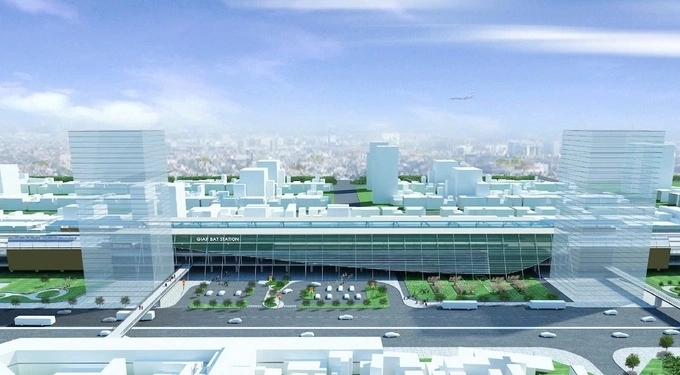 |
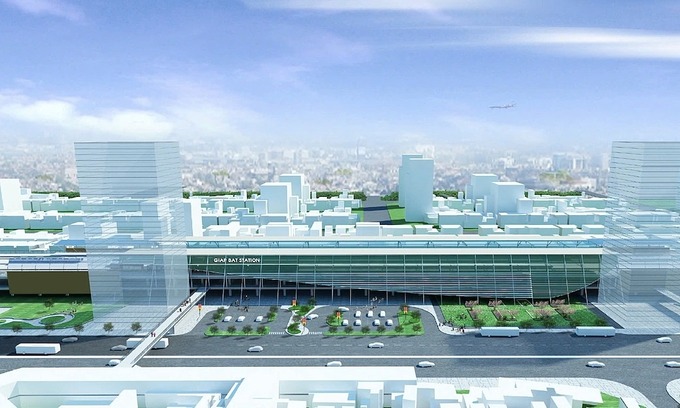
A rendering of Giap Bat metro station in Hanoi. Photo courtesy of Hanoi People’s Committee |
Hanoi People’s Committee Chairman Vu Dai Thang called the program the city’s largest urban rail investment to date and a turning point from building lines one at a time to assembling a city-wide network.
Urban rail, he said, will form the backbone of Hanoi’s multi-polar, multi-center development model, easing congestion while steering transit-oriented development (TOD), unlocking land value and strengthening regional links.
Once finished, the lines will connect Noi Bai airport, Hanoi Station, the Ngoc Hoi station complex, Hoa Lac, Thu Lam, Co Loa and the Ocean Park township, and tie into lines 3 and 5 already under construction.
The five routes are a down payment on a far larger plan. Under Hanoi’s recently approved 100-year master plan, the city intends to build a 979-km urban rail network, rising to nearly 1,200 km when national and inter-regional railways are counted.
It aims to complete roughly 500 km by 2035 and the remaining 479 km between 2036 and 2045.
For now, Hanoi runs only two operating stretches: the Cat Linh-Ha Dong line and the elevated Nhon-Cau Giay section of the Nhon-Hanoi Station line.
The first of those took more than a decade to finish, which makes the new 2030 target the central question hanging over the program: whether five lines and 303.5 km of track can be delivered in roughly four years, when a single earlier line took 10.
The simultaneous launch reflects a broader government drive to sustain growth through large infrastructure, and an expanding role for private conglomerates in projects once reserved for the state.
Comments are closed.