
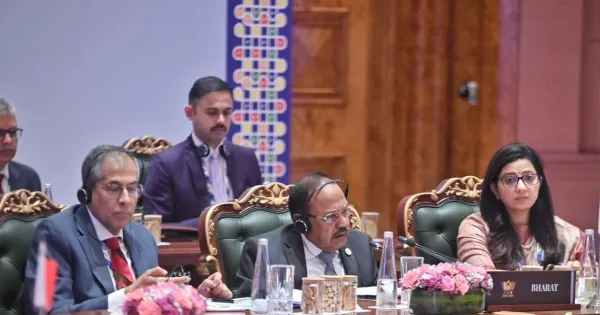
BRICS Summit: Ajit Doval said – ‘Opening of the Strait of Hormuz is a welcome step, will help in energy security’

New Delhi. While welcoming his counterparts from BRICS countries here on Tuesday, India’s National Security Advisor (NSA) Ajit Doval has given a big statement. He said that the opening of the Strait of Hormuz is a very welcome step, as it will greatly help in global energy security.
New Delhi is hosting the conference as the current chair of the influential group. China’s Foreign Minister Wang Yi, Russia’s NSA Sergei Shoigu, Iran’s security officer G Nizamipur and other top security officials of BRICS countries are participating in this high-level conference chaired by Doval.
India welcomed the MoU between America and Iran
In his opening remarks at the conference of NSAs of BRICS countries, Doval spoke at length on the impact of geopolitical uncertainties and economic disruptions. Doval said, “India welcomes the MoU between the US and Iran. We hope it will work. It will help in energy security.” He further said, “The opening of the Strait of Hormuz is a very welcome development. This will remove bottlenecks in supply chains and solve the problem of shortage in sectors like fertilizers and chemicals.”
‘Multilateralism is weakening and instruments are inadequate’
Ajit Doval underlined the importance of BRICS in addressing multiple global challenges, saying, “We meet at very turbulent times. The world is facing geopolitical uncertainties, economic pressures and disruptive technology.”
“Not only are the threats increasing, but the instruments and institutional mechanisms available to resolve or mitigate these conflicts are also proving inadequate,” he said, expressing concern. He clearly said that at present “multilateralism is weakening” and the role of BRICS has now become very important in dealing with various global challenges.
The main objective is to strengthen the voice of ‘Global South’
Recalling the essence of BRICS, NSA Doval said, “BRICS was conceived as an informal grouping of emerging economies to move towards a more multipolar world order. Its objective was to promote economic cooperation and strengthen the voice of the ‘Global South’.” (Note: ‘Global South’ refers to countries often referred to as developing, least developed or underdeveloped, located primarily in Africa, Asia and Latin America.)
He further added that BRICS also envisioned reform of global governance and institutional improvement. It is a very special alliance of countries that believes in peace, progress, development and cooperation.
‘BRICS’ represents half the world’s population
Figures of the increasing influence of BRICS were also put forward in the meeting. BRICS originally included Brazil, Russia, India, China and South Africa. It expanded in 2024 to include Egypt, Ethiopia, Iran and the United Arab Emirates (UAE), while Indonesia joined in 2025. The grouping now brings together the world’s 11 major emerging economies, representing about 49.5 percent of the global population, about 40 percent of global GDP and about 26 percent of global trade.
There will be discussion on terrorism and non-traditional threats
Ajit Doval said that in this conference, the results of the two joint working groups of BRICS on counter-terrorism action will also be discussed in depth. Along with this, he also expressed concern about the non-traditional security threats facing the world. “We need to remain alert to new security threats and challenges. Non-traditional threats transcend national borders and have evolved systems that defeat traditional responses,” he cautioned.

Comments are closed.