
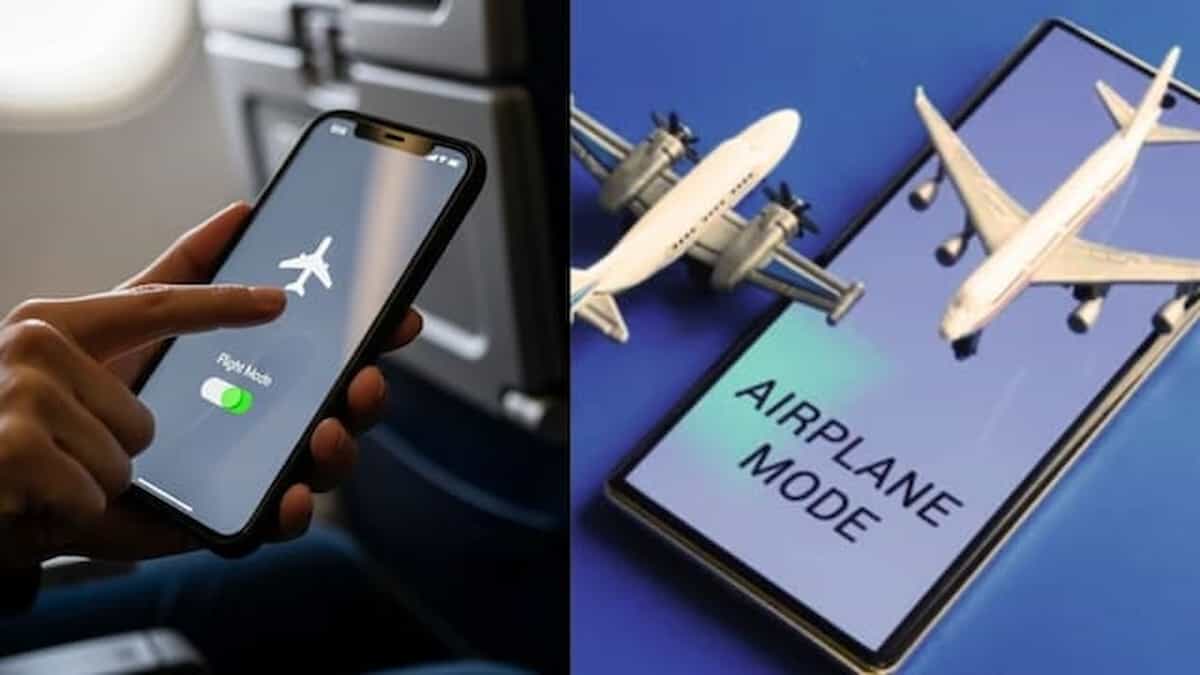
Travel Tips: Why are you asked to turn on flight mode of your phone in the plane? What will happen in the sky if you do not switch off your mobile?

Traveling by plane has become very common these days, but a warning given by the flight attendant just before take-off always echoes in the ears of every passenger –"Please put your mobile phone on flight mode or switch it off." Most of us follow this rule without thinking, but sometimes this question comes to our mind that what difference is a small mobile phone going to make in this huge plane flying at an altitude of 30 to 40 thousand feet? From the perspective of an aviation reporter, this is not a simple safety instruction, but there is a very complex science behind it and the safety of the lives of hundreds of passengers sitting on the plane. Let us know what will actually happen if you leave your phone on in the air. Dangerous interference arises in the communication between the pilot and the air traffic control. When the airplane is flying in the sky, the pilot keeps getting necessary instructions and weather information through radio signals from the air traffic control (ATC) present on the ground every moment. Now let’s talk about your smartphone. When your phone is on normal mode, it continuously emits high-frequency radio waves to find the nearest mobile network tower. As the plane rises rapidly, the phone loses contact with towers on the ground and tries its best to pick up signals. These strong signals emanating from the passengers’ phones directly produce a very annoying and loud beep-beep (buzzing sound) in the pilot’s headphones. Exactly the same sound that sometimes comes when the phone is taken near a loudspeaker. Can an airplane crash by not turning on the flight mode of the mobile? Often the biggest fear in people’s mind is whether a phone being on can cause the entire plane to crash? According to technical experts and aviation experts, modern airplanes are so advanced that just because one or two mobile phones are on, the plane will not crash directly. But the problem becomes bigger when 50 or 100 passengers on the flight leave their phones on simultaneously. Due to the emission of such a large number of mobile signals, the possibility of malfunctioning of the aircraft’s extremely sensitive navigation system and radar equipment increases. Especially at night or during bad weather and heavy fog, when the pilot is completely dependent on the automatic landing system and ground signals, even the slightest interference due to mobile signals can take the flight in the wrong direction, leading to a major accident. Why this strict rule becomes most important at the time of take-off and landing? ‘Take-off’ and ‘Landing’ are considered to be the most delicate and sensitive stages in the entire flight journey. According to aviation statistics, most air accidents occur during this time. This is the reason why pilots are in constant live contact with air traffic control during this time and they need moment-to-moment information about the runway. If at this crucial time, due to a passenger’s phone, the pilot does not hear any important instruction from ATC clearly, then there can be a collision between two planes on the runway or a major landing error. To avoid this serious danger, airlines and aviation regulators around the world (like DGCA in India) have strictly enforced this rule. Breaking the rules can lead to jail time and hefty fines. Many travelers take this rule lightly and secretly keep their phones on normal mode so they can play offline games or record videos. But you will be surprised to know that violating the instructions of the flight crew inside the aircraft and not putting the mobile on flight mode comes under the category of legal offense. If your irresponsible behavior results in a major equipment malfunction or forces the pilot to make an emergency landing, you may be placed on the ‘No-Fly List’. Additionally, you may be taken into police custody as soon as you land at the airport, which carries heavy fines as well as jail terms. So next time you board a plane, give priority to safety and act wisely.

Comments are closed.