
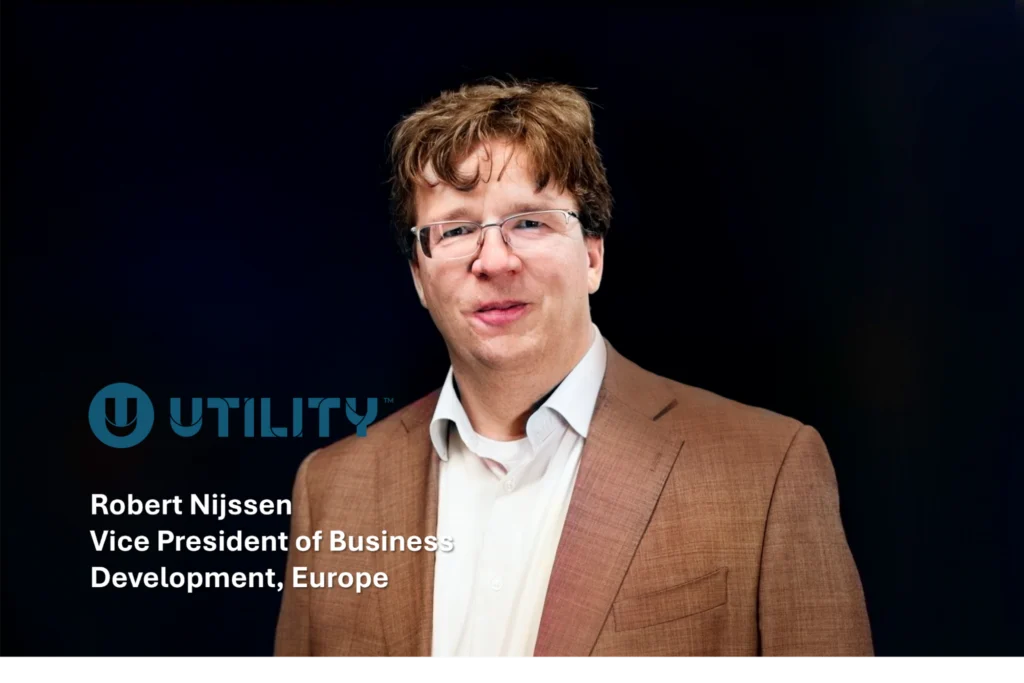

When a young, US-based industrial technology company plants its flag in Europe, it is easy to file the news under “another energy-transition press release” and move on. That would be a mistake. Utility Global’s announcement this week that it has appointed Robert Nijssen as vice president of business development for Europe is not just an executive hire, it is a statement of intent from a company that has decided to go where the hardest problems, and the most demanding customers, live. And it is precisely the kind of move that India’s steelmakers, Tata Steel chief among them, ought to be studying closely.
A bold move, and the right one
Europe is not the easy market. It is the most aggressive industrial-decarbonization arena on the planet, where carbon pricing bites, emissions mandates tighten every year, and industrial operators are under genuine competitive pressure to clean up or fall behind. Walking into that environment with a hydrogen technology is not for the faint of heart. That is exactly why Utility’s decision reads as the right one.
The company unveiled its European entry at the World Hydrogen Summit 2026 and has now backed that ambition with serious commercial firepower. Nijssen brings more than 25 years across industrial gas, petrochemicals and energy technology, with deep credentials in hydrogen and carbon capture, utilization and storage. His track record is not theoretical: he has generated over €100 million year-over-year in new industrial energy contracts in the Benelux region, led a large-scale CO₂ export terminal project, helped pioneer some of the industrial sector’s earliest power purchase agreements, and built commercial teams across Europe and the Middle East. Hiring a builder of this caliber to open a market tells you the company is not testing the waters. It is committing to them.
Choosing to prove a decarbonization technology in the toughest regulatory and commercial conditions first is a confident, disciplined strategy. If their flagship technology, the H2Gen reactor, works in Europe, it works anywhere. That is what makes this a company moving in the right direction.
What Utility actually does and why it’s different
The heart of the story is the technology. Utility’s H2Gen platform produces low-carbon hydrogen on-site from water using a proprietary electrochemical process and, crucially, without electricity. Instead of drawing grid power or dedicated renewables, it harnesses used energy from industrial off-gases and biogas to split water into hydrogen. In the same step, it generates a concentrated carbon dioxide stream of up to 98% purity, dramatically reducing the cost and complexity of carbon capture.
That combination matters enormously. Most “green hydrogen” pathways depend on electrolysis, which is hungry for vast amounts of cheap renewable electricity, a constraint that has slowed deployment everywhere, India included. Utility’s approach sidesteps that bottleneck by turning the off-gases a heavy industrial site already produces into a feedstock. The systems are modular, scalable, and designed to slot into existing assets with a famously small footprint. In other words: this is decarbonization built for brownfield reality, not greenfield fantasy.
Why India’s steelmakers should care
Here is where the story comes home. Steel is one of the world’s hardest sectors to abate, responsible for roughly 7-9% of global CO₂ emissions, and it sits at the very center of the industries Utility is targeting. India is now the world’s second-largest steel producer, with enormous growth still ahead of it, which means the country’s decarbonization challenge in steel is among the most consequential anywhere on earth.
India’s policy backdrop is already moving in Utility’s direction. The National Green Hydrogen Mission, approved in 2023, targets at least 5 million tonnes of green hydrogen annually by 2030 and explicitly funds pilot projects in steel. The demand signal is there. What the market lacks is technology that is economically viable inside existing plants and that is exactly the gap H2Gen is designed to fill.
The Indian steel manufacturer case
No Indian company embodies this opportunity more than Tata Steel, and the fit is striking.
Tata Steel has committed to net zero by 2045 across its operations, one of the earliest and most ambitious targets adopted by any major global steelmaker. In India, it has set out to bring CO₂ emission intensity below 2 tonnes per tonne of crude steel, tightening to under 1.8 tonnes by 2030. It is not a laggard experimenting at the margins; it conducted a world-first trial of up to 40% hydrogen injection at the E Blast Furnace in Jamshedpur, and it has partnered with Germany’s SMS Group to deploy EASyMelt, a technology that itself runs on coke oven gas and other off-gases. Tata Steel, in short, has already concluded that the future of its furnaces runs partly on hydrogen and partly on smarter use of process gases.
That is precisely the world Utility’s H2Gen is built for. Consider the alignment:
- It feeds on what Tata Steel already wastes. Integrated plants like Jamshedpur and Kalinganagar generate enormous volumes of coke oven gas and blast furnace gas. H2Gen is designed to harness exactly these industrial off-gases to produce hydrogen, turning a liability into a feedstock.
- It doesn’t fight India’s power constraints. By producing hydrogen without electricity, H2Gen avoids the renewable-power bottleneck that makes electrolysis so expensive to scale in India today. That is a profound cost advantage in a market where every rupee per kilogram of hydrogen matters.
- It makes carbon capture cheaper. Tata Steel is already piloting CCU and has built CO₂ capture capacity in India. A technology that produces a near-pure CO₂ stream as a byproduct slashes the single biggest cost driver in carbon capture and a direct accelerator for Tata’s existing roadmap.
- It fits brownfield retrofits. Tata Steel cannot rebuild century-old integrated plants overnight. Modular systems that integrate into existing assets with a small footprint are exactly what a phased, economically-disciplined transition requires.
Put plainly: Utility Global has built a technology whose core advantages map almost line-for-line onto Tata Steel’s stated decarbonization strategy. Where Tata is using hydrogen and off-gases, H2Gen produces hydrogen from off-gases. Where Tata is investing in carbon capture, H2Gen hands it a concentrated CO₂ stream for free. The overlap is too clean to ignore.
The takeaway
Utility’s European push is the bold, correct move of a company that understands where industrial decarbonization is actually being decided. But the deeper lesson for Indian readers is that the technology now winning credibility in Europe is tailor-made for the problems India’s steelmakers face every day. Tata Steel and JSW, SAIL and the rest of India’s heavy-industry roster should be watching this company not as a distant European story, but as a preview of a partner they may soon want at the table.
The companies that move first to pair ambitious targets with practical, plant-ready technology will define the next decade of Indian steel. Utility Global has just made itself impossible to overlook.

Comments are closed.