
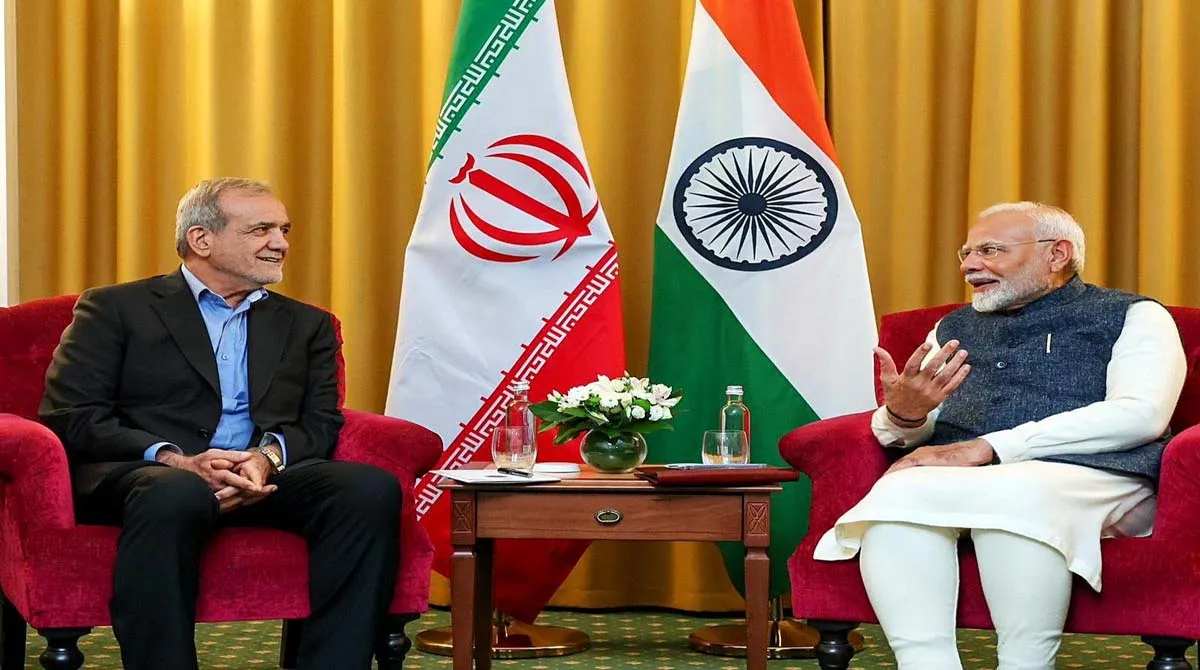
India invited for Khamenei’s funeral, will Prime Minister Narendra Modi himself go to Iran?

Amidst the ongoing tension in West Asia, a very big diplomatic news is coming out. Iranian President Masoud Pejeshkian has sent a very formal and special invitation to Indian Prime Minister Narendra Modi. Through this letter, PM Modi has been invited to personally attend the state funeral and burial ceremony of Iran’s Supreme Leader Ayatollah Ali Khamenei.
Let us tell you that Iran’s most powerful leader Ayatollah Ali Khamenei was killed in a horrific American-Israeli air attack in February this year. There is an atmosphere of mourning in Iran since his death. Now the official programs related to his last farewell will start from 4th July till 9th July. However, it is not completely clear in the diplomatic circles whether Prime Minister Narendra Modi himself will go to Iran on behalf of India on this very sensitive and big occasion or any other high-level representative from the Indian government will leave for Tehran to attend this historic event. Earlier, immediately after Khamenei’s demise, Foreign Secretary Vikram Misri, on behalf of the Indian government, had visited the Iranian Embassy in New Delhi and expressed India’s deepest condolences by signing a condolence book there.
The last farewell journey will start from July 4, lakhs of people will gather in 5 cities.
According to the official schedule released by the Government of Iran, during the funeral of the Supreme Leader, many major religious and state events are going to be organized in historical and holy cities like Tehran, Qom, Najaf, Karbala and Mashhad. It is expected that lakhs and crores of people from India and abroad will participate in these programs. The Iranian government said that the main ceremonies will start from July 4 with full state honours. First of all, Khamenei’s mortal remains will be kept in the grand Grand Mosallah Complex in Tehran for the general public and foreign guests to see.
Immediately afterwards, huge public mourning processions will be taken out on the streets of the capital Tehran and the religious city of Qom. In the next phase of this journey, special prayer meetings will be organized in Najaf and Karbala, considered very holy cities of the neighboring country Iraq, where many big leaders of the Muslim world will gather. After this, on July 9, he will be buried with full religious rites at the famous and sacred Imam Reza Dargah located in Khamenei’s ancestral hometown Mashhad. Iranian officials believe that within these six days the largest gathering in the country’s history is going to gather.
Why did India get this special invitation among all the countries of the world?
This question is bound to arise in the minds of experts of international politics that why has Iran given so much importance to India amidst this crisis in West Asia? In fact, India has always considered Iran as its extended neighbour. There have been centuries-old strong trade, strategic and cultural ties between the two ancient civilizations and countries. This is the reason why the Indian government is also deeply mourned by Khamenei’s sudden demise.
Earlier, last year in May 2024, when the then President of Iran Ebrahim Raisi died in a tragic helicopter crash, India, showing its unwavering friendship with Iran, had declared a day of national mourning in the country and lowered the tricolor flag at half mast on all government buildings. At that time, Vice President Jagdeep Dhankhar was sent to Iran as a special envoy on behalf of the Government of India. However, this time due to security and diplomatic reasons it is yet to be decided who will represent India.
Interestingly, even during the 40-day fierce military conflict that has been going on in West Asia for the last several months, Prime Minister Narendra Modi and Foreign Minister S. Jaishankar had maintained constant contact with the Iranian leadership through phone and hotline. Recently, Iran’s Foreign Minister Abbas Aragchi had specially come to New Delhi to participate in an important meeting of foreign ministers of BRICS countries. During that time he met Prime Minister Modi and Foreign Minister S. Had also held very confidential and successful bilateral meetings with Jaishankar.
Due to its deep friendship, apart from India, Iran has also sent invitations for this state farewell to Iraq, Pakistan, Afghanistan, Syria, Lebanon, Russia, China and many Central Asian countries. Ayatollah Ali Khamenei was the most influential and powerful leader in the history of Iran, who single-handedly decided the political and religious direction of the entire country for almost four decades (40 years). After his departure, the eyes of the whole world are now on the future of Iran.

Comments are closed.