
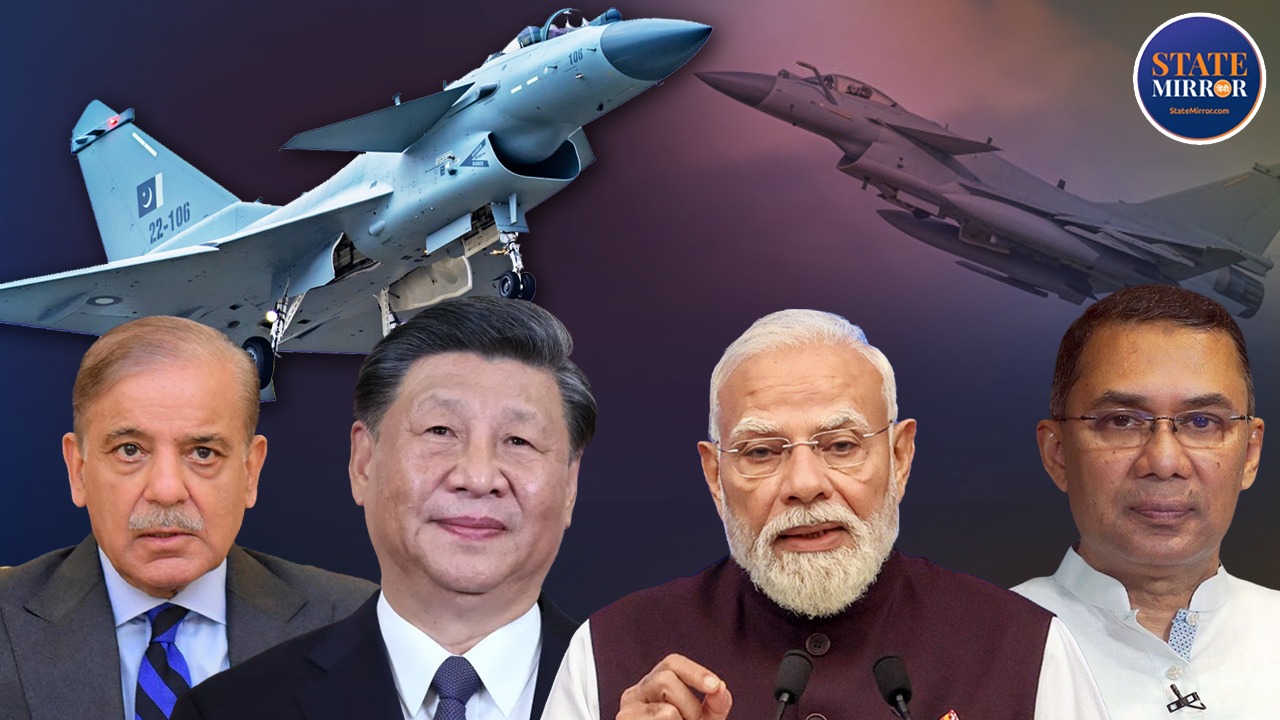
China made it, Pakistan flew it against India, now Bangladesh will buy the same fighter plane, how much tension for India?

Pakistan tried J-10CE in war conditions, China made it a symbol of its military technology and now Bangladesh is going to make it the new strength of its Air Force. This visit of J-10CE fighter aircraft in South Asia is not just the story of an arms deal, but also an indication of changing strategic equations. Dhaka’s preparation to purchase 24 Chinese J-10CE fighter jets has come to light at a time when Pakistan has already included them in its fleet and their use was claimed during ‘Operation Vermillion’ against India.
The question is not whether 24 aircraft will challenge India’s military edge, but what kind of strategic challenge the arrival of the same Chinese platform in Pakistan and Bangladesh can pose for New Delhi. Is this just defense modernization or another layer of China’s growing influence in South Asia?
Preparation to buy 24 J-10CE fighter jets
bangladesh The Air Force is moving towards finalizing one of the largest defense purchases in its history. According to media reports, Dhaka is working on a plan to buy 24 J-10CE multi-role fighter jets from China and the agreement can be signed by August. This is the same aircraft which was used by Pakistan Air Force during “Operation Sindoor” against India.
If this deal is completed, there will be a big change in the capability of Bangladesh Air Force (BAF), and it may also affect the strategic equations of South Asia.
What is J-10CE and why is it special?
J-10CE is an export version of China’s Chengdu J-10C fighter aircraft. It is counted among China’s most capable 4.5 generation fighter aircraft. Equipped with WS-10B afterburning turbofan engine, this aircraft can achieve a speed of approximately Mach 1.8.
The delta-wing and canard design, digital fly-by-wire control and high maneuverability make it extremely effective in situations such as dogfights and missile defense. Its biggest feature is that it can perform many types of missions simultaneously – air war, ground attack and sea strike operation.
There are 11 hardpoints in the aircraft, on which about 5,600 kg of weapons can be carried. These include air-to-air missiles, precision guided bombs and other modern weapons.
Radar and PL-15 missile its strength
The advanced AESA radar of J-10CE is one of its biggest technical features. It is capable of finding and tracking multiple targets simultaneously despite enemy electronic jamming.
Apart from this, it can be equipped with China’s long-range PL-15 air-to-air missile. This missile can also target targets beyond “beyond visual range”. This is the reason why it is seen as an economical alternative to many modern fighter aircraft of western countries in the international market.
Why does Bangladesh need this?
Bangladesh has long been working on its “Forces Goal 2030” defense modernization programme, which was initiated in 2009. Its objective is to equip the Army, Navy and Air Force with modern weapons.
At present Bangladesh Air Force has about 40 to 44 fighter aircraft. These include most of the older Chengdu F-7/J-7 and eight Russian-origin MiG-29s. The technical age of these aircraft has increased and the need to replace them is being felt.
In such a situation, J-10CE can provide Bangladesh with a platform that can handle many types of missions despite limited resources. This is the reason why Dhaka wants to make it the basis of its future air power.
How big is this deal?
According to reports, a J-10CE could cost around $40 million, which is much lower than western fighter planes like Rafale or F-16. The size of the entire deal of 24 aircraft is said to be around $2.2 billion.
This package will include not only aircraft but also pilot training, logistics support, spare parts, maintenance infrastructure, weapons and long-term technical assistance. If the agreement is reached on time, deliveries could begin in late 2026 or early 2027.
Will India’s security be affected?
From a military point of view, the purchase of only 24 J-10CE aircraft is unlikely to bring about a major change in the balance of power between India and Bangladesh. The Eastern Command of the Indian Air Force has several modern squadrons deployed in Assam and West Bengal, which include aircraft like Su-30MKI and Rafale. India has 60 to 70 modern fighter aircraft in the eastern region. Apart from this, India also has a strong air defense network, better command-and-control system and extensive surveillance capability. Therefore, the immediate military balance is likely to remain in favor of India.
Then what is the reason for concern?
The big reason for concern is not only the plane but the China behind it. The operation of a modern platform like the J-10CE requires a constant supply of spare parts, software updates, weapons, technical support and upgrades. China has control over all these.
This means that Bangladesh’s defense system may be more dependent on China than before. This is likely to increase Beijing’s military and diplomatic influence in India’s eastern neighbourhood.
Another important aspect is that Pakistan also operates J-10CE. In such a situation, the possibilities of technical cooperation, training, intelligence sharing and operational interoperability between China, Pakistan and Bangladesh can increase.
Not just defense, but also strategic message
The J-10CE deal is not being seen merely as an arms purchase. This is also considered to be a part of Bangladesh’s broader strategy in which it wants to expand its defense and economic relations with various countries.
China’s increasing involvement in Teesta River Project, development of Mongla region and other infrastructure projects has already strengthened the relations between the two countries. Now, with the expansion of defense cooperation, these relations can deepen further.
The possible purchase of 24 J-10CE fighter aircraft will increase Bangladesh’s air power, but it will not immediately change the military balance in South Asia. India will still be ahead in terms of technology, numbers and network-centric warfare capability. Nevertheless this deal is being seen as a big geopolitical signal.
China appears to be taking another step towards strengthening its influence in India’s eastern neighbourhood. In such a situation, this deal can become not just the purchase of fighter planes, but an important development related to regional balance of power and future strategic politics.

Comments are closed.