
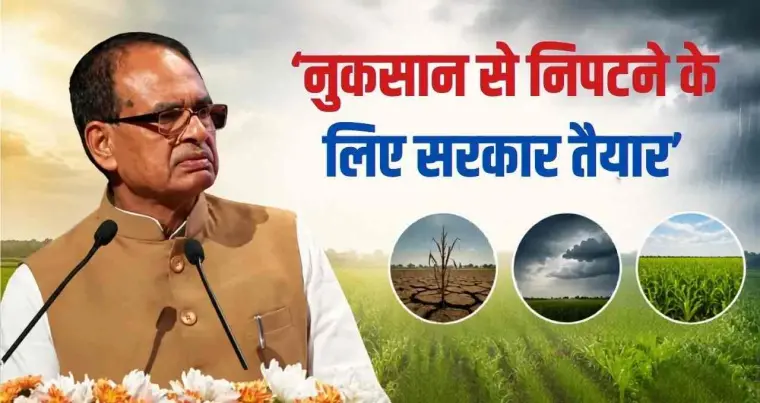

Concern regarding monsoon has increased in the country this year. India Meteorological Department (IMD) has estimated that there may be about 43% less rainfall than normal in the month of June, due to which there is a possibility of drought-like situation in many areas. Less rainfall can impact agriculture, water resources and the rural economy.
New Delhi: In view of the possible low monsoon rainfall and El Niño effect in India, the Central Government has started preparations on a large scale. According to the estimates of the Meteorological Department, there is a possibility of less rainfall than normal this year, which can have a serious impact on the agricultural sector. Keeping this in mind, the government has included 315 sensitive districts of the country in the monitoring list, out of which 111 districts have been identified as “high risk” areas.
Low rainfall and risk of drought
According to initial assessments by the India Meteorological Department (IMD), rainfall this monsoon season may be about 43 percent less than normal. If this estimate proves correct, drought-like conditions may arise in many states, especially in areas where irrigation facilities are limited. The El Nino effect causes changes in sea surface temperatures, which directly impacts global weather patterns and the Indian monsoon in particular.
Special monitoring on 315 districts
Considering the seriousness of the situation, the Central Government has placed 315 districts in the special monitoring list. Of these:
- 111 districts in high risk category (where irrigation facility is less than 25%)
- 76 districts in medium risk category (25% to 50% irrigation facility)
- 128 districts in relatively low risk areas (with better irrigation infrastructure)
The status of agricultural activities, sowing and water resources in these districts is being continuously monitored.
Special Mechanism for Monitoring and Emergency Arrangements
The government has created two major institutional mechanisms to deal with the situation—
- El Niño Monitoring Cell
- Crop Weather Watch Group
Their objective is to provide real-time monitoring of weather conditions, sowing patterns and water availability. The Agriculture Ministry has prepared District Agriculture Contingency Plans (DACP) for all the affected districts. These schemes include measures related to alternative crops, water conservation techniques, irrigation management and income security of farmers.
Most affected areas in the states
According to government data, the high-risk districts are mainly located in 12 states: Madhya Pradesh, Maharashtra, Gujarat, Uttar Pradesh, Rajasthan, Tamil Nadu, Karnataka, Bihar, Jharkhand, Telangana, Andhra Pradesh and Odisha. These states have large populations dependent on agriculture, so the economic impact could be more widespread in case of low rainfall.
Union Agriculture Minister Shivraj Singh Chouhan held a review meeting with agriculture ministers of states, senior officials and district collectors. The current situation, possible risks and preparations were discussed in detail in the meeting. He appealed to the states to intensify preparedness at the local level and implement District Emergency Plans (DACP) immediately and effectively.
“Turning Challenge into Opportunity” Approach
The Agriculture Minister said that there is no need for farmers to panic, rather this is the time for collective preparation and coordination. He stressed that if the Central and State Governments, scientific institutions, district administrations and farmers work together, the challenge of El Nino can be turned into an opportunity. According to him, water conservation, crop diversification, technical advice and social security schemes together can create a strong security blanket for farmers.

Comments are closed.