
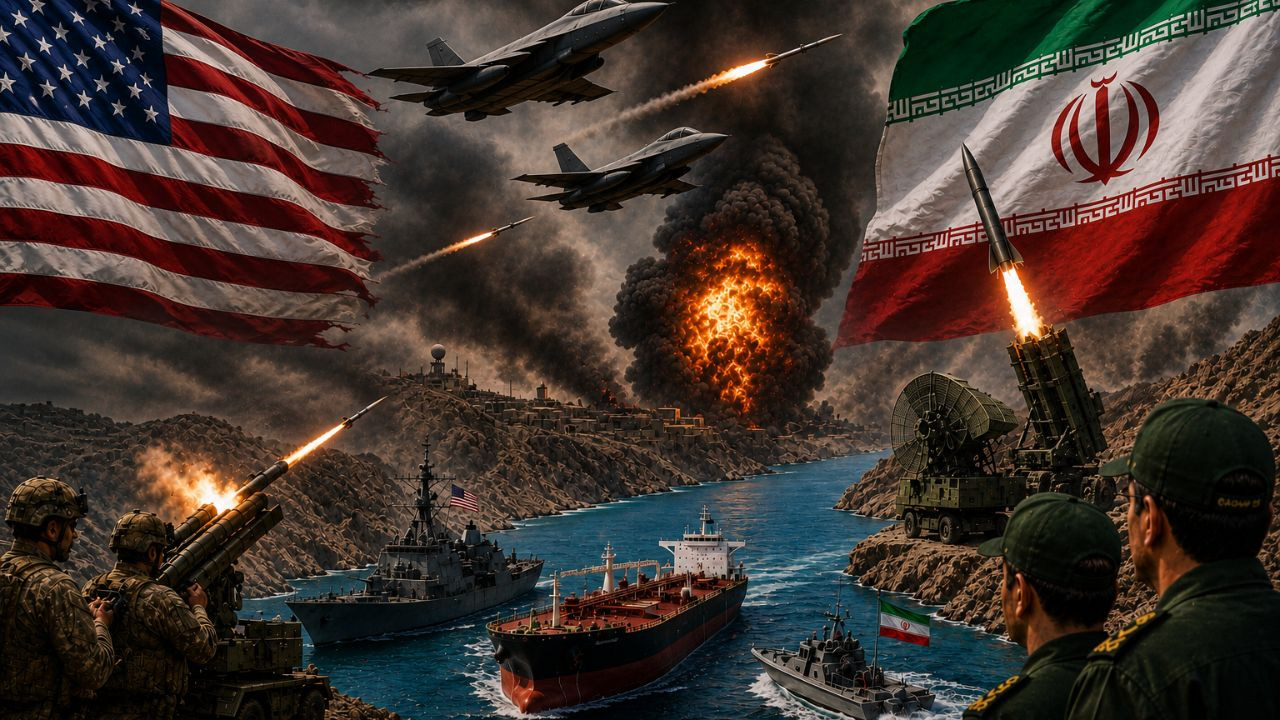
America-Iran dispute flared up again within a week of ceasefire, both countries opened front against each other

New Delhi: Now clouds of crisis are looming over the recently implemented interim ceasefire between America and Iran. The agreement which had given rise to hopes that the situation would become normal after nearly four months of conflict, has now become mired in controversy within a week. Both countries have accused each other of violating the terms of the ceasefire, due to which tension has once again increased across West Asia. This development has also increased the concern of the international community. The latest controversy began when a drone attack occurred on a commercial cargo ship passing through the Strait of Hormuz.
America directly held Iran responsible for this attack and called it a violation of the ceasefire agreement. After this, the US Army retaliated by carrying out air strikes on many military bases of Iran. According to the US Central Command (CENTCOM), missile and drone storage centers as well as coastal radar systems were targeted in this campaign. After the completion of the military action, the army also released a video related to the operation and said that this step was taken to ensure the safety of commercial ships.
What did America say?
Centcom says that the attack on the commercial ship by Iran was against the interim agreement. According to US officials, the retaliation was absolutely necessary and is aimed at preventing such attacks in the future. US Vice President JD Vance also supported the government’s decision. He said that America has followed all the conditions of the ceasefire and if any party had any complaint then it should have adopted the path of dialogue. He also made it clear that any kind of violent action will be responded to.
Iran rejects America’s allegations
On the other hand, Iran has described American allegations as completely baseless. Iranian officials say that the US attack targeted the area around the southern port of Sirik, while Iranian forces were only enforcing maritime rules. According to government media, after the alleged violation of navigation rules, a warning was given and then limited action was taken. Iran claims that this step was part of security arrangements and not an attempt to break the ceasefire.
Warned of retaliatory action
Iran’s Revolutionary Guards claimed that they responded by targeting US military bases in the area. The organization issued a statement saying that if America continues military action further, a more comprehensive response will be given. The Guards also say that Iran’s rights over the Strait of Hormuz were acknowledged in the ceasefire agreement. They allege that America is deliberately trying to weaken this system by increasing tension. Iranian MP Ebrahim Azizi also accused US President Donald Trump of not respecting the spirit of the agreement and said that recent incidents raise questions about America’s commitment.
Why is the Strait of Hormuz so important?
The entire dispute is also related to the Strait of Hormuz. It is counted among the most important maritime trade routes in the world, through which a large amount of global oil and natural gas passes. After the ceasefire, Iran had talked about monitoring and controlling this waterway, while America has been continuously saying that the movement of international ships here should continue without any restriction.
US Secretary of State Marco Rubio, after meeting with the leaders of Gulf countries, had said that the monopoly of any country on this sea route cannot be accepted. Iran responded by saying that its role in the governance of this region cannot be ignored.
Tension on one front, diplomatic initiatives on the other
While tensions are increasing between America and Iran, another important diplomatic initiative has also emerged in the region. A framework agreement has been agreed between Israel and Lebanon under US mediation, which aims to reduce the long-running conflict on the border. However, Iran-backed Hezbollah has rejected the proposal and warned that any attempt to implement it could lead to new conflicts in the region.

Comments are closed.