
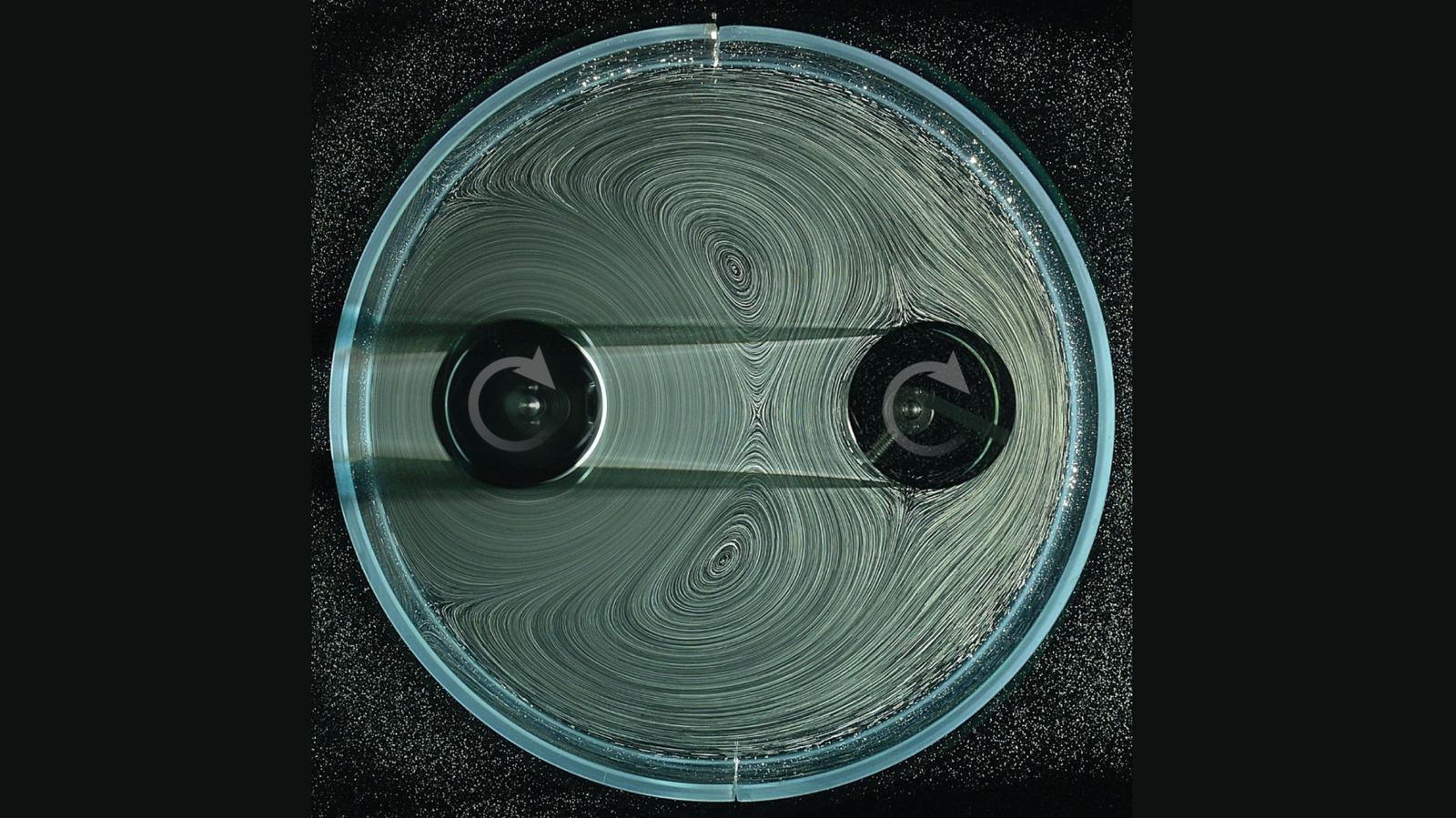

Teeth are pretty crucial for gears because they act as the primary contact point for the transfer of mechanical power. It’s almost impossible to imagine how gears would work without them, but a team at New York University not only dared to do that, they actually went ahead and built the contraption. Their take on a gear works just fine without a single tooth, using liquid instead for “contact.” It’s a big deal because regular gear teeth, regardless of how they’re built or what they’re made from, are stiff — so they can sometimes snap under pressure. They also have to line up perfectly, or the machine ends up seizing.
The team was led by Jun Zhang, who teaches math and physics at NYU and NYU Shanghai, and the work is published in the journal Physical Review Letters. The way they achieved this was by dropping two smooth cylinders, which they’ve referred to as rotors, into a ring-shaped tank. This container is filled with a blend of glycerol – a syrupy liquid — and water. Only one cylinder gets a motor, though, while the other just sits there, passive. As the cylinder spins, it drags the second along as well, without the two ever touching. The neat part is that the team could even dial in both the speed and the direction of that spin.
The inspiration behind the creation was actually turbines. They are spun by wind and water all day, and there’s even a power plant in Japan that turns seawater into electricity by using pressure to spin one, so it’s smart to think gears can work the same way.
How liquid acts as teeth
The team had to play around with plenty of configurations to reach the sweet spot, during which they also made some pretty cool findings. For one, they had to seed the fluid with tiny bubbles, which helped them track how they streaked around. They also messed around with the liquid’s viscosity (how thick and gluey it feels). After that, they mostly tuned two settings: The gap between the cylinders and how fast the driven one spun.
Here, they found that spacing plays a pretty big role. Place the gears too close together, and the swirling flow pinches into the gap. This ends up sending the passive rotor spinning the opposite way. Pull them apart, and the liquid ends up acting like a belt over a pulley, causing both cylinders to then start turning in the same direction. Interestingly, sometimes even altering the spinning speed could cause the flow pattern to flip over.
As for real-world use cases, Zhang’s team sees a fit in the cramped joints of humanoid robots, which plenty of companies are working on. In those with normal gearboxes where the teeth touch, a stray bit of sand or dust can wedge between them and lock the whole thing up. A fluid gear would leave a small gap between those parts, so the same debris simply drifts through the liquid and keeps moving without jamming anything. The potential downsides are energy loss in the fluid and, of course, the occasional leak. Another arguably more realistic application, according to Earth.comis soft robots, the squishy kind built to bend and grip gently.

Comments are closed.