
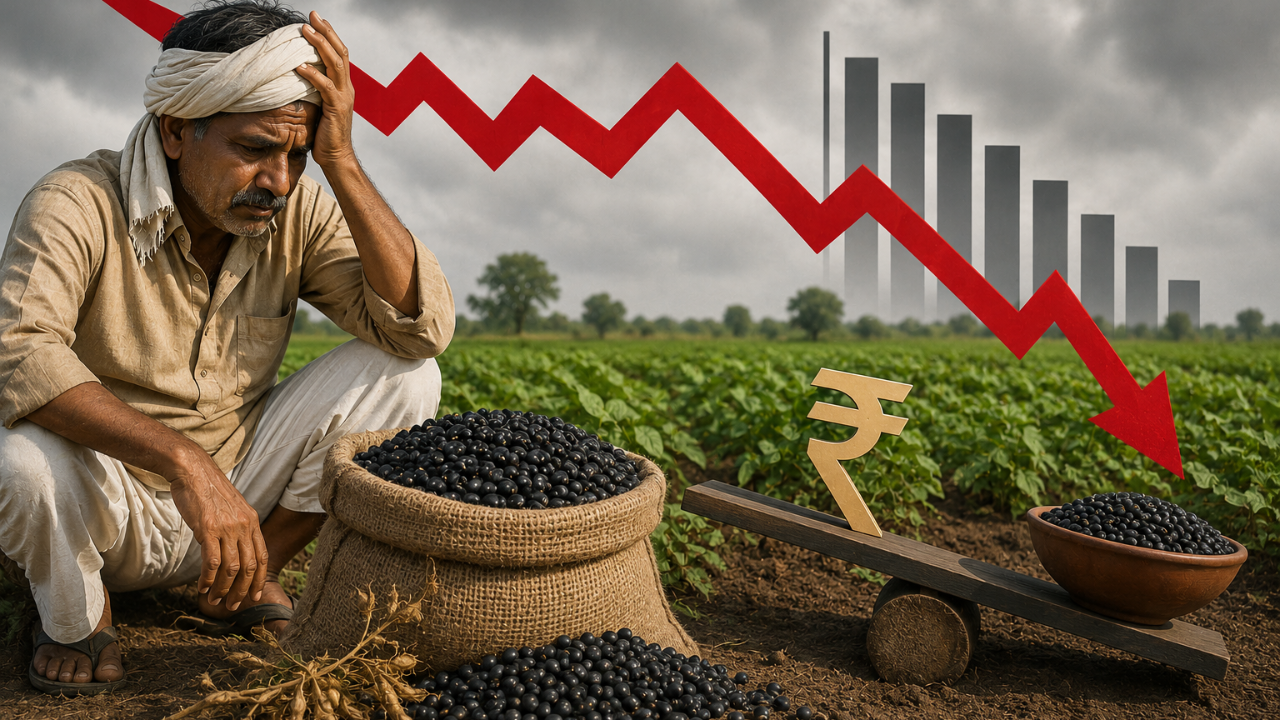
Urad Price: The common man’s pocket will get a big bang! Sowing reduced by 40% due to low rains, Udid will be expensive

- The country may have to import a record amount of urad, which could affect the availability and prices of pulses.
- However, to provide relief to farmers, the central government has approved government procurement of Udaipur at Minimum Support Price (MSP) in Uttar Pradesh, Gujarat, Tamil Nadu and Haryana.
- This has given hope to the farmers to get a good price for their produce
This year, there is a possibility of increased pressure on the production of Udid Dal in the country. For the fifth year in a row, ood cultivation is facing challenges during the kharif season. Delayed monsoons, delays in sowing and farmers switching to maize, soybeans and other more profitable crops have dashed hopes of increasing the area under UID cultivation. This may affect production and put pressure on market prices.
According to agricultural experts, if the current climate and of sowing If the situation does not improve, Udaipur production may fall short of demand this year. As a result, India may have to rely on more imports to meet domestic needs, raising fears that import dependency could reach record levels.
40% reduction in urad sowing
According to government data, till June 19, the area under urad was about 40% less than last year. According to experts, Udi dal cultivation is declining in many states due to weather uncertainty and farmers’ fear of reduced profits. This could impact both production and markets in the coming months.
Farmers stuck in Kharipa seed scheme due to lake closure; The demand for extension is now starting
Farmers were worried about the weather
According to experts, Udid is a crop that is easily affected by weather conditions. Unseasonal rain or prolonged drought can affect crop growth. Heavy rainfall during harvest can also damage the crop. There has been a steady increase in such weather events over the past few years, causing losses to farmers.
About 52% of the country’s agriculture is still rain-fed, while nearly a quarter of agricultural land lacks adequate irrigation. Consequently, the progress of monsoon is very important for kharif crops. The country had recorded about 42% below normal rainfall till June 26, which has slowed down sowing in many states.
Farmers tend to shift to soybeans and other crops
Madhya Pradesh, Maharashtra and Rajasthan are the major producing states of Udid crop in the country, accounting for almost half of the total production. However, many farmers in these states are now preferring to grow crops like soybeans, maize and coarse grains instead of pulses. Farmers believe that these crops are less vulnerable to weather and fetch better prices in the market.
According to experts, soybean may remain the most competitive crop for Uida this year as well. Government procurement and other schemes, particularly in Madhya Pradesh and Maharashtra, are creating more options for soybean farmers. Since both crops require almost the same amount of irrigation, many farmers may choose to plant soybeans instead of udara.
Satara News: ‘Kashmir’ blossomed in Satara! A successful apple orchard in Prasaran Ghat; Farmer Bapu Bhilare’s sting across the state
Fear of rising imports
According to several media reports, the production of udida in the country has declined steadily over the past few years. In the crop year 2021-22, production was estimated at 2.8 million tonnes, while in 2025-26 it declined to approximately 2.2 million tonnes. This decline in production is also affecting the market and the country has to increase its imports to meet its needs.
According to the data, India imported approximately 6.11 lakh tonnes of urad dal in the financial year 2022-23, which increased to an estimated 1.05 million tonnes in 2025-26. According to agricultural commodity market experts, the import of urad dal may touch 1.1 to 1.2 million tonnes in 2026-27. If the monsoon does not remain normal and sowing does not improve, the dependence on imports may increase further. This is likely to have an impact on the availability and prices of Udi Dal in the coming months. As a result, Udid Dal may become more expensive for consumers.
Udid dal will be procured at Minimum Support Price (MSP).
Just last week, the central government has taken a big step for the welfare of farmers. Under the Price Aadhaar Scheme (PSS), the government has sanctioned government procurement of green gram, udi dal and ground gram in Uttar Pradesh, Gujarat, Tamil Nadu and Haryana. This decision will help farmers to get Minimum Support Price (MSP) for their crops.
The aim of the government was to save farmers from being forced to sell their crops at low prices in the market and increase their income. With the start of government procurement, farmers’ hopes of getting a fair price for their produce have also risen.

Comments are closed.