
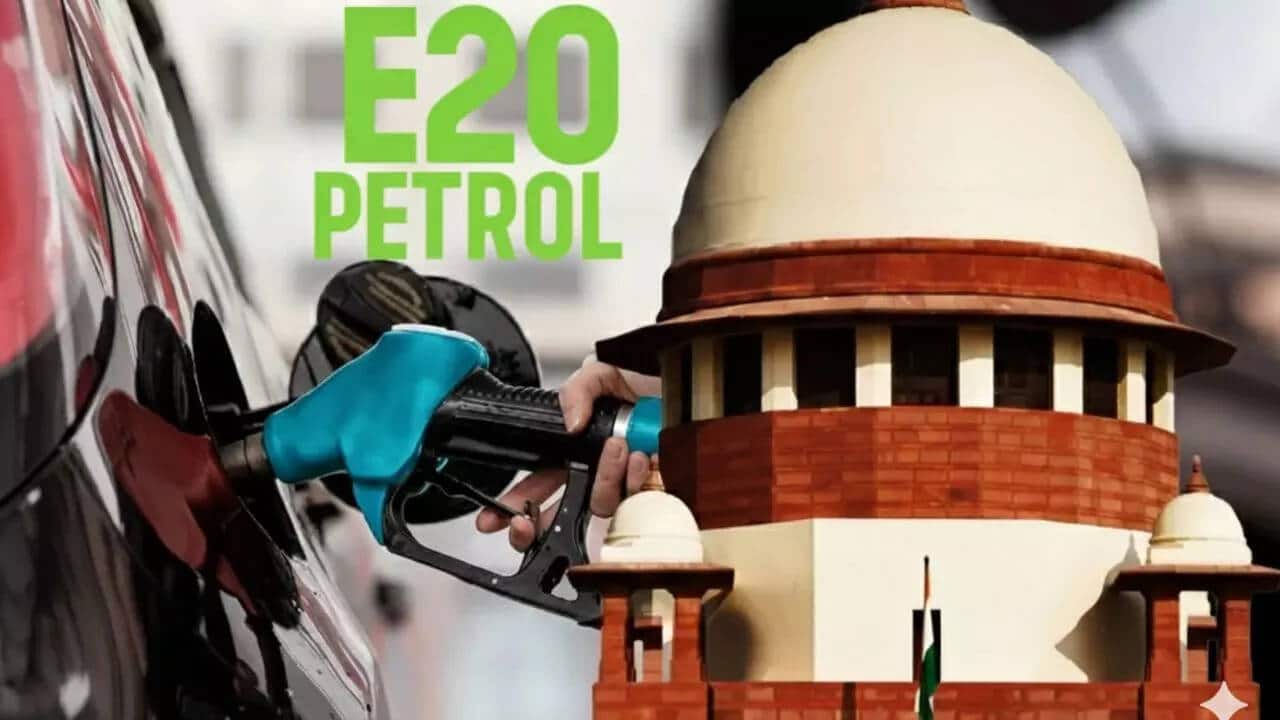
Supreme Court Orders Status Quo on Ethanol Allocation; Centre Says E20 Fuel Programme Is Still an ‘Experiment’

The Supreme Court on Tuesday ordered a status quo in a case related to ethanol supply allocation after Bharat Petroleum Corporation Limited (BPCL) challenged a Karnataka High Court order directing oil marketing companies to increase ethanol procurement for the 2025–26 supply year.
During the hearing, the Centre informed the apex court that India’s 20% ethanol blending programme (E20) is still being evaluated and that its full impact is expected to become clearer next year.
Centre Calls E20 Programme an Ongoing Experiment
Appearing for the Centre, Attorney General R. Venkataramani told the Supreme Court that the ethanol blending programme is effectively an ongoing experiment, with authorities expected to better assess its results after more data becomes available.
He said ethanol supply contracts for the current cycle were finalised in October 2025, with allocations made to 378 suppliers for approximately 1,050 crore litres of ethanol. As of June 18, 2026, nearly 680 crore litres had already been supplied.
Why BPCL Challenged the Karnataka High Court Order
BPCL argued that increasing ethanol allocation for one supplier, as directed by the Karnataka High Court, could disrupt the country’s uniform ethanol blending policy.
The company maintained that altering allocations after the process had been completed could affect the national implementation of the E20 programme.
A bench of Justices M.M. Sundresh and Sheel Nagu accepted the plea for interim relief and ordered both sides to maintain the existing position until further proceedings.
What Triggered the Legal Dispute?
The dispute began after an ethanol manufacturer approached the Karnataka High Court, claiming it received a much smaller allocation than its production capacity.
According to the company, its plant can produce 9.9 crore litres of ethanol annually but was allocated only 3.92 crore litres for the 2025–26 supply period.
The Karnataka High Court subsequently directed BPCL, Hindustan Petroleum Corporation Limited (HPCL) and Indian Oil Corporation Limited (IOCL) to consider increasing the allocation.
India’s E20 Fuel Programme
India introduced its ethanol blending programme to reduce dependence on imported crude oil, improve energy security and lower vehicle emissions.
Under the National Policy on Biofuels, the government gradually increased ethanol blending in petrol and has already achieved its target of 20% blending (E20).
Although the current policy does not officially approve blending beyond 20%, Union ministers Nitin Gadkari and Hardeep Singh Puri have previously suggested that higher ethanol blends, including up to 85%, could be explored in the future.
Debate Over Higher Ethanol Blending
The E20 programme has sparked debate among consumers and automobile owners.
Some experts and motorists have raised concerns about the impact of higher ethanol content on older vehicles and fuel efficiency. However, the government has consistently maintained that there is no conclusive evidence linking approved ethanol-blended petrol to mechanical damage in compatible vehicles.
The Supreme Court will continue hearing the matter as it examines whether changes to ethanol allocation could affect the implementation of India’s national biofuel policy.
Comments are closed.