

There seems to be no limit to horsepower these days. The latest Toyota Corolla will blow the doors off many of the performance cars of yesteryear, and that power just keeps increasing. With supercars and hypercars stretching well into quadruple-digit horsepower ratings, the trickle-down effect has sports cars priced for mere mortals delivering diving performance.
Modern traction control, braking, and safety systems make this power more usable than ever, but that doesn’t mean any person off the street should slide in behind 500 horsepower and think it’s all going to go swell. When the blip of the throttle can send you into the speed stratosphere, it’s wise for new or inexperienced drivers to master driving at a slow, steady pace. In the interest of spreading information (and diving into some cool and extremely powerful automobiles), we rounded up several sports cars that new drivers would do well to steer clear of.
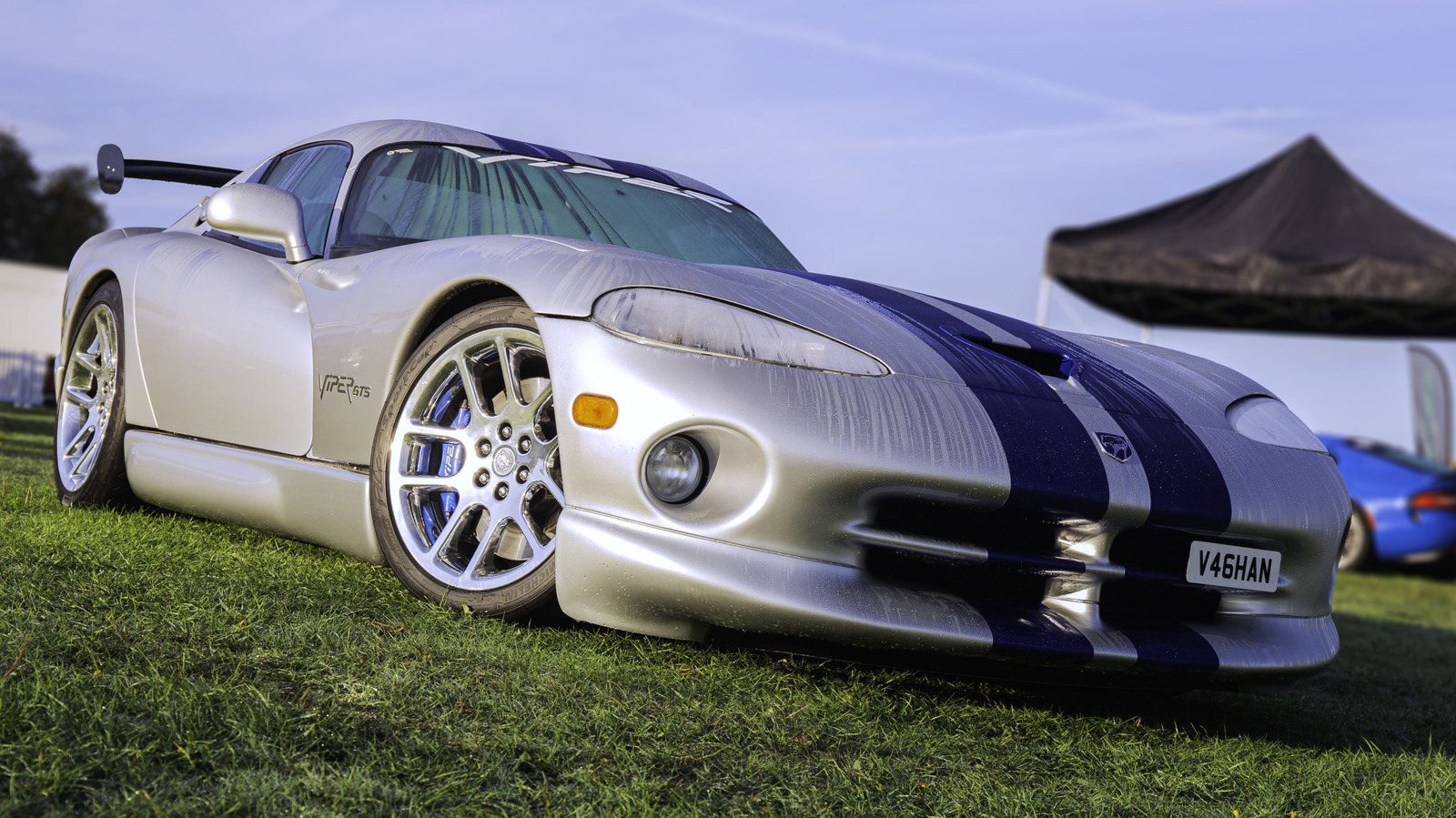
Dodge Viper RT/10
The first-generation Dodge Viper may be the rawest supercar to hit the market in the latter half of the 20th century. Developed for Dodge by none other than Carroll Shelby, the Viper was a new-age Shelby Cobra. Like the original Cobra, the Viper was almost entirely race-oriented. It famously lacked glass windows and exterior door handles. It was the opposite of the grocery-getter, an unrestrained V10-powered maniac that made at least 400 horsepower and 465 lb-ft of torque, all with a curb weight of about 3,400 pounds.
The power-to-weight ratio makes it a vehicle that drivers need to stay on top of at every moment if they hope to reach their destination. Adding injury to insult, Dodge left out modern systems that would have made it more tenable. It completely eschewed traction control, even though the tech was well established by its 1992 introduction. Oh, and the list of things missing from the Viper also included little tidbits like airbags and anti-lock brakes.
Despite coming out 30 years after the Cobra, it had little discernible tech differentiating it from the original track weapon. The Viper was a brutish engine and a pair of seats on wheels, and it did not suffer fools gladly. It’s a road-legal race car based on the Shelby ethos, not a candidate for your driving school fleet.
Chevrolet Camaro
There’s no question that Chevrolet paid attention to Ford’s success with the retro-inspired fifth-generation Mustang. When the Camaro returned in 2010 after a 12-year hiatus, it featured a vintage visage that harkened back to the beloved first gen. The fifth- and sixth-generation Camaros offered multiple engine configurations. Even the more benign V6 packs over 300 horsepower, but it’s the V8s where things truly get out of hand.
The 2010 6.2-liter L99 V8 made 400 horsepower and 410 lb-ft of torque. Those were supercar numbers in the early Viper days, which weren’t all that long before. Now they were mass-marketed to anyone with a fresh license and pockets deep enough to cover the insurance premium. By the time the Camaro sang its (most recent) siren song in 2024, horsepower ranged from 335 to a whopping 650! The latter figure came from the top-flight ZL1, but even the standard V8 made 455 horsepower.
The Camaro’s power is not the only reason new drivers ought to choose something else. Chevrolet incorporated thick A-pillars and low-profile windows to achieve its distinct lean-and-mean look. The resulting vehicle earned a reputation for being impossible to see out of. In 2021, Consumer Reports called the Camaro the “Worst Sporty Car For Visibility” (via GM Authority). Oodles of power plus a limited range of vision is a recipe for disaster for any driver, let alone new ones. No matter how cool the Camaro is.
Dodge Charger
There is a wealth of powerful Dodge Chargers to avoid if you’re a new driver. The nameplate has been in production since the dawn of the first muscle car era, when, in 1966, the first Charger rolled off the line with a selection of V8s ranging from 265 horsepower to 425 horsepower. A new driver wouldn’t want to get in one of those cars today just because wrecking one of these relics will cost a pretty penny. Rear-wheel drive and a ’60s-era suspension and brakes could make for some squirrely moments behind the wheel. The Charger was defanged during the Malaise Era, but came roaring back with a vengeance in 2005, when Dodge hopped on the muscle revival bandwagon.
The new breed of Charger was something of a wolf in sheep’s clothing. Buried in the handsome if somewhat sedate sedan was a sleeper’s secret. The 2005 edition came with available V8 packages making 340 to 370 horsepower, and things only got crazier from there. As the new Charger evolved, so did its power ratings, until a 2023 Charger came with a V8 that sported a minimum of 375 horsepower, and cracking into Hellcat territory was a whole different animal. The 2023 Charger SRT Hellcat made as much as 807 horsepower, which Car and Driver called “more horsepower than its tires can handle.”
The tricky thing about the Charger is that it didn’t change much cosmetically between 2005 and 2023. Though it’s unlikely you’ll accidentally purchase a Hellcat given the prices, an incurious parent might not notice that their young driver’s new whip isn’t the family-friendly sedan it appears to be.
Honda S2000
The S2000 burst onto the scene in 1999 and shortly thereafter became an icon thanks in part to its role as Suki’s flashy ride in 2003’s “2 Fast 2 Furious”. In production from 1999 to 2009, the sports car had enough room for a driver plus just a single passenger and between 240 and 250 horsepower under the hood, depending on year and trim. Earlier editions used a 2.0-liter engine, while later iterations received a 2.2-liter powerplant. Both used Honda’s VTEC technology, a high-revving setup that delivers power when the engine is screaming.
The S2000 might not deliver an eyebrow-raising amount of power (especially by modern sports-car standards), but it’s a handful for inexperienced drivers. Part of the reason is its lightweight, rear-wheel-drive architecture. It weighed in at under 3,000 pounds, and early models lacked niceties such as anti-lock brakes, stability control, and traction control. More than one driver discovered that putting max power down in a corner could cause the tires to break loose. And if you lifted the accelerator mid-corner, the S2000’s propensity for snap oversteer could send you off the road just as fast.
New drivers would do well not to mistake the S2000 for an Accord. It’s a genuine sports car that might hang out with a friendlier Mazda Miata before it gets bored and goes in search of new drivers to eat for lunch.
Porsche Carrera GT
If you’re planning to give an ultra-rare, multimillion-dollar supercar as a Sweet Sixteen gift, we beseech you to reconsider. The refined yet raw Carrera GT is the closest you can get to a street-legal race car this side of the Aston Martin Valkyrie. It is infamous for being difficult to handle, prompting drivers to declare it one of the most dangerous supercars out there.
It’s a truism that the closer a car gets to the race track, the further away inexperienced drivers should stay, and the Carrera GT is a perfect illustration of that. Derived from Porsche’s LMP 2000 prototype – a never-built Le Mans race car. It featured a V10 engine packing 610 horsepower. At a hair over 3,000 pounds, it sprinted to 60 mph in 3.7 seconds, and 100 mph in 6.8 seconds on its way to a top speed of 205 mph.
Aside from the intense power, the Carrera is considered an analog sports car — there are no driver aids or traction control to bail out unwary drivers. Hagerty reported Porsche test driver Jörg Bergmeister saying, “The car wasn’t so easy to drive, so it was restricted to just a limited amount of persons that were allowed to drive it.” If you’re hearing that from a person who professionally pushes Porsches to their limits, that car is probably not for the beginner.
“Fast & Furious” star Paul Walker was killed in a 2005 Carrera GT driven by his friend, Roger Rodas, in 2013. Though the contributing causes of that accident were found to be irresponsible speed and old tires, it didn’t stop Porsche from settling a wrongful death lawsuit brought by Walker’s daughter. The unfortunate incident only added to the Carrera GT’s reputation as a dangerous and difficult car to drive.
Jaguar F-Type
The Jaguar F-Type is a surprise on our list of two-seater sports cars you can get for under $30,000. Despite the legendary name, these sports cars have dropped in value to the point where a new driver might consider snagging one for the thrill. Produced between 2014 and 2024, there are plenty of used models out there, but the performance-oriented F-Type R packs a powerful punch.
The 2022 model year, for example, delivers 575 horsepower and 516 lb-ft of torque from its supercharged 5.0-liter V8. With a zero-to-60 mph time of around 3.5 seconds and a (limited) top speed of 186, it’s more than enough to get a new driver in trouble. That’s plenty of power for anyone to handle, but Jag mitigates some of it with an all-wheel-drive system that puts power to the ground with all four wheels. Note that prior to 2015, the Type R was purely rear-wheel drive and lacked the advantage of all-wheel drive.
Nonetheless, the F-Type R is designed for cornering, but primarily for people who already know how to do it. Motor Trend lamented the tendency of all V8 F-Types (not just the Type R) to struggle to put power down properly. The resulting “Slip’n Slide” traction, paired with gobs of power, is best handled with kid gloves and a steady, mature approach.
Mitsubishi Lancer X
Rally is one of the wildest motorsports, and the Lancer X was the ultimate in a line of legendary road-legal rally cars. Young new drivers won’t even remember the Lancer, as the final Evolution rolled off the assembly line a decade ago. Yet rally fans will recall its stellar all-wheel-drive performance in the World Rally Championship.
Built between 1992 and 2016, the Lancer was constantly updated, resulting in 10 generations, each upgraded to dominate the toughest tracks in the world. In its final form, the Lancer Evolution X made 295 horsepower and 270 lb-ft of torque with its turbo 2.0-liter. Not an eye-popping amount, but considering its nimble handling and aggressive suspension, the temptation for a new driver –- especially a young one -– to put all that power down at once could be irresistible. One of the tricks of the Lancer is that it is relatively benign-looking. That compact sedan is not the economy commuter it appears to be; it has the DNA of one of the great rally champions of all time coursing through its veins. Heck, if you don’t believe us, consider Car and Driver’s opinion: “The Mitsubishi Evo is not a car -– it’s a weapon.”
BMW M3
The BMW 3-Series is a wonderful entry to the Beemer world. In production since the 1970s, it has endured many iterations, evolving into today’s tech-forward driving machine. The long production history offers new drivers many used models to choose from. Most will find it a capable, fun, and manageable drive. The performance version, the M3, however, doesn’t quite fit the bill for the new driver.
Despite its status as a sedan, there is little doubt the M3 is pure sports car. Up-muscled by BMW’s performance M-division, the most recent M3s bring everything the vaunted builder has to bear. The 2026 M3, for example, makes 473 horsepower with a 3.0-liter twin-turbo inline six-cylinder. The top trim M3 Competition bumps that up to 503 horsepower –- good enough for a 3-second zero-to-60-mph time. That’s Ferrari F12 territory.
If the power doesn’t get you in trouble, the handling might. The M3 is noted for its razor-sharp ability to take a corner. And we all know how dangerous it is to play with razors.
Lexus LC500
The majority of cars on this list are unsuitable for new drivers because of their raw, visceral driving experience, but the LC500 is an outlier. As a premier offering by Toyota’s luxury lineup, it offers plenty of power, interior luxury, and rear-wheel drive –- a potentially problematic combination for the inexperienced driver.
With a refined 5.0-liter that sends 471 horsepower and 398 lb-ft to the rear wheels, this grand tourer might not feel as fast as it is from the lux interior –- and therein lies the problem. The LC500 is as far from the Dodge Viper as a fellow sports car can get. With Toyota’s Active Noise Canceling, an engineered exhaust note, and reduced cabin noise, it’s easy to forget that you’re driving too fast.
Lexus rightfully boasts of its impressive audio engineering and focus on driver experience, but the last thing a new driver needs in a fast car is a sense of security and confidence. Drive defensively, people!
Chevrolet Corvette
The Chevrolet Corvette is seldom tossed around without the words “value” and “budget”, which is a real shame. The most iconic American sports car of the past 70 years is often thought of as an affordable alternative to a supercar, but that’s only because it is such a superb sports car in its own right.
The last Corvette to have anything less than an eight-cylinder engine was the first one. The 1955 debut model had an inline six-cylinder known as the Blue Flame under the hood. Every model since has been a powerful rear-wheel drive sports car that shone in the muscle era and continues to do so today.
While some of the cars on this list are unrealistic for new drivers to even purchase, let alone drive on the street, the Corvette remains delightfully (and perhaps dangerously) accessible. Take your pick. An enterprising high school student could fish someone’s junked third-generation ‘Vette out of the backyard and turn it into a fire-breathing drag strip monster with a few Sundays’ worth of wrenching. Even the sometimes maligned fourth-generation Malaise Era ‘Vettes are guaranteed a 5.7-liter V8 power plant. Don’t get us wrong; we love the Corvette in all its forms. But it’s not the one to hop into the day after you pass your driving test.

Comments are closed.