
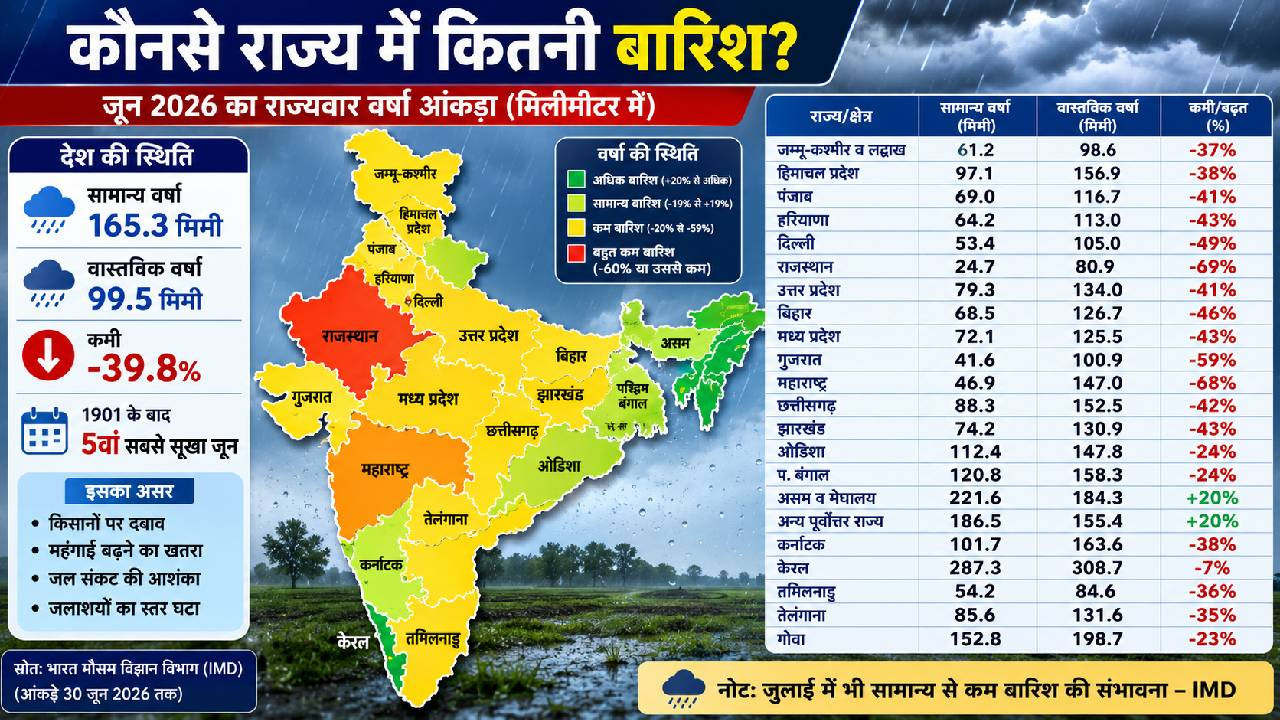
Explainer: Clouds stuck in the sky, country’s concern increased! Will the situation change in July or will the crisis deepen?

India Weath: The month of June passed, but in many states the clouds did not rain as expected. Meteorological Department figures show that this time June was much drier than normal. This is not just weather news. It is directly related to agriculture, market and the pocket of the common man. A large population of India is still dependent on monsoon. If water does not reach the fields, the crop will be affected. If the crop is less then the arrival in the markets will decrease. And its impact will eventually reach the kitchen of every home.
This is the reason why every percentage of rain in June can change the economic picture of the entire year. Experts believe that if the initial monsoon remains weak then the entire strategy of Kharif season gets affected. Its impact is not limited to villages only. Its effect is also visible on the inflation of cities and the cost of industries. Therefore, this year’s drought in June is not an ordinary seasonal phenomenon, but has become a matter of national concern.
After all, why is there so little rain?
The biggest question is why the monsoon became weak. Meteorologists are considering El Nino as an important reason for this. The rising temperature of the Pacific Ocean affects the weather around the world. India’s monsoon also does not remain untouched by this. This time many weather systems formed from the Arabian Sea and Bay of Bengal also did not become active as expected. The result was that many areas recorded much less rainfall than normal. That is, many reasons together slowed down the pace of monsoon. Climate change is also continuously changing the weather patterns.
Where earlier it used to rain for several days, now we see heavy rains in a short period of time and then a period of long drought. This unequal distribution is becoming the biggest challenge. Meteorologists say that such fluctuations may increase further in future. Therefore, monsoon forecasting has become more complex than ever before.
Why did farmers’ concern increase?
Now the biggest concern is of the farmers. The time for sowing of Kharif crops like paddy is fast passing. Farms in many states are still waiting for adequate water. If there is no good rain in early July, farmers will have to irrigate with diesel pumps. This will increase the cost of farming. If costs increase, production will become expensive. This is the reason why every delay in monsoon directly affects the economy of the village and its effect is gradually visible in the entire country.
The biggest challenge faced by small farmers is additional expenses. For those who have limited resources, every day’s delay increases the loss. If sowing is not done on time, production may also decrease. This will affect the income of farmers. This is the reason why in the villages at this time most of the eyes are fixed on the sky.
How much will the concern about inflation increase?
The effect of less rain is not limited to fields only. When production is affected, the first pressure on the prices of vegetables and pulses increases. After this, the cost of fodder and edible oil may also increase. Its effect is also visible on milk and other everyday items. That means lack of rain gradually affects the budget of the common family. This is the reason that now not only farmers, traders and consumers are also keeping an equal eye on every weather report.
If production decreases, the government may also have to take additional steps to keep the food supply balanced. Many times we have to resort to imports. This increases government expenditure. That is, the effect of weak monsoon is not limited to the market only, but is visible on the entire economy.
How deep can the water crisis become?
If the monsoon remains weak, the pressure on the reservoirs will also increase. Many big dams and reservoirs of the country depend on rain water. If sufficient water does not reach them, the availability of drinking water may be affected. There is already a shortage of water in many cities. At the same time, the production of hydropower projects may also be affected. This means that less rainfall is not only a crisis for agriculture but can also become a challenge for both water and electricity. This is the reason why every update of monsoon becomes a matter of national concern.
If the level of reservoirs remains below normal, there may be a situation like restriction on water use in the coming months. Dependence on groundwater will increase. This will also affect future water security. Experts are constantly advising to make water conservation the biggest priority.
Will July bring relief?
Now the hope is from July. The Meteorological Department estimates that rainfall activities may increase in many parts. But experts believe that just a few days of good rain cannot compensate for the entire loss. If the distribution of rain remains uneven, there will be pressure on agriculture. It is not easy to prevent crop loss after the time of sowing has passed. Therefore, the eyes of the country are now fixed on every weather bulletin.
Every cloud brings a message of hope for crores of farmers and crores of families. If July remains normal then the situation can be controlled to a great extent. But if the rains remain weak again, the pressure on agricultural production will increase. Along with this, concerns about food prices and water resources will also deepen. This is the reason why the coming few weeks are considered very important.
Will you understand the changing climate?
This is not the story of just one year. The weather patterns have changed rapidly in the last few years. At some places there is record rainfall and at other places there is a situation of long drought. Climate change is no longer a subject of scientific debate but has become an everyday reality. Therefore, now just hoping for good rain will not be enough. Water will have to be managed better. Farming methods will have to change. Water conservation has to be given priority.
Because the biggest challenge in the coming years will be to adapt not only to the monsoon but also to the changing weather. Experts believe that preparations for the future will have to start from today. Water conservation, modern irrigation and weather based agricultural planning have no longer become an option but a necessity. Coordination with the changing climate will prove to be the country’s biggest strength in the times to come.

Comments are closed.