
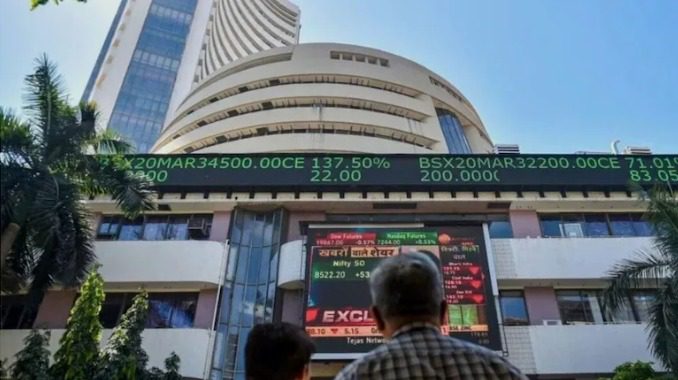
Now the stock market will be afraid of ‘Super El Nino’, not of crude oil! Weak monsoon increases investors’ worries

Now the biggest threat facing the Indian stock market is not the prices of crude oil, but the rainy season. Brent crude prices in the international market have fallen by about 40 percent from the 2026 high of $120 per barrel, but despite this, the Indian stock market did not see the expected rise.
Market experts believe that the biggest reason for this is the rapidly developing “Super El Nino” Which has made the onset of monsoon this year the weakest in the last decade. If rainfall remains below normal in the coming months, it may have a direct impact on the rural economy, domestic demand, agricultural production and stock market.
Market stuck in limited range for two years
Country’s main stock index Nifty-50 It has remained almost stable for the last two years. During this period investors have received very limited returns.
Market analysts say that earlier the biggest concern of investors was the rising prices of crude oil, but now the situation has changed. There has been relief from oil becoming cheaper, but the danger of weakening domestic demand has become much bigger.
Experts believe that if rural income is affected, consumer spending will decrease, the impact of which will be visible on FMCG, automobile, tractor, consumer goods and retail sectors.
Weak monsoon increased concern
According to Indian Meteorological Department (IMD) data By June 26, 2026, there will be 42 percent less rainfall in the country compared to the general average (LTA). Has been registered. This is considered to be the weakest start of monsoon in the last ten years.
around the country 72 percent share There has been less rainfall than normal.
The area wise situation is as follows –
- Central India – 57% less rain
- Eastern and North-Eastern India – 43% less
- South India – 30% less
- North and West India – 24% less
According to experts, this situation is more serious than El Nino years like 2019 and 2023.
IMD reduced monsoon forecast
Indian Meteorological Department has reduced the forecast of monsoon this year. 90 percent of long term average (LPA) Is done. Also, there is a possibility of less than normal rainfall. 60 percent It has been told.
If this estimate proves correct then Kharif crops may be seriously affected. Nearly half of India’s total food grain production comes from Kharif crops and about 46 percent of the country’s population is directly or indirectly dependent on agriculture.
In such a situation, weak monsoon will not be a problem limited to agriculture only, but can affect the entire economy.
Pressure will increase on rural economy
The rural economy remained a major force of Indian growth in the last two years. Better farm income, strong sales of tractors and rising consumption in rural areas had boosted the business of many companies.
But now the situation seems to be changing.
Experts say that the income of farmers may be affected due to weak monsoon as well as rising prices of fertilizers and expensive loans. If this happens, consumer spending in rural areas will decrease and this will have a direct impact on the sales of companies.
Recent surveys by the Reserve Bank of India (RBI) are also indicating that consumer confidence is weakening in both urban and rural areas.
Biggest impact on FMCG companies
Brokerage houses have already started adopting a cautious approach towards consumer-oriented sectors.
Experts say that if rural demand decreases then the greatest pressure will be FMCG companies But it will happen. Apart from this, weakness may also be seen in shares of companies manufacturing tractors, agricultural equipment, two-wheelers and consumer products.
Some brokerage companies have also advised to reduce their investment stake in the consumer sector.
Financial pressure may also increase on the government
Weak monsoon can affect not only the market but also the financial condition of the government.
If drought like situation arises in many states then the Central and State Governments should-
- More money will have to be spent on schemes like MNREGA.
- Farmers may have to be given a relief package.
- The burden of food grain distribution and subsidy may increase.
Due to this, there is also a possibility of increase in fiscal pressure.
The role of foreign investors is also important
Market experts say that a new rise in the Indian stock market will be possible only when the selling by foreign portfolio investors (FPIs) is less.
The share of foreign investors is especially high in the banking and IT sectors. If global investors increase investment in the Indian market again, the market may get support.
However, at present the eyes of investors are fixed on the progress of monsoon and the condition of El Nino.
Is the Indian economy in complete crisis?
However, not all experts are presenting a very disappointing picture.
Some rating agencies believe that India is in a better position than before because—
- Irrigation facilities have expanded.
- Adequate water is available in the reservoirs.
- Government buffer stock of wheat and rice is strong.
- The rural economy is no longer dependent only on agriculture.
- The contribution of sectors like animal husbandry and fisheries is continuously increasing.
Apart from this, weather experts estimate that the full effect of “Super El Nino” may be seen in the last months of the year, due to which its impact on the main monsoon season may be limited to some extent.
What signals for investors?
Market experts believe that at present the direction of the Indian stock market will largely depend on the monsoon. The benefit from the fall in crude oil prices has almost been absorbed in the market. Now, if the monsoon remains normal, the market may get new energy, but a major shortfall in rains may put a halt to the stock market’s rise by increasing pressure on domestic demand and corporate profits.
The coming few weeks are going to be very important for investors, companies and policy makers, because this time the eyes of the market are not fixed on oil prices but on the rain falling from the sky.

Comments are closed.