
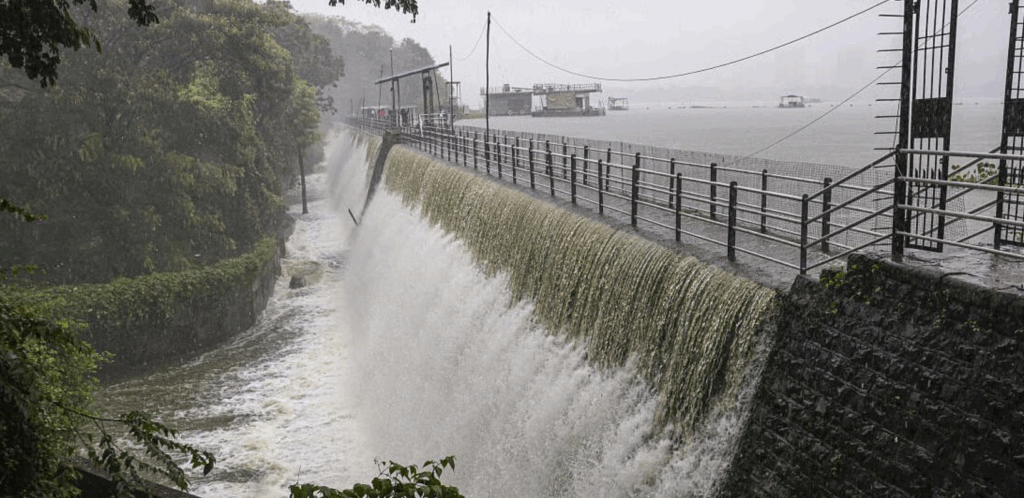

Mumbai received a boost from the monsoon this week as Powai Lake started overflowing after heavy rainfall in its catchment area. While the development is being viewed as a positive sign for the city, authorities have cautioned that water levels in the seven reservoirs that supply drinking water to Mumbai remain significantly below comfortable levels.
The contrasting situation highlights the challenges posed by a delayed monsoon season and the continuing need for water conservation across the financial capital.
Powai Lake Reaches Full Capacity
The Brihanmumbai Municipal Corporation (BMC) announced that Powai Lake began overflowing early on July 1 following sustained rainfall. With a storage capacity of around 545 crore litres, the lake has reached its maximum holding level, causing excess water to flow into the Mithi River before eventually reaching the Arabian Sea.
However, Powai Lake does not play a major role in Mumbai’s drinking water supply. Its water is primarily used for industrial and non-potable purposes, limiting its direct impact on the city’s drinking water reserves.
Drinking Water Reservoirs Still Running Low
Despite the encouraging overflow at Powai Lake, the seven reservoirs that provide drinking water to Mumbai continue to face low storage levels. Earlier in June, water stock in these reservoirs had fallen to around 10% of total capacity, prompting the BMC to implement water-saving measures and consider additional supply restrictions.
Recent rainfall has improved the situation slightly, with authorities reporting rising water levels across several key reservoirs. However, overall storage remains well below the levels typically required to ensure uninterrupted supply throughout the year.
Delayed Monsoon Behind the Water Stress
Officials attribute the low reservoir levels largely to the delayed onset of the southwest monsoon. Powai Lake had overflowed much earlier during previous monsoon seasons, but this year’s delayed rains postponed replenishment across the region.
The late arrival of significant rainfall forced authorities to tighten water conservation measures for industries, commercial establishments and construction activities in order to preserve existing reserves.
Hope for Further Improvement
Meteorologists expect continued monsoon activity over Maharashtra in the coming weeks, which could help replenish the city’s major reservoirs. Authorities remain optimistic that sustained rainfall will gradually restore water stocks and reduce the risk of prolonged supply restrictions.
For now, Mumbai’s water situation presents a mixed picture. While the overflow of Powai Lake is an encouraging sign of monsoon progress, the city’s primary drinking water sources still require substantial rainfall before the threat of shortages can be fully eliminated.
Summary
Powai Lake has started overflowing after recent monsoon rains, offering a positive sign for Mumbai. However, the seven reservoirs that supply drinking water to the city continue to hold relatively low water stocks despite recent improvements. Officials say the delayed monsoon has strained water reserves, and sustained rainfall in the coming weeks will be crucial for restoring reservoir levels and easing concerns over water shortages.
Image Source
Comments are closed.