
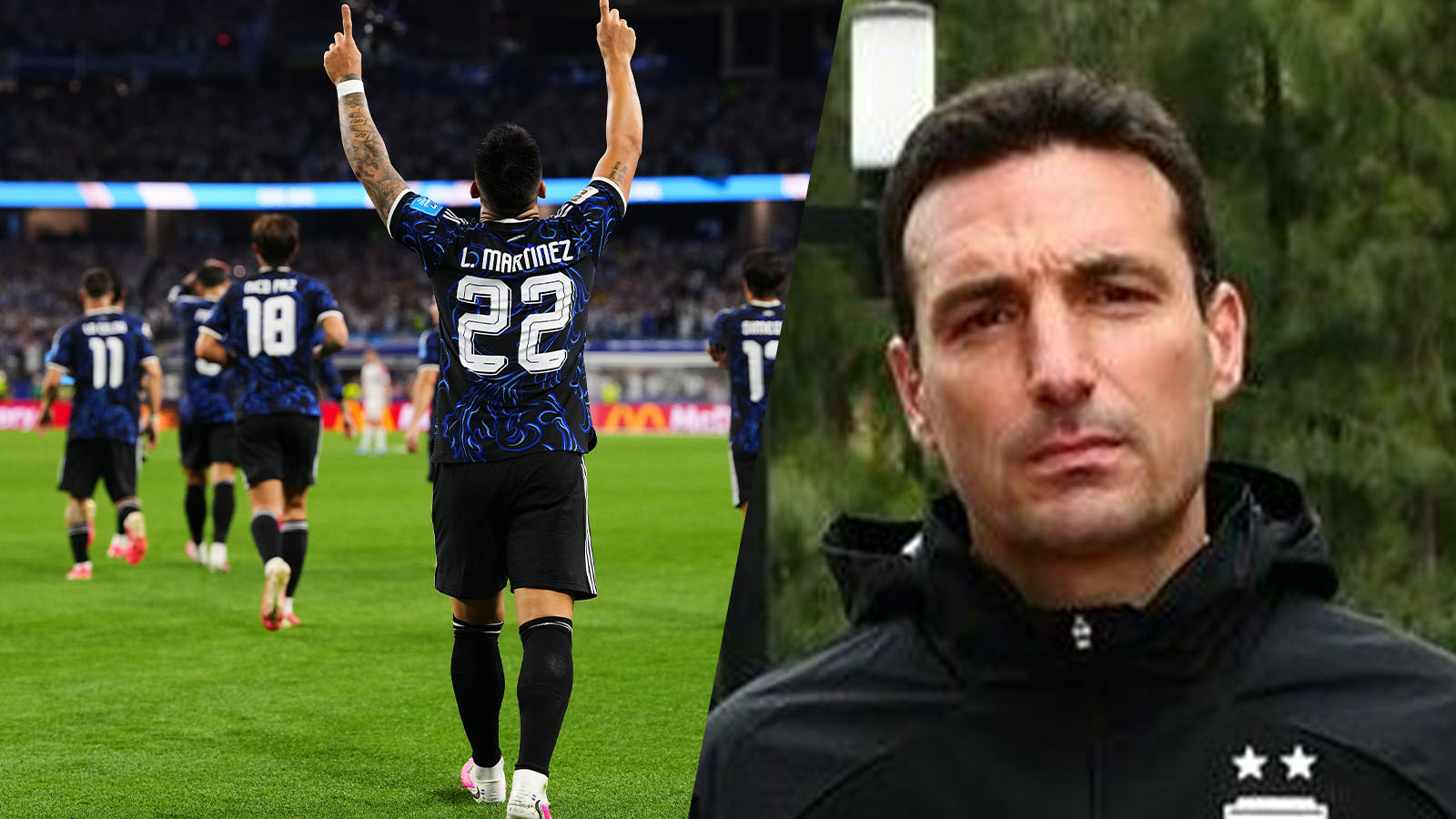

When Argentina take on Cape Verde in their Round of 32 clash in Miami on Friday (July 3), Messi will not be the only Lionel that eyes will chase. The match will also mark the 100th for Lionel Sebastian Scaloni as the head coach of the Albiceleste. The feat is rare, given the expectations and pressure that modern football brings.
Also read: Croatia vs Portugal: What happened in those final, chaotic minutes?
As a playing member of the Argentina national team, the 48-year-old Scaloni’s achievements are limited. He has represented his country only seven times between 2003 and 2006 and never scored a goal for it. His name appeared on the scoresheet just once, thanks to an assist against Libya in a friendly in 2003.
About Lionel Scaloni: Argentina head coach
♦ Age 48 years
♦ Played 7 matches for Argentina, didn’t score any goal.
♦ Appeared in one game for Argentina in 2006 World Cup in Germany
♦ Took over as manager of national team after 2018 World Cup as caretaker
♦ Led Argentina to win major trophies, including two Copa America titles in 2021 and 2024 and the FIFA World Cup in 2022
♦ Have completed 99 matches as coach in which Argentina won 72, drew 18 and lost 9
♦ Is the country’s second longest-serving manager after the legendary Guillermo Stabile who stood for 124 games
Scaloni was part of the Argentina squad at the 2026 FIFA World Cup but appeared on the turf only in the Round of 16 match against Mexico in Leipzig, Germany. He played all 120 minutes in the game that went into extra time as Argentina defeated their opponents 2-1.
As a player, Scaloni was dependable rather than spectacular, a disciplined defender who rarely commanded headlines.
Scaloni as a coach, a different story altogether
But as a coach, the man has upended the script. Initially seen as a stopgap after the Latin Americans’ debacle in the 2018 World Cup in Russia, he has emerged as the architect of one of the most glorious periods of Argentina’s football history.
Scaloni’s record as the national team coach already places him among the country’s greatest managers. The 100-game milestone cements his place as the second longest-serving manager in Argentina’s history by the number of matches, trailing only Guillermo Stabile, who was in charge in 124 matches between 1941 and 1961.
Some of the prominent names that Scaloni has already overtaken as Argentina coach are Cesar Luis Menotti (79 matches), Carlos Bilardo (79), Alfio Basile (76) and Marcelo Bielsa (69).
Also read: World Cup 2026: Why England is wary of the altitude factor before Mexico game
In 99 matches in charge so far, Scaloni has guided Argentina to 72 victories, with 18 draws and only nine defeats. While the numbers are impressive in themselves, they become even more remarkable when viewed alongside the trophies won during that period.
One trophy after another
Under Scaloni, Argentina ended a 28-year wait for a major title by winning the Copa América in 2021, lifted the Finalissima against European champions Italy in 2022, conquered the FIFA World Cup the same year, and added another Copa América crown in 2024 before arriving at the 2026 World Cup as defending champions and one of the favourites to retain their title.
Few coaches in Argentine football history have built such a remarkable record in such a brief time.
The first three matches of this World Cup have only reinforced that belief. Scaloni has approached each opponent differently, altering formations, pressing patterns and midfield combinations without compromising the team’s identity, keeping Messi at the helm.
At 39, the latter is no longer expected to dominate every phase of the game. Instead, he remains the fulcrum around which everything else revolves. The team now understands how to maximise his genius while carrying much of the physical burden themselves. Messi’s good form has made the team’s task easier.
That may be Scaloni’s greatest achievement. When he inherited Argentina after the 2018 World Cup, the national team looked directionless. His predecessor Jorge Sampaoli’s brief tenure had ended in confusion; the dressing room appeared fractured, and Messi seemed weighed down by the expectations of an entire football nation. Few believed the relatively inexperienced Scaloni could rebuild the side.
Scaloni never believed in one-size-fits-all
Instead of imposing a rigid philosophy, he built trust. Alongside former players Pablo Aimar, Roberto Ayala and Walter Samuel, Scaloni formed a coaching group that prepared meticulously for every opponent while giving complete confidence to the players. Argentina no longer chased an ideology. They searched for the best solution to every match.
Also read: Messi bags 6th in World Cup 2026 albeit late start vs Jordan
That flexibility became the defining feature of ‘La Scaloneta’, as the team is affectionately called under Scaloni. The coach was never married to a single formation. Argentina could play with a back four, switch to a back five, overload the midfield or attack through wide forwards. The system changed according to the opponent, but the team’s belief never did.
Argentina bounced back from Saudi shocker to win title in 2022
The defining moment of that philosophy came in Qatar four years ago. The 1-2 defeat against Saudi Arabia in the opening game shocked the football world. Argentina arrived unbeaten in 36 matches and suddenly looked vulnerable. The Asian side’s disciplined offside trap and aggressive high line exposed weaknesses Argentina had failed to anticipate.
Many teams would have panicked, but Scaloni’s team adapted.
From that point onward, every knockout match reflected better preparation and greater tactical clarity. The Netherlands presented perhaps the toughest challenge in the quarterfinals. Against Louis van Gaal’s physical side, Argentina changed shape again. Even after surrendering a two-goal lead, they never lost their composure. Emiliano Martínez became the hero in the penalty shootout, but the performance also highlighted Scaloni’s willingness to adjust instead of retreat.
Also read: Liberals for Messi, conservatives for Ronaldo? Political views might decide loyalty, says study
The semi-final against Croatia revealed another side of his coaching.
The European team expected Argentina to dominate possession. Instead, Scaloni invited pressure and attacked with devastating speed. Messi later admitted that Argentina had deliberately allowed Croatia more of the ball. Every transition looked rehearsed. Julian Álvarez’s two goals were the reward for careful planning rather than improvisation. Argentina won 3-0.
Then came the final.
Scaloni’s decision to restore Angel Di María to the starting line-up and deploy him on the left caught France completely off guard. Argentina’s second goal remains one of the finest in World Cup history. A sequence of effortless one-touch passes, Alexis Mac Allister’s perfectly timed run, Di María’s sublime finish and Messi’s delicate involvement combined to produce a goal that blended tactical precision with the traditional beauty of Argentina’s football.
Scaloni understood something many coaches before him had struggled to accept.
Messi did not need to do everything. He only needed to do what nobody else could.
Argentina never a one-man army
Football writer Jonathan Wilson famously described Messi during the Qatar World Cup as a ghost, drifting unnoticed around the edges of the game before suddenly appearing where nobody expected him. That freedom was carefully designed.
Around Messi, Rodrigo De Paul became the tireless runner, Enzo Fernández controlled the rhythm, Mac Allister connected midfield and attack, while Álvarez constantly stretched opposing defences. Every role existed to free Messi without making Argentina dependent on him.
Also read: World Cup Golden Boot race hots up as Mbappe tops Messi; Harry Kane joins Haaland
That remains true in 2026.
Players like Thiago Almada, Nico Paz and Giuliano Simeone have not been asked to replace Messi. They have been taught how to play alongside him, learn from him and eventually succeed him. Scaloni has quietly prepared Argentina for the day their greatest player finally steps aside.
Every great Argentinian era has had its defining figure. Menotti had Kempes. Bilardo had Maradona. Scaloni had Messi. Unlike those before him, however, Scaloni also built a system capable of outliving its greatest player.
His greatest triumph lies beyond medals and trophies. He has given Argentina more than any other generation of champions. He has given them an enduring football identity. Its name is ‘La Scaloneta’.

Comments are closed.