
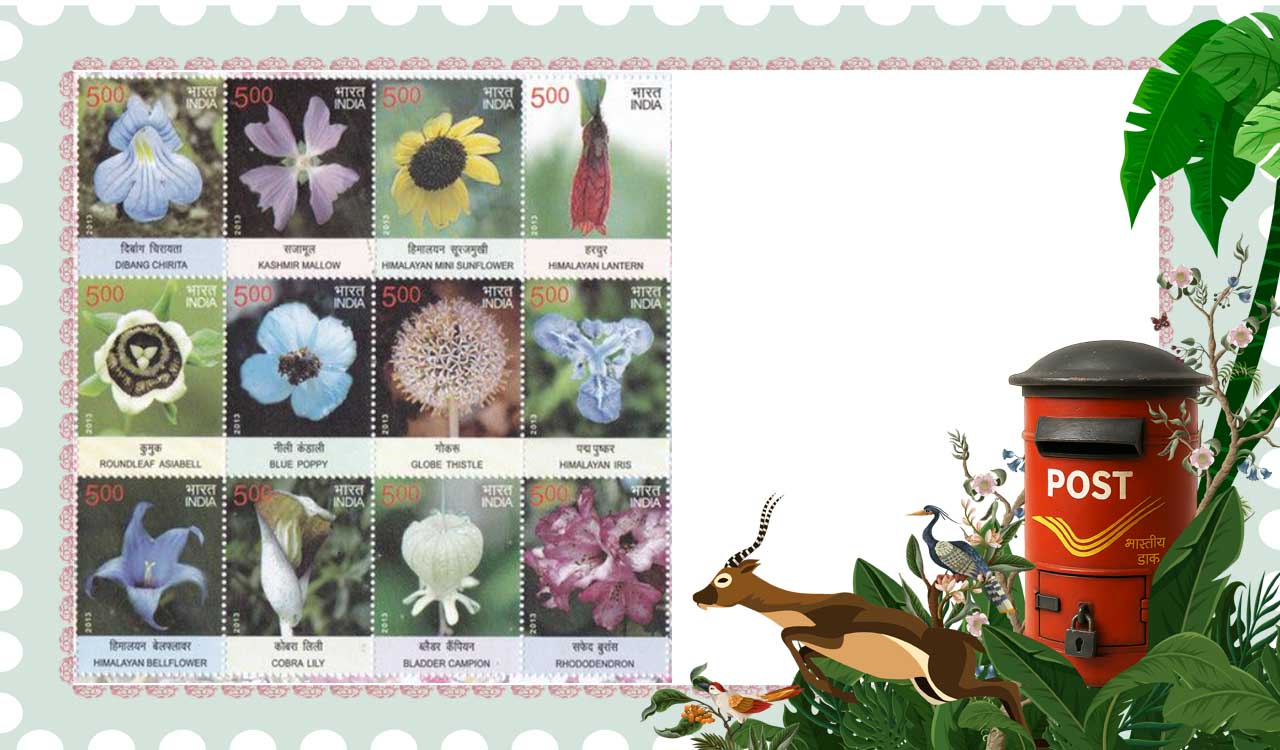

Long before social media campaigns and environmental documentaries, India’s postage stamps carried messages of conservation, biodiversity and sustainable living across the world
Published Date – 5 July 2026, 12:05 AM
Illustration: GuruG
By N Shiva Kumar
Since Independence, Indian postal stamps have quietly blossomed into miniature ambassadors of nature, carrying the splendour of India’s flora and fauna across villages, cities and continents. Tiny in size yet immense in influence, these colourful stamps transformed envelopes into travelling galleries of the wild, introducing generations to majestic tigers, graceful cranes, rare orchids, medicinal plants, coral reefs, butterflies, forests and endangered species that many people had never seen in real life.
Through every carefully engraved issue, the postal service nurtured curiosity and pride for India’s extraordinary natural heritage, while subtly reminding citizens of the urgent need for conservation.
Collecting Nature
Growing up in Bangalore during the 1970s was sheer bliss. The city was a cool, green paradise where towering trees seemed to outnumber people, and life moved at a gentler pace. With no smartphones, the internet and endless television channels to distract us, our days were filled with simple pleasures like reading Enid Blyton adventures, cycling through leafy lanes and, above all, collecting postage stamps. The arrival of the postman was often the highlight of the day. As letters poured in from relatives across India and from pen pals in distant places, we would eagerly gather around, less interested in the contents of the letters than in the colourful stamps adorning the envelopes.
Stamps were miniature windows to the world, showcasing wildlife, flowers, monuments, leaders and faraway countries. Almost every classmate was an avid collector, proudly trading duplicates and displaying treasured finds in albums. What began as a childhood hobby often grew into a lifelong passion, with some friends eventually building remarkable collections.
In an age when communication travelled at the speed of a letter, stamp collecting nurtured patience, curiosity, knowledge and a sense of connection with the wider world —qualities that seem even more precious in today’s instant digital age.
Nature Delivered
Long before wildlife documentaries, nature channels and social media flooded our screens, postage stamps were miniature windows into the wild. These tiny works of art carried the forests, mountains and grasslands of India into homes, classrooms and collectors’ albums, awakening curiosity and admiration for the country’s remarkable natural heritage.
For generations of children, naturalists and philatelists, stamps became silent ambassadors of conservation, narrating stories of biodiversity, endangered species and environmental stewardship through the simple act of sending a letter. They transformed everyday communication into a journey of discovery, planting the seeds of awareness long before ecology became a global concern.
I vividly remember how stamps shaped my own understanding of wildlife. Until my 20s, the only panda I knew was the giant panda of China, the iconic black-and-white bear admired across the world. It was through Indian postage stamps that I first discovered another enchanting cousin, the red panda, a flame-coloured, bushy-tailed marvel inhabiting the misty forests of the Eastern Himalayas. Its fox-like face, chestnut-red coat and gentle appearance instantly captivated me.
A decade later, while exploring the remote mountains of India, I was fortunate enough to see a Red Panda in its natural habitat in Darjeeling. The encounter was exhilarating, sobering, and thrilling because a stamp had come alive before my eyes, yet deeply moving because this charming creature was struggling to survive in a world of shrinking forests and mounting threats. In that moment, I realised how a humble postage stamp had not only introduced me to a species but had also quietly nurtured a lifelong appreciation for wildlife conservation.
Long before the digital age, India relied on its vast postal network of stamps, postcards, letters and special postmarks to encourage people to participate in the national census. From the first census after Independence in 1951 to today’s digital census, postal campaigns have helped build public trust, spread awareness, and promote the census as a vital tool for nation-building, development, and democratic planning.
By 1970, India had more than 1,00,000 post offices delivering mail to nearly 6,00,000 villages, making the postal system the country’s most extensive communication network. According to the India Post website, there were 1,64,999 post offices as of March 31, 2025.
Philatelic Nation
When viewed through the lens of philately, India emerges not merely as a nation that prints stamps, but as one of the world’s most fascinating custodians of natural and cultural heritage. Among the great philatelic nations of the world, India occupies a uniquely distinguished position, where every postage stamp serves as a miniature canvas portraying the country’s astonishing biodiversity, ancient wisdom, wildlife wealth, and ecological treasures.
India’s philatelic journey began with the legendary Scinde Dawk of 1852, Asia’s first adhesive postage stamp, placing the nation among the pioneers of global postal history. Since then, Indian stamps have evolved into vibrant chronicles of nature and civilisation. While collectors worldwide admire the celebrated classics such as the Inverted Head Four Annas and the rare issues of the princely States, an equally remarkable chapter lies in India’s unparalleled thematic philately devoted to wildlife, forests, medicinal plants, birds, butterflies, rivers, mountains, and conservation.
Few countries can rival India in the sheer diversity of subjects depicted on its stamps. From the majestic Bengal tiger stalking through dense jungles and the mighty Asian elephant wandering ancient forests, to the elusive Snow leopard of the Himalayas and the endangered red panda of the Eastern Himalayas, Indian stamps have introduced generations of collectors to creatures many would otherwise never encounter. Delicately engraved orchids, rhododendrons, lotuses, medicinal herbs, mangroves and rare endemic plants have transformed stamp albums into botanical gardens in miniature.
For countless schoolchildren growing up during the 1960s, 1970s, 1980s and 1990s, stamps became their first field guides to the natural world. Before wildlife channels and the internet existed, a colourful stamp depicting a hornbill, a lion-tailed macaque, a blackbuck, and a Siberian crane often sparked a lifelong fascination with nature. Many naturalists, birdwatchers, botanists and conservationists trace their earliest encounters with India’s flora and fauna not to a forest or wildlife sanctuary, but to a humble postage stamp affixed to a letter.
On the international exhibition circuit, Indian philatelists have earned increasing recognition through numerous awards and special distinctions at exhibitions conducted across the globe. Indian exhibitors are particularly respected in thematic philately, postal history, traditional philately and philatelic literature, often presenting world-class collections that blend scholarship with storytelling.
Today, despite the decline of traditional correspondence in the digital age, Indian philately remains vibrant among collectors, researchers and exhibitors. Increasingly, these tiny pieces of paper are being appreciated not just as collectables, but as enduring historical documents and powerful educational tools. They remind us that long before social media campaigns and environmental documentaries, India’s postage stamps were already carrying messages of conservation, biodiversity and sustainable living to every corner of the world.
My favourite stamp is India’s first scented postage stamp, honouring the prized Sandalwood (Santalum album), which was issued by India Post on 13 December 2006. Designed by Sankha Samanta and printed at the India Security Press, Nashik, the Rs 15 stamp used innovative microcapsule technology that released the rich fragrance of sandalwood when gently rubbed.
Celebrating one of India’s most revered trees, renowned for its aroma, medicinal value, spiritual significance, and role in Ayurveda, the stamp was far more than a postal label; it was a fragrant ambassador of India’s natural and cultural heritage. The issue proved immensely popular, with nearly 30 lakh stamps sold within just two weeks, making it one of the most memorable and innovative stamps ever produced by India Post.
‘Thematic collecting inspires environmental awareness’
Rajashekar Tummala of Hyderabad, who won a Bronze-Gold medal for his exhibit Medicinal Plants on Indian Stamps, shares the inspiration behind his collection, the challenges he faced, and his philatelic journey. Excerpts:
What inspired you to compile this philatelic literature on the Medicinal Plants of India?
My fascination with medicinal plants and their role in India’s natural heritage inspired this work. Postage stamps are miniature ambassadors of biodiversity, and I wanted to showcase the rich medicinal flora portrayed on Indian stamps since Independence. The book also includes references to medicinal plant-themed stamps issued in former French and Portuguese India. While I have been studying medicinal plants since 1998 and was involved in developing an arboretum in Hyderabad, the actual compilation for the Boston exhibition was completed in an intense two-month effort after my entry was accepted in January 2026.
How did you source and verify the complete listing of Indian plant-themed stamps, First Day Covers, cancellations, and related philatelic material?
Philately has been a lifelong passion, nurtured from childhood by my father, Dr Surya Prakash Tummala, a physician and philatelist. To ensure accuracy, I cross-checked every plant-themed issue with official Department of Posts records, philatelic catalogues, and specialised references. The material was gathered from post offices, philatelic auctions, reputed stamp dealers, and fellow collectors. I also included First Day Covers, special covers, cancellations, and even stamp errors, creating a comprehensive record of India’s botanical philatelic heritage.
Winning a Silver-Bronze medal at the prestigious Boston 2026 World Stamp Exhibition must have been a proud moment.
It was a moment of immense joy and satisfaction. While I was hopeful of winning a medal, seeing the result was truly rewarding. My first call when the results were announced on May 27, 2026, was to my mother.
How important is international recognition for Indian philatelic literature?
International recognition through FIP-sanctioned (Fédération Internationale de Philatélie) exhibitions is highly significant because it places Indian philatelic literature on a truly global platform. At Boston 2026, nearly 191 literature exhibits from around the world competed for honours, making the recognition especially meaningful. Such exhibitions, conducted under the auspices of FIP and FIAP, provide Indian researchers and authors with an opportunity to benchmark their work against the best international standards.
Any botanical or medicinal plant issues that fascinated you most during your research?
The stamp that fascinated me the most was the stylised Bodhi Tree (peepal) issue released in 1956 to commemorate the 2500th Buddha Jayanti, designed by KK Prakashi. The Bodhi Tree has appeared on Indian stamps three times, reflecting its deep spiritual, ecological and medicinal significance.
Challenges you faced while documenting older Indian stamp issues and rare philatelic references?
The biggest challenge was tracing reliable references for older stamp issues, especially those from the 1950s and earlier, where official philatelic brochures were often unavailable. Research involved consulting rare catalogues, historical botanical literature, archival records and international sources. Among the most rewarding discoveries were references to the 1942 French India Lotus stamps, Portuguese India’s medicinal plant issues linked to the 1958 Tropical Medicine Congress, and historical records relating to Cinchona, one of the earliest documented medicinal plants associated with Indian philately.
Can thematic philately help younger generations appreciate India’s natural heritage in a deeper way?
Absolutely. My own journey began as a child when I started collecting stamps at the age of three. That early fascination eventually led me into ecology, medicinal plant conservation and environmental policy. Thematic philately encourages curiosity, research and observation, while connecting young minds with India’s rich natural heritage. Stamps serve as miniature classrooms, introducing collectors to native plants, forests and biodiversity. Although the number of serious collectors has declined since the 1980s and 1990s, thematic collecting remains a powerful way to inspire environmental awareness and foster a lifelong appreciation of nature.

(The author is a wildlife writer and photographer)

Comments are closed.