
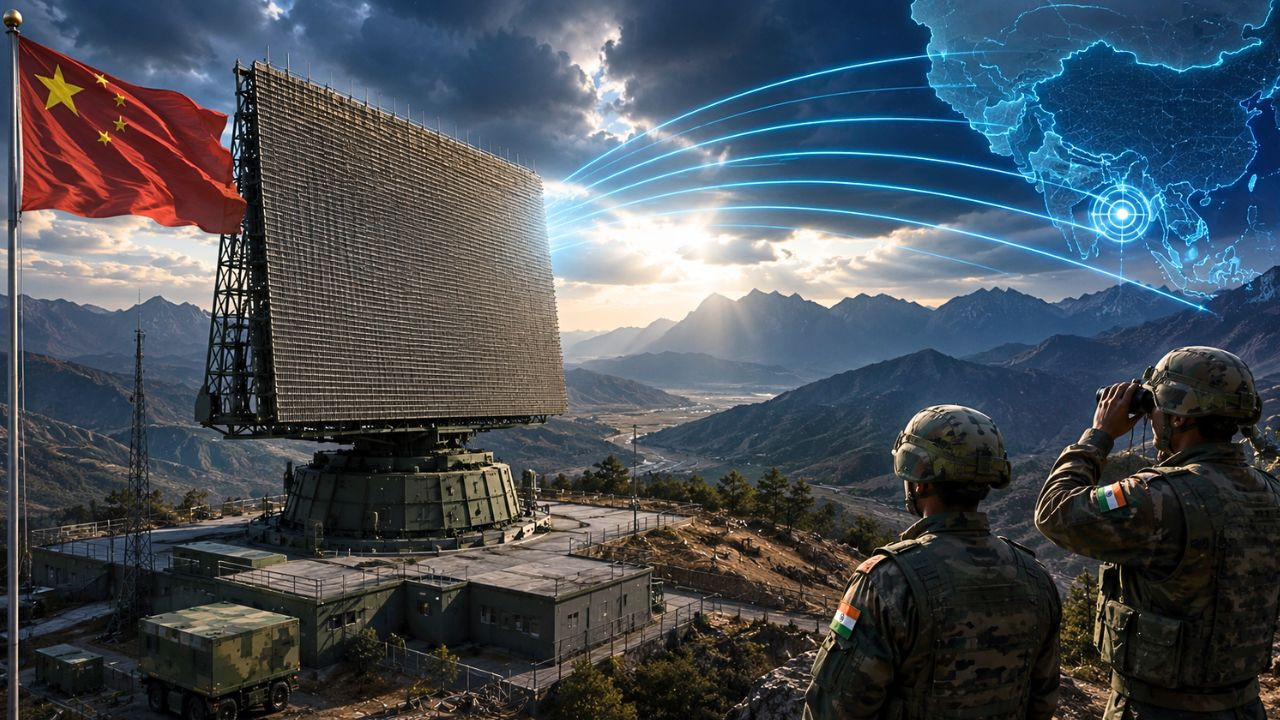

New Delhi: Amidst the tension on the India-China border, China has once again increased its surveillance power. According to reports, China has commissioned a new Large Faced Array Radar or LPAR in Yunnan province bordering Myanmar.
Its range is said to be more than 5000 kilometers. Defense experts believe that this radar can become a direct strategic challenge for India.
What is LPAR radar and how dangerous is it?
LPAR is a long range surveillance radar. It can detect ballistic missiles from a distance, monitor their flight and gather complete information.
Due to the range of more than 5000 KM, this radar will cover the eastern part of India, the Bay of Bengal and large areas of the Indian Ocean. It is claimed that it will also track missile tests taking place from Dr. APJ Abdul Kalam Island in Odisha.
India tests Agni-5, K-4 and other new missiles from here. If any country gets data about the speed, range and technology of the missile during these tests, then it can prepare its defense system to destroy it.
Why a matter of concern for India?
Defense experts say that missile test data is the most valuable information for any country. From that data, the strength, weakness and lethality of the missile can be estimated.
If China tracks India’s missile tests in real time, it can upgrade its anti-missile system accordingly. For this reason, this new radar installed in Greece is being considered a big threat to India’s security.
Indian Ocean will also be monitored
Due to Greece’s location, China will now be able to keep an eye on the Bay of Bengal and large parts of the Indian Ocean. The Indian Ocean is very important for India. The Indian Navy has a strong presence here and many of the world’s major shipping routes pass through here. China’s increasing surveillance in this area may affect India’s maritime security and trade routes.
China’s surveillance network becomes stronger
China already has long-range radar systems in Xinjiang and Korala. After LPAR became active in Greece, its surveillance network has spread further. So far, no official statement has come from both India and China on this deployment.
But experts believe that in the coming times, India will have to further strengthen its anti-surveillance technology and counter-radar capability. Overall, this step of China is not just being considered as surveillance but an attempt to shake India’s strategic balance.

Comments are closed.