
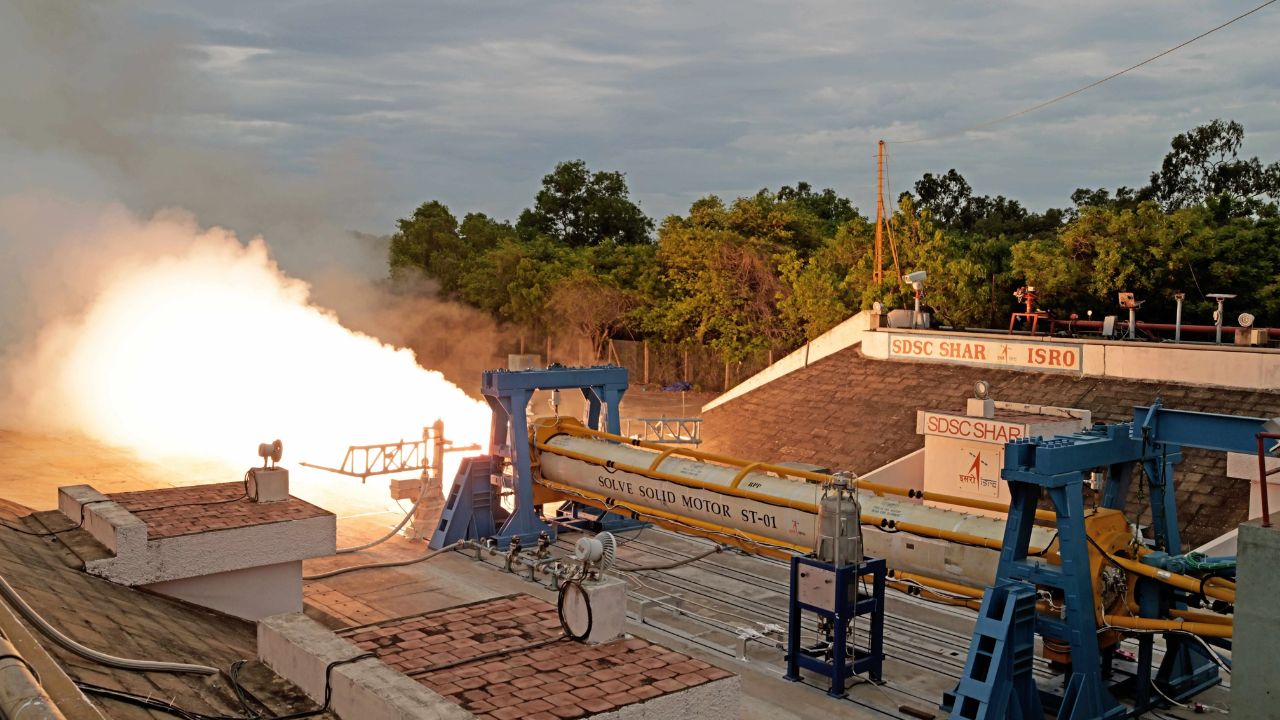
ISRO Gaganyaan Mission: India’s ‘Gaganyaan’ mission a big success! First successful test of special ‘SOLVE’ rocket by ISRO

- India’s ‘Gaganayaan’ campaign a big success!
- First successful test of special ‘SOLVE’ rocket by ISRO
- Read the detailed news
There is an exciting and important news about India’s first manned space mission i.e. ‘Gaganayaan’. Indian Space Research Organization (ISRO) A very important test for this campaign has been successfully completed. ISRO conducted the first successful test of a ‘solid motor system’ (solid fuel system) for a special test rocket called ‘SOLVE’ (Sub-Orbital Launch Vehicle for Experiments).
Successful trial at Sriharikota
According to ISRO, the successful test took place on July 3 at 10:00 AM at the Satish Dhawan Space Center in Sriharikota, Andhra Pradesh. During the test, the rocket’s motor performed as well as the scientists expected. This success has greatly boosted the confidence of Indian scientists.
The Indian Space Research Organization (Isro) has successfully conducted the first ground test of the solid motor that will power its experimental Sub-Orbital Launch Vehicle for Experiments (Solve), marking another major milestone in the development of technologies for India’s… pic.twitter.com/ufTluSyvYZ
— IndiaToday (@IndiaToday) July 5, 2026
ISRO headquarters threatened to blow up with a bomb! As soon as the email reaches the President’s office, the entire complex is empty, there is excitement in the area
Why is this test important?
‘SOLVE’ is no ordinary rocket; It is specially designed to test the safety of the ‘crew module’ (the part where the astronauts will sit) in the Gaganyaan mission. This rocket will carry the Crew Module to an altitude of approximately 10 to 17 km. After that, the module will separate from the rocket and ten parachutes will open one after the other. These parachutes will decelerate the module, ensuring a safe ‘splashdown’ of the astronauts into the sea.
What is the Gaganyaan campaign?
The Gaganyaan mission is India’s most ambitious space project. Under this mission, India plans to send two to three astronauts into Earth orbit, usually at an altitude of 400 km. The astronauts will spend three days in space after which they will be safely brought back and landed in Indian waters. ISRO is also developing a special ‘Crew Escape System’ (Astronaut Rescue System) to protect astronauts in case of emergency. The mission will primarily use the ‘Human-Rated LVM-3’ (HLVM-3) rocket; This rocket is designed to be extremely robust and reliable to ensure human safety. This major mission is being carried out in collaboration with the country’s scientists, Indian industry and leading research institutes.
Mission Aagaman: ‘Mission Arrival’ of India’s First Private Orbital Rocket; Sky-Route’s Vikram-1 will enter space for the first time

Comments are closed.