
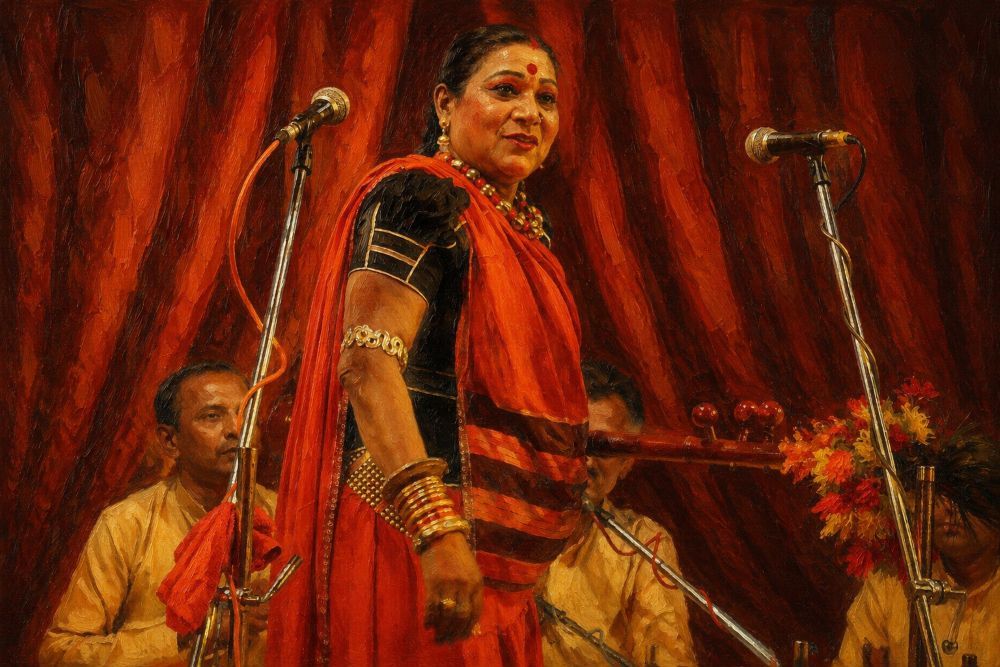
Teejan Bai obituary: Pandavani legend didn’t just narrate Mahabharata, changed who could claim it

There are artistes who attain greatness within a tradition. And then, there are those who irrevocably alter the tradition itself, changing not merely how it is practised, but who is allowed to inhabit it. Legendary Pandavani performer Teejan Bai, who died in Raipur in the early hours of Sunday (July 5) following a prolonged illness, belonged to that rare order. Through the force of her artistry and the courage of her convictions, she redrew some of the oldest fault lines that have shaped Indian culture: between the classical and the folk, the written and the oral, the privileged and the marginalised, the masculine and the feminine.
Rooted in the villages of Chhattisgarh, Pandavani is among India’s most extraordinary oral traditions. The folk form recounts episodes from the Mahabharata through song, narration, dramatic dialogue and improvisation. Every performance is simultaneously inherited and freshly created. The performer is not merely recounting an epic but inhabiting it.
And with Teejan Bai’s death — just weeks before her 70th birthday — marks the passing of one of India’s most transformative cultural figures, one who is credited with taking Pandavani to the global stage. Yet, to remember her merely as the country’s ‘greatest Pandavani exponent’, decorated with the Padma Shri, Padma Bhushan and Padma Vibhushan, would be to diminish the scale of her achievement. She did not simply preserve a centuries-old storytelling tradition. She changed the terms on which it was seen, heard and valued, establishing its place for posterity.
The hierarchies of art
“For decades, India’s cultural imagination has been quietly ordered by hierarchies. Classical forms have enjoyed institutional prestige, while folk traditions have too often been admired as quaint inheritances from the countryside rather than recognised as sophisticated artistic systems in their own right. Those hierarchies have frequently mirrored others — of caste, class and gender — determining not only which art forms command respect, but whose voices are deemed worthy of carrying the nation’s greatest stories,” says cultural historian and commentator Mukund Kule, who had been following Teejan Bai’s art since the late 1980s.
Few understand the absurdity of such distinctions and hierarchies better than theatre director and former National School of Drama (NSD) director Waman Kendre. “Whether it is theatre legend Vijaya Bai (whom we lost last month), one of the world’s best-known Indian vocalists Lata Bai (Lata Mangeshkar, who died last year) or Pandavani exponent Teejan Bai, they were each an equally tall pinnacle in their own right in their respective art. Any attempt to hierarchise is a reflection on our inability as a society to appreciate this greatness. It doesn’t take away from an artiste of Teejan Bai’s calibre. Just because someone doesn’t know where Mount Everest is, it doesn’t stop existing, does it?” he questions.
Kendre’s observation highlights not only Teejan Bai’s stature, but also the prejudice she spent a lifetime dismantling. She never sought to make Pandavani resemble a classical form in order to win acceptance. Nor did she dilute its rustic idiom, soften its Chhattisgarhi cadence or smooth away its earthiness for metropolitan audiences. Instead, she compelled India’s cultural establishment to travel towards the tradition, proving that artistic greatness has never depended on geography, language, social privilege or institutional endorsement.
That quiet act of insistence became one of the most radical cultural interventions of modern India.
Also read: Vijaya Mehta obit: How the stage veteran reshaped modern Indian theatre, mentored generations of actors
What Teejan Bai reclaimed was not simply a performance tradition but a way of belonging to one of India’s foundational narratives.
The Mahabharata cannot and has hence never been the exclusive preserve of any one language, community or canon. Across centuries, it has travelled through songs, ballads, rituals and oral traditions, acquiring new voices with every retelling. Teejan Bai entered the epic not as an outsider seeking admission but as someone who instinctively knew it was hers to inhabit.
“She was a tigress on the stage. The sheer ferocity she unleashed with her powerful command over the Mahabharata, moving seamlessly from raconteur to any of its nearly 2,800 characters — gods, kings, warriors, women, sages and countless others — left one enthralled or reeling or both,” he recalled with a laugh, adding that he had watched her perform live at least 50 times. “Yet the power she held — as a storyteller and performer — over me never diminished by even a notch. And she knew that. According to me that glint in her eyes when she performed came from there,” says Kendre.
For the NSD director, however, that extraordinary theatrical command was inseparable from what it represented. “She did not merely perform the Mahabharata; she reclaimed it. For centuries, the epic had largely remained within the custody of Sanskritic, upper-caste, male traditions. Teejan Bai, a woman from one of the most marginalised communities — the Pardhis — strode into that space with astonishing authority, making the epic answer to the rhythms, dialects and lived realities of rural Chhattisgarh.”
The price of performance
The confidence with which she occupied that space had its origins in childhood. Born in Ganiyari village in undivided Madhya Pradesh (present-day Chhattisgarh, since the state was carved out of Madhya Pradesh in 2000), she grew up in a world where stories were not read so much as remembered after being handed down in an aural tradition. Her grandfather, Brijlal, became her first guru, introducing her to the epic Mahabharata not through books but through evenings of recitation in which memory itself became an archive. Listening was apprenticeship. Repetition was scholarship. Long before she understood performance, she had absorbed cadence, character and the emotional pulse of the epic.
Life, however, demanded conformity before it permitted ambition. Married at the age of 12, she was expected to settle into the rhythms prescribed by patriarchy and caste for women of her community. Instead, barely a year later, she stepped before a public audience in the neighbouring village of Chandrakhuri in Durg district and earned Rs 10 for her first performance. The payment was modest. The transgression was immense.
She had chosen to perform in the Kapalik style of Pandavani, a vigorous, physically demanding tradition in which the performer traverses the stage, inhabits multiple characters and transforms the ektara (a single-string musical instrument) into whatever the drama requires — a weapon, a crown, a sceptre or a symbol of grief. This had long been regarded as a strictly male domain.
“For a young woman from a socially and economically marginalised community to claim that space was to challenge several hierarchies at once,” points out Kule. He underlines how she was questioning not merely who could perform Pandavani but who could embody Bhima’s strength, Yudhishthir’s truth, Karna’s generosity, Draupadi’s fury, Krishna’s wit, Eklavya’s helplessness or Abhimanyu’s bravery before an audience. “In doing so, she quietly dismantled assumptions about authority that had shaped both society and culture for generations.”
Teejan Bai made it impossible to dismiss folk performance as accompaniment to the ‘mainstream’, compelling audiences to recognise Pandavani’s dramatic sophistication, emotional complexity & philosophical depth. Photo: By special arrangement
The backlash was swift. She was abandoned by her husband, cast out by her in-laws and ostracised by members of her own village and community. The punishment reflected the anxieties of a society unsettled by a woman refusing to remain within the boundaries that had been drawn for her.
Years later, in 2009, while speaking to this writer after a performance in Mumbai, Teejan Bai had reflected on those years with the same unadorned honesty that marked both her speech and her art. “I was humiliated, left to go hungry and told that I would have to bend. But I wouldn’t let go of my art. I knew deep down that it would silence those against me,” she had said.
She was finally able to more than silence her detractors. Over the decades that followed, the young woman who had once been ostracised for daring to sing the Mahabharata came to be celebrated across the world as one of its greatest interpreters. The institutions that eventually honoured her with the Padma Shri, the Padma Bhushan, the Padma Vibhushan and the Sangeet Natak Akademi award and the subsequent fellowship were, in many ways, acknowledging a truth that village audiences had recognised much earlier: that genius has little regard for the boundaries society constructs around it. Teejan Bai not only overturned assumptions about who could perform the Mahabharata, but also altered the place of folk performance within India’s cultural imagination.
Mainstreaming Pandavani
For generations, Pandavani had flourished in the villages of what is now Chhattisgarh, sustained by memory, community and oral transmission rather than institutions. Its survival depended not on academies or archives but on performers who carried entire worlds within them. Yet, like so many of India’s folk traditions, it existed largely outside the national cultural conversation until a handful of discerning eyes recognised in it an artistry that demanded a far wider audience.
Among the earliest was the legendary theatre visionary Habib Tanvir. Deeply rooted himself in the theatrical traditions of Chhattisgarh, Tanvir recognised in Teejan Bai not simply a gifted performer but a phenomenon capable of reshaping how India viewed its own folk heritage. His encouragement opened doors to national festivals and, eventually, to international stages. It was a journey that carried Pandavani from village squares to the world’s great auditoriums without sacrificing its Chhattisgarhi idiom, its improvisatory spirit or its earthy humour.
Also read: K Bhagyaraj beyond cinema: Why MGR’s ‘artistic heir’ failed in politics
That trajectory, believes Mayurbhanj Chhau exponent Pagulu Jena, offers an important lesson that extends well beyond one remarkable career. “Teejan Bai is an excellent example of the heights an artiste can reach with the right kind of patronage, encouragement and support from the right kind of people, institutions or corporates at the right time,” he says. “It is to the credit of the ‘powers that were’ that they allowed a woman with virtually no formal education to come into her own as one of India’s greatest cultural ambassadors!”
For Jena, however, Teejan Bai’s story is as much an argument for the future as it is a celebration of the past. “She constantly reminded us that this has to happen on a much larger scale for more and more folk performing traditions across the country. Every state has niche art forms like these; many have several. The most fitting tribute we can pay Teejan Bai is to create platforms for these exponents so that we do not have to wait another 70 years for another Teejan Bai to emerge.”
His words illuminate a paradox at the heart of Indian cultural life. The country proudly celebrates its extraordinary diversity, yet countless traditions continue to survive on the devotion of ageing practitioners, often with little institutional support, laments Kule. “Teejan Bai became an icon because her genius was eventually recognised. How many others, equally gifted, remain unseen because that recognition never arrives?”
Perhaps her greatest contribution was that she changed the terms of that conversation. She made it impossible to dismiss folk performance as a charming relic or a colourful accompaniment to the ‘mainstream’. Without altering the grammar of Pandavani, she compelled audiences to recognise its dramatic sophistication, emotional complexity and philosophical depth. The form did not become great because it entered prestigious concert halls. Those halls became richer because Pandavani entered them.
Classical vocalist Shubha Mudgal readily acknowledges that Teejan Bai transformed not only audiences but fellow artistes too. “As a young student of classical music in Allahabad, I had no exposure to Pandavani,” Mudgal recalls. “It was through Teejan Bai, and the many articles about her, that I learnt of the art form and her unmatched contribution in making it accessible for women performers. I must thank her for introducing me to the art.”
Though they met only occasionally as fellow-performers at festivals, Mudgal remembers an artistic presence that was impossible to ignore. “Her fearless, intense presence on stage was riveting, to say the least,” she says. “Teejan Bai’s greatest performance may well have been the life she chose to live. In a world where beliefs, ideologies and values are often on sale, she stands out as an exemplar who surrendered only to Pandavani.”
Bharatanatyam exponent Malavika Sarukkai locates that power in something even more elemental while lamenting Teejan Bai’s passing as a great loss for society. “She blazed a path of fearless passion for her art that was magnetic in its power,” Sarukkai underlines. “The emotional truth of her storytelling transcended language, making grief, valour, betrayal and devotion instantly intelligible. She proved that India’s folk traditions never needed reinvention for contemporary audiences. They simply needed to be heard.”
That may ultimately be Teejan Bai’s most enduring intervention. She did not ask India to lower its standards in order to appreciate folk art. She asked it to simply raise its gaze.
For all the honours that eventually accumulated around her, those who knew Teejan Bai seldom begin talking of her by recalling the decorations. They remember instead a generosity of spirit that remained curiously untouched by fame.
Veteran Manipuri exponent Darshana Jhaveri, who encountered that warmth during a Sangeet Natak Akademi fellowship ceremony at Rashtrapati Bhavan in 2023, where both artistes were honoured by President Droupadi Murmu. Age and illness had begun to weigh visibly on Teejan Bai, yet neither had dimmed the light that seemed to animate her. “Though her health was failing, that unmistakable spark was clearly discernible when we spoke,” Jhaveri recalled. Later, despite obvious frailty, Teejan Bai joined the fellow in a brief performance, refusing to let physical limitations define her final public appearances. “Gracious and polite to a fault, I will never forget her almost childlike 1000-watt smile and that ringing laughter that could light up a room with its sheer warmth.”
That capacity to illuminate a room was, perhaps, only another expression of the generosity with which she had spent a lifetime illuminating a tradition.
Sangeet Natak Akademi chairperson Dr Sandhya Purecha, who describes Teejan Bai’s passing as “an irreparable loss to India’s cultural heritage”, remembers an artist whose commanding presence and lifelong dialogue with the Mahabharata inspired generations of performers, while reaffirming that “the country’s folk traditions remain living repositories of civilisational wisdom rather than relics to be admired from a distance.”
Also read: Bharathiraja obit: Legend who shattered studio walls to give Tamil cinema its rural soul
The distinction is an important one. Teejan Bai never treated Pandavani as something fragile that needed preservation behind a glass wall. She believed traditions remained alive only when they continued to breathe, evolve and speak to each generation in their own voice.
Few have articulated that truth more eloquently than Kathak exponent Saswati Sen. “Teejan Bai carried an oral tradition from the villages of Chhattisgarh to concert halls across the world without sanding away its rough edges or softening its earthiness. She proved that folk art need not aspire to classicism to command reverence. It only needed an artist courageous enough to believe in it completely.”
That courage may well prove to be Teejan Bai’s most enduring inheritance.
The legacy of Teejan Bai
Tributes from President Droupadi Murmu, Prime Minister Narendra Modi and Chhattisgarh Chief Minister Vishnu Deo Sai acknowledge the magnitude of the loss created by her death. Yet no citation, however distinguished, can fully measure a life that altered the cultural grammar of a nation.
The real measure of Teejan Bai’s legacy will be found elsewhere. It will lie in whether a young girl in a remote village can now imagine herself at the centre of an epic instead of its margins… It will lie in whether a folk performer no longer feels compelled to imitate classical aesthetics in order to be taken seriously… It will lie in whether institutions recognise brilliance before it has struggled for decades against poverty, prejudice and neglect… And it will also lie in whether India finally accepts the lesson that Teejan Bai spent a lifetime teaching — not through speeches or manifestos, but through performance — that its most profound cultural inheritances are often safeguarded not in the corridors of power but in forgotten villages, in oral traditions, in regional dialects and among communities that history has too often chosen not to see.
Teejan Bai left behind no school bearing her name, no artistic manifesto and no doctrine to be followed.
She left behind something far more demanding: a reimagined idea of cultural citizenship.
An India in which a Pardhi girl could claim the Mahabharata with absolute authority… An India in which folk memory could stand shoulder to shoulder with classical canon… An India in which the distance between the margins and the mainstream became, if only for the length of a performance, wonderfully impossible to discern.
If the generations that follow can continue to narrow that distance, her greatest performance will not have ended with her.
It will only have found entirely new voices.

Comments are closed.