

Under the Tenth Schedule, legislators become liable to disqualification the moment they turn to the rival party, not when they resign the seat. Voluntarily giving up party membership is the ground, and the Supreme Court has read that phrase to reach well beyond a formal resignation. A member cannot use a resignation to escape a disqualification the crossover has already fixed. That would be doing by an indirect route what the Schedule denies by the direct one, defecting without consequence.
AIADMK exodus
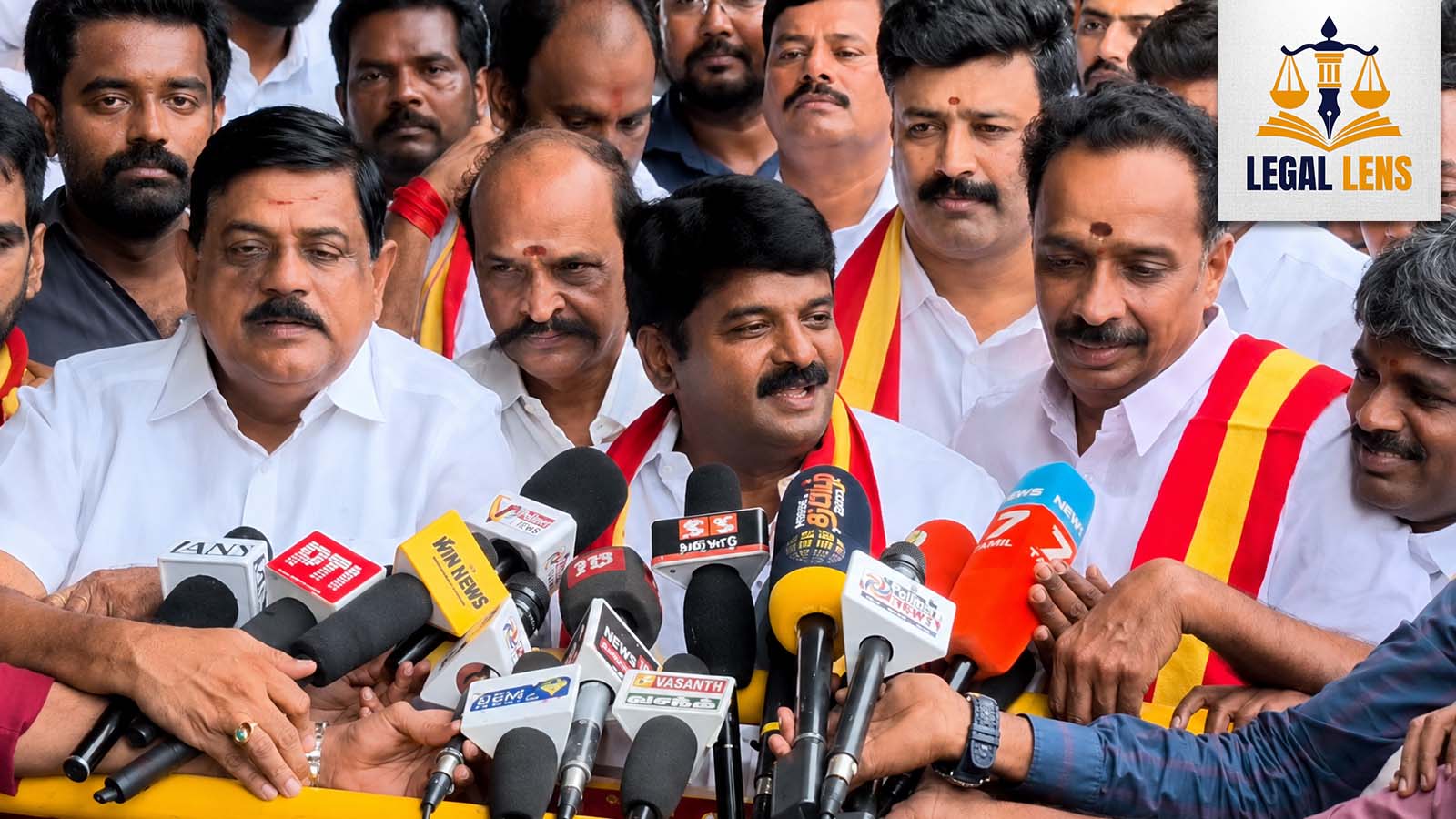
Six AIADMK MLAs have crossed over to the ruling Tamilaga Vettri Kazhagam (TVK) after quitting their Assembly seats. But each one of them could have been disqualified before writing to the Speaker. The act that triggers disqualification came first. The resignations only confirmed a crossover that was already underway.
Disqualification is incurred at the moment of the act, the crossing over or the defiance of the whip. It is not postponed to the Speaker’s decision, still less to a resignation. The liability attaches on the day, and relates to it.
Also read/watch: AIADMK crisis: Can EPS stop exodus and revive party faith?
The exits ran in sequence after the AIADMK’s rout in the May election. Maragatham Kumaravel, S Jayakumar and P Sathyabama resigned in late May. A fourth, Esakki Subaya, followed within days, as the Edappadi K Palaniswami faction scrambled to stop the Speaker from accepting the resignations. C Vijayabaskar, a former health minister, left soon after. The sixth, the former transport minister MR Vijayabhaskar, quit on June 29. Speaker JCD Prabhakar accepted each letter on the day it arrived, in accordance with the Tamil Nadu Legislative Assembly Rules.
Disqualification-defining moment
Now, two different legislations are in play, and the Tenth Schedule punishes only one of them. The act of resigning the seat is governed by Article 190(3)(b) of the Constitution. Giving up party membership is governed by paragraph 2(1)(a) of the Tenth Schedule to the Constitution. A member can abandon their party long before, and quite apart from, resigning the seat. It is the abandonment, not the resignation, that the law disqualifies them for.
So, when does a member give up their party? It is not only through a resignation letter. In Ravi S Naik v Union of India, the Supreme Court held that the phrase is wider than resignation and can be inferred from conduct. In Rajendra Singh Rana v Swami Prasad Maurya, a Constitution bench went further. Merely asking the Governor to install the rival was itself giving up membership.
Also read: AIADMK ship continues to sink as former TN minister MR Vijayabhaskar quits party
And the timing is settled. Rana held that disqualification is incurred at the moment of the act, the crossing over or the defiance of the whip. It is not postponed to the Speaker’s decision, still less to a resignation. The liability attaches on the day, and relates to it. However, the process starts only on a formal petition. The parent party must allege disqualification on the ground of defection to set the Speaker’s determination going.
Two grounds
In the AIADMK’s case, two grounds were available, and they have met different fates. The first was the whip defiance of May 13, when 25 AIADMK MLAs backed the TVK in the trust vote. Paragraph 2(1)(b) of the Tenth Schedule catches that, but it lets the parent party condone the defiance within 15 days. The May 27 reconciliation did just that, and the petitions were withdrawn.
Disqualification is a finding against the member, recorded by the Speaker, that they betrayed the party that elected them. Resignation is an exit that they authored themselves. Only one carries the word defector on the record. So they resign rather than await disqualification, to escape the stigma.
The second ground is untouched. Negotiating a crossover with the ruling party, while still an AIADMK member, is itself voluntarily giving up membership under paragraph 2(1)(a). On the Rana reasoning, that act is complete before any resignation. Paragraph 2(1)(a) carries no exemption for pardon within 15 days of the act of defection.
Resignation served a narrower purpose. To stand again as TVK candidates, the defectors were required to vacate their seats first. Resigning was the clean way to do it. It was never a shield against the Tenth Schedule.
Why petition must be filed
Nor could a resignation head off a petition. A petition must still be filed to set the inquiry going. But a resignation does not bar its filing. Shrimanth Balasaheb Patil v Speaker, Karnataka Legislative Assembly held that a petition already pending survives the member’s resignation. Rana fixes the liability at the earlier act. So a petition for a completed pre-resignation defection can proceed, resignation or not.
Also read: AIADMK split deepens as EPS faces rebellion after trust vote
What would disqualification have cost them? Less than it sounds. It is not a ban for six years; that penalty belongs to the Representation of the People Act. Tenth Schedule disqualification costs the seat and nothing more lasting. Patil holds that the disqualified member may contest the very next by-election. The only added sting, Article 164(1B), bars the member from the ministry until re-elected.
Resignation an escape?
That sting scarcely bites here. None of these MLAs is being sworn in as a minister before winning back a seat. So the ministerial bar, which lifts on re-election anyway, costs them nothing. Set immediate office aside, and the two routes converge entirely. Both lose the seat, both fight a by-election, both return unencumbered on winning. What is left to separate them is not consequence but character.
Disqualification is a finding against the member, recorded by the Speaker, that they betrayed the party that elected them. Resignation is an exit that they authored themselves. Only one carries the word defector on the record. So they resign rather than await disqualification, to escape the stigma, not to gain anything material. Whether resignation earns them that escape is a separate question, and not theirs to answer.
What defines inducement?
Where, then, does inducement fit? On the resignation track, it could matter, but only as coercion. Under Article 190(3)(b), the Speaker may refuse a resignation that is not voluntary. In the Madhya Pradesh case in 2020, senior advocate Kapil Sibal argued exactly that for the Kamal Nath government, which faced rebellion from 22 MLAs.
Also read: Trust vote won, but AIADMK’s fracture is the real story
But Sibal’s case was captivity, not temptation. He told the court that 16 of the rebel MLAs had been flown to a Bengaluru resort and held incommunicado. His point was that a sequestered signature is not a free one. On the contrary, an offer of a ticket or a ministry is not that. It is not duress at all.
On the disqualification track, inducement cuts the other way. There, voluntary means one’s free will. The Tenth Schedule was written to catch the defection that the lure of office drives. So an inducement to cross over does not excuse the abandonment of the party. It proves it.
The court never decided Sibal’s argument. A floor test overtook it, and Kamal Nath fell before the Speaker inquired. So even the coercion question remains formally open. But it is not the AIADMK rebels’ question.
Why disqualification applies to AIADMK rebels
For them, the reported facts point the wrong way for a coercion defence. Since May 13, the TVK leadership is reported to have approached at least a dozen of the AIADMK MLAs who backed it. MR Vijayabhaskar is said to have resigned only after such a conversation. That is courtship, not captivity. On the disqualification track, it is evidence of a willing crossover.
Also read: EPS slams Vijay: ‘Must people die while you learn how to govern TN?’
So the resignations settle nothing on their own. The reconciliation disposed of the first ground by condoning it. The second ground, the crossover, remains open, unpressed and undefeated by any resignation. On May 27, the AIADMK’s rival factions reconciled, and the party has raised nothing since. What protects the rebels is not law but the AIADMK’s silence.
That leaves one open question. It is whether the AIADMK will invoke the crossover and press for disqualification despite the resignations. Far from helping the rebels, the inducements they accepted would confirm that they willingly quit. Making the defectors carry the stigma of disqualification, despite having resigned, would mean testing the limits of the anti-defection law as it stands.

Comments are closed.