
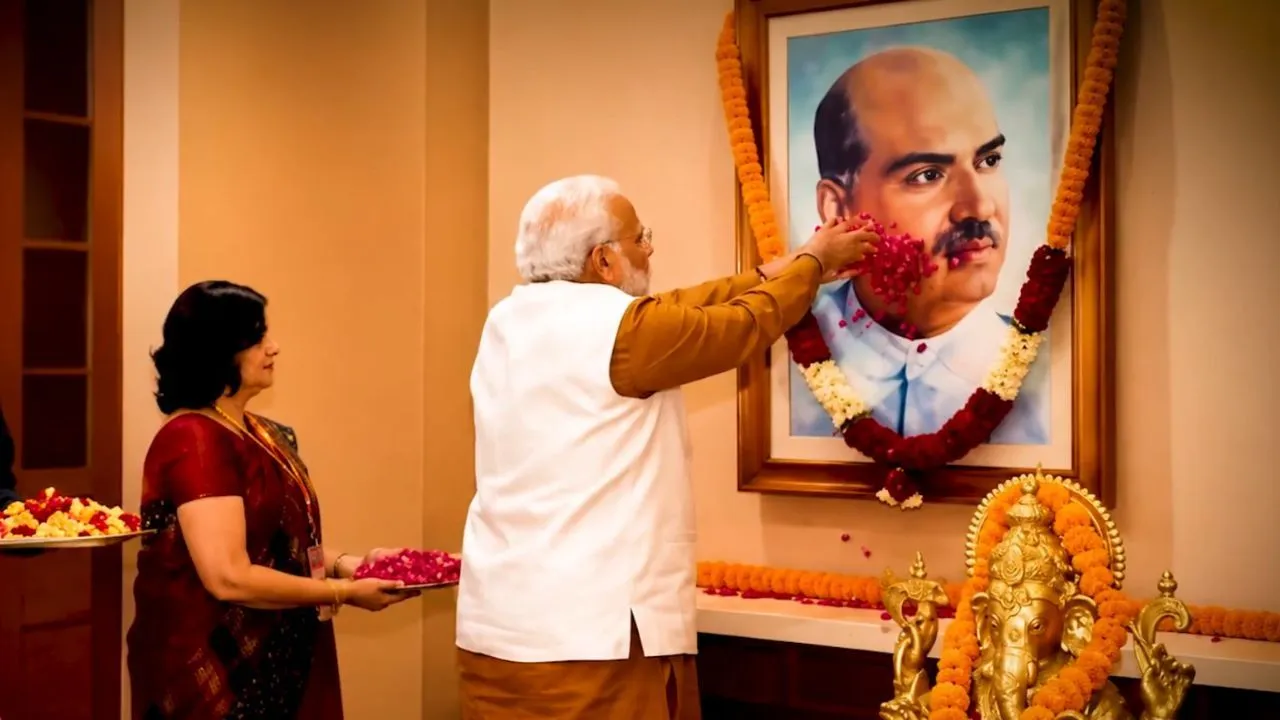
PM Narendra Modi’s article dedicated to Dr. Shyama Prasad Mukherjee, opens untold pages of history on his 125th birth anniversary

PM Narendra Modi Article: Today the 125th birth anniversary of Shyama Prasad Mukherjee is being celebrated. On his birth anniversary, Prime Minister Narendra Modi has written a letter and paid tribute to him. He has paid tribute to Shyama Prasad Mukherjee, the pioneer of united India, a fierce nationalist and founder of Bharatiya Jan Sangh, on his 125th birth anniversary. He said that his vision of a strong and self-reliant India is giving new energy to our resolve to build the nation. On this occasion, PM Modi wrote an article dedicated to his invaluable contribution.
PM Narendra Modi said in his article, ‘Today, July 6, is a very special day for crores of countrymen who believe in the ideals of nationalism and selfless service. Today we are celebrating the 125th birth anniversary of Dr. Shyama Prasad Mukherjee. His life is an inspiring example of courage and unwavering dedication towards Mother India. There was a wonderful combination of scholarship, public service and high moral values in the personality of Dr. Shyama Prasad Mukherjee. So many qualities are seen together in only a few leaders of modern India.”
Shyama Prasad chose the path of national service
Talking about the life of Shyama Prasad Mukherjee, PM Narendra Modi said, Shyama Prasad was born in a family where he could easily get a life full of comforts and luxuries. His father Sir Ashutosh Mukherjee was counted among the great educationists of his time. But despite all the facilities, Shyama Prasad chose the path of sacrifice and national service. He strongly believed that whether it was opposition to British rule, fight against communalism or facing humanitarian crises, he could not remain a silent spectator in front of these challenges of his time.
In this journey he also had to face many deep personal sorrows. First he lost his small child and later his wife also passed away. But even in these tragic circumstances he did not let his courage weaken. His resolve became stronger and his dedication towards national service deepened.
Unity and integrity of India objective
He also remembered the contribution of Shyama Prasad Mukherjee towards the unity of the country. He said, ‘The biggest aim of Shyama Prasad Mukherjee’s life was to protect the unity and integrity of India. At the time of partition of the country, he played an important role in keeping West Bengal an integral part of India. A few years later, with the same objective, he also fought on the issue of Jammu and Kashmir. Even jail and house arrest could not dissuade him from the path. When he died under house arrest, he was far away from the countless people for whom he fought throughout his life.”
PM Modi said that there come some moments in history, when the supreme sacrifice of a person rises above politics and becomes a part of the memory of the country. Dr. Mukherjee’s sacrifice was also similar. Acharya Vinoba Bhave had said that Dr. Mukherjee sacrificed his life for a cause in which he had full faith. Decades later, the removal of Articles 370 and 35(A) in 2019 was a true tribute to him.
Youngest Vice Chancellor of Calcutta University
In his article, PM Modi wrote, ‘Dr. Mukherjee always gave top priority to national interest and Indian values. For this, he built strong institutions and created systems which were far ahead of the thinking of that time. He became the youngest Vice Chancellor of Calcutta University. He made such changes in the education system, which were in accordance with the national interest and future needs.”
PM Modi further wrote, ‘In a conference of educationists, Dr. Mukherjee had said, ‘It is wrong to consider educational institutions as mere factories for producing babus or low-paid employees. We have to prepare students so that they can play leadership roles. Be prepared to assume greater responsibilities in our self-governing institutions like municipal corporations, provincial and central legislatures. Along with this, they can also show their talent in areas like finance, business and industry.’”
Important works of Shyama Prasad Mukherjee
The Prime Minister said that under his leadership, Shyama Prasad Mukherjee did many important works in Calcutta University. These included improving library facilities, promoting research in science, encouraging the study of historical objects and starting courses related to agriculture. He also paid special attention to areas like sports, teachers training and student welfare. In order to develop a sense of pride among the students towards their university, he started the tradition of celebrating the foundation day of the university on 24 January. He also requested Gurudev Tagore to write a song for the university.
PM Modi said that another example of this spirit was seen in the later years of Shyama Prasad Mukherjee’s life, when he decided to form the Bharatiya Jana Sangh. At that time, the Congress Party was dominant everywhere in the country. In such a situation, he felt that the country was in great need of a new alternative, which would both talk about India’s progress and also remain connected to our cultural roots. Perhaps keeping this in mind, the party’s election symbol was ‘Deepak’ That means an earthen lamp was kept. A single lamp may look small, but it has the amazing power to eradicate the deepest darkness around it. Jana Sangh did exactly this during its active period and even after that.
Shyama Prasad Mukherjee who has Virat Vijay
Prime Minister Narendra Modi said, ‘Syama Prasad Mukherjee’s tenure as India’s first Industry and Supply Minister was very important. He is remembered as a politician whose vision was very grand. He considered industry as a powerful medium to spread respect, opportunity and self-confidence among the people of newly independent India. He well understood the importance of wealth and value creation. He took landmark initiatives like Damodar Valley Corporation, Sindri Fertilizer Plant and strong industrial policy. Through this, the foundation of modern industrial India was laid. Along with this he also ensured that India’s traditional strengths were never neglected. He was also a strong supporter of the interests of handloom, cottage industries, artisans and workers associated with the textile industry.”
Sharing his personal experience, PM Modi said, ‘The Sindri plant, for which Dr. Mukherjee had made tireless efforts to establish with a clear vision of a self-reliant India, was grossly neglected by those in power for many decades. I am satisfied that our government got the good fortune of its revival. Attending that event became one of the most special and unforgettable moments of my public life.”
The most vocal critic of the constitutional amendment
He said, ‘India’s ancient tradition has respected dialogue and discussion for centuries. Dr. Mukherjee was a strong symbol of this democratic spirit. He accepted to join Pandit Nehru’s cabinet because he believed that the responsibility of nation building in the early years of the country’s independence was far above political differences. He performed his responsibilities with complete dedication and creative approach. But when he felt that it was necessary to adopt a different path in the national interest on some questions of national importance, he resigned from his post with full dignity. After this he devoted his entire life to achieving the political goal which he considered necessary for the nation.”
Also read – explainer:What was Liaquat Agreement? When Shyama Prasad Mukherjee left Nehru cabinet, laid the foundation of Jan Sangh
Referring to the first constitutional amendment brought by Pandit Nehru 75 years ago, the Prime Minister said, ‘It was considered a direct attack on freedom of expression. At that time Dr. Mukherjee had been its most vocal critic. He understood very well to what extent Congress could go. With time his apprehension proved correct. The same party which had brought the first constitutional amendment 75 years ago, imposed emergency on the country in 1975. Not only this, by bringing the 42nd Constitutional Amendment Act 50 years ago, the foundation of democratic values was once again attacked.”
Service to victims of Bengal famine tragedy
He said, “Dr. Mukherjee is also particularly known for his human sensibilities and spirit of service. In the year 1943, when Bengal was facing the tragedy of severe famine, he completely dedicated himself to the service of the victims. He also ensured that people could get food, for which many canteens and relief centers were started. On the one hand, he was deeply distressed by the suffering of the people, on the other hand, he was extremely angry at the insensitivity of the British government. He also wrote a book named Panchasher Manvantar to express his pain. When a severe cyclone hit Medinipur in 1942, he led relief operations in the affected areas.”
In his article, PM Modi has also mentioned the speech given by Dr. Mukherjee in a college in Kolkata. The article reads, ‘While addressing the youth, Dr. Mukherjee had urged them, ‘Whatever work you do, do it with full seriousness, dedication and honesty. Never leave any work incomplete. Don’t consider yourself satisfied until you have given your best contribution to it.’ Today our country is moving rapidly towards the goal of developed India.”
Prime Minister Modi said that our true tribute to Shyama Prasad Mukherjee would be that we make continuous efforts every day towards building the India that he had envisioned. An India that is strong, united, full of confidence and sensitive. I have full faith in the youth of the country that they will actively participate in achieving this goal and will work with full energy to make this resolution come true.
(with agency input)

Comments are closed.