
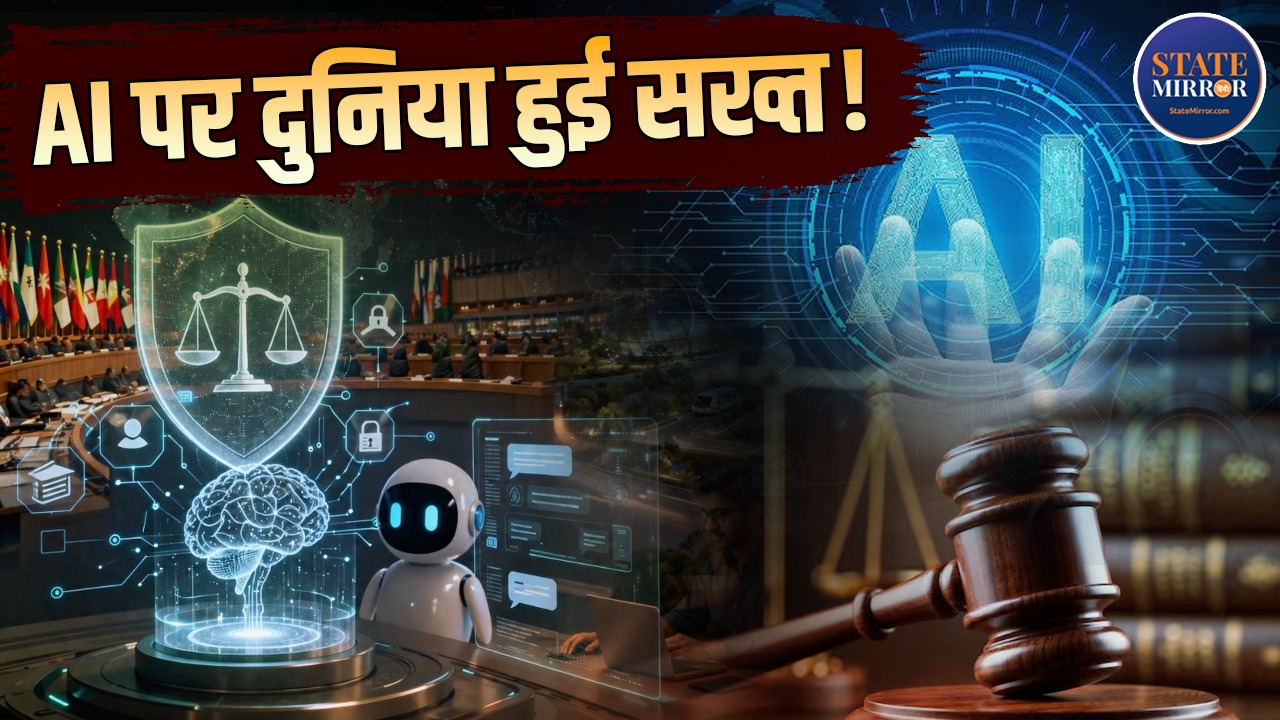
Why is the world making new rules on AI? Is strict regulation coming for AI companies like ChatGPT?

in the country and the world Artificial Intelligence As fast as AI is expanding, the chances of its misuse are also increasing. ChatGPT had more than 100 million monthly users in just two months after its launch (November 2022), making it one of the fastest-growing consumer technologies in history. Today, companies like OpenAI, Google, Meta, Anthropic, Microsoft and China’s DeepSeek are developing AI models that can generate text, video, code, images and even voice.
On the other hand, the cases of fake news, deepfakes, cyber fraud and election propaganda have increased through AI. With more than half of the world’s population going through the voting process in the election year of 2024, global concerns about the misuse of AI have further increased. For this reason, many countries including Europe, America, China and India are making new rules related to accountability, transparency and security for AI companies.
Why is there a need to make new rules on AI?
AI is no longer just a chatbot, but has reached banking, healthcare, defence, education, judiciary and government services. In such a situation, if AI gives a wrong decision, it can affect millions of people.
In 2023, an American lawyer conducted legal research with ChatGPT, but the AI cited cases in court that did not actually exist. After this the court imposed a fine on the lawyer. Similarly, many media organizations found that Generative AI sometimes gives wrong information with confidence, which is called AI Hallucination.
AI companies train models by taking billions of webpages, books and images from the Internet. For this reason, The New York Times, writers and artists have also filed copyright infringement lawsuits against many AI companies. This is why governments are now moving towards making AI “the more powerful, the more accountable”.
What kind of rules are the big countries of the world making?
The European Union has implemented the world’s first comprehensive AI law. In this, AI system is divided into four categories (Unacceptable Risk, High Risk, Limited Risk and Minimal Risk). Bans or strict conditions have been imposed on technologies such as social scoring, monitoring people’s emotions and some types of biometric identification.
America has established the AI Safety Institute, which will conduct safety checks of advanced AI models. At the same time, China has made algorithm registration, content moderation and compliance with government rules mandatory for generative AI companies.
India has not yet enacted a separate AI law, but a budget of ₹10,300 crore has been released under the IndiaAI Mission. Under this, work is going on to increase GPU computing capacity in the country, develop AI models in Indian languages and support startups. The government’s focus at present is on “Innovation with Guardrails”.
What will be the impact on AI companies like ChatGPT?
If the new rules come into effect, it will not be enough for companies like OpenAI, Google, Anthropic, Meta and Microsoft to simply launch AI. They will have to prove that their model is safe.
In future, companies may have to disclose what data the model was trained on, whether it includes copyrighted material, whether security tests have been conducted and whether the model can prevent misuse in sensitive topics such as biological weapons, cyber attacks or election disinformation.
Under Europe’s AI rules, violating companies can be fined up to 7% of their global annual turnover or 35 million euros (whichever is higher). This is considered to be one of the most stringent tech regulations in the world.
Will this slow down the development of AI?
Tech companies say that too much regulation could prove costly for small startups. Millions of dollars may have to be spent on security testing, data audit and legal compliance of AI models.
However, AI experts argue that without regulation the harms of AI could be much greater. Just as medicines have to undergo clinical trials before coming into the market, advanced AI systems also require independent safety testing. OECD, G7 and the United Nations have also advocated “Responsible AI” so that people’s trust in technology remains.
What can change in the future?
Over the next few years, AI companies may have to go through processes like regular security audits, independent evaluation, deepfake labeling, transparency of data sources, and licensing for high-risk AI.
It is possible that in the future, digital watermarks or identification marks may be mandatory on every AI-generated photo, video or audio. Different rules may be applied to political AI content during elections. Additional safety standards can also be created on AI platforms related to children.
With this, users can get the right to know whether they are talking to a human being or AI, and if AI has taken any decision, what was the basis behind it.
AI is no longer just a technological product but has become the most important strategic resource of the 21st century. Just as rules were made over time for the Internet, nuclear energy and social media, similarly AI is also now entering the era of regulation. The world’s effort is not to stop AI, but to make it safe, transparent and accountable. The rules will certainly get stricter for companies like ChatGPT in the coming years, but these rules will also lay the foundation for increased trust in AI and its responsible use.

Comments are closed.