
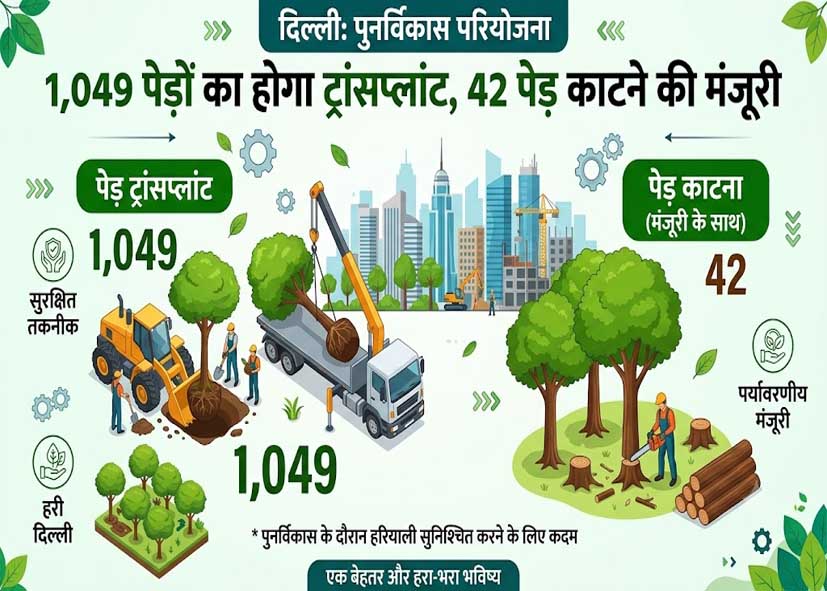
1,049 trees will be transplanted for the redevelopment project in Delhi, approval to cut 42 trees

Delhi Tree Transplantation: A large number of trees will be transplanted for the redevelopment project of General Pool Residential Accommodation (GPRA) Colony located in Sarojini Nagar, Delhi. Under this, 1,049 trees will be planted from one place to another, while approval has been given to cut 42 trees. Delhi Forest Department has issued an order in this regard on June 19. According to the department, wherever possible under the project, priority will be given to transplanting trees instead of cutting them so that maximum green cover can be saved.
According to the forest department, initially 1,218 trees were being affected by the GPRA redevelopment project at Sarojini Nagar. During detailed investigation, 48 trees were found outside the project area, while 79 other trees were also saved on the instructions of the Central Empowered Committee (CEC). After this the total number of affected trees reduced to 1,091. According to the order of the Forest Department, out of these, 1,049 trees will be transplanted, while permission has been given to cut 42 trees. The responsibility of this entire work has been handed over to NBCC. The agency has been directed to shift all the trees to be transplanted to Bharat Vandana Park in Dwarka. Apart from this, planting of new saplings of 10,910 native species has also been made mandatory to compensate for the environmental damage. The Forest Department has also clarified that if the transplanted trees do not survive at the new location, NBCC will have to plant additional trees at its own expense as per the prescribed rules, to ensure replenishment of the green cover.
How are big trees transplanted?
Transplanting large trees is a complex and technical process. It is not as easy as uprooting a small plant and planting it elsewhere. This entire process requires expert monitoring, modern machines and long-term care. First, experts decide which trees can be safely transplanted. After this, digging is done in a large area around the roots of the tree, so that sufficient amount of soil can be preserved along with the roots. This portion of roots and soil is called the ‘root ball’, which is tightly bound with special material so that the roots are not damaged during transfer.
After this, with the help of cranes and other heavy machines, the entire tree is carefully lifted and placed on a truck and transported to the designated place. The tree is planted in a pre-prepared pit at the new place and necessary supports are given to keep it stable. Post-transplant care is the most important part of this process. Regular irrigation, fertilization, maintaining soil moisture and supporting the tree are necessary for several months. According to experts, the first few months after transplant are the most important, because during this time it is decided whether the tree will be able to survive successfully in the new place or not.
Can trees survive in a new place after transplant?
The chances of transplanted trees surviving in their new location depend on several factors. According to experts, the species of the tree, its age, condition of the roots, weather, transplant technique and subsequent care decide the success of this process. If the transplant is done scientifically and then regular monitoring, irrigation, fertilization and proper maintenance is ensured for a long period of time, many trees grow successfully in the new place. However, due to lack of adequate care or adverse conditions, many trees dry up. Therefore, experts consider post-transplant monitoring to be the most important step in the entire process. Keeping this in mind, in the Tree Transplantation Policy-2020 of Delhi Government, it has been made mandatory to upload geo-tagged photographs of the entire process of transplant and submit progress report every year. Its objective is to regularly monitor the translocated trees and maintain a transparent record of their survival status.
Environmentalists expressed concern over tree transplantation
Environmentalists and environmental activists have expressed concern over the decision to transplant a large number of trees under the Sarojini Nagar redevelopment project. He says that transplantation is definitely an option to save trees, but its success is not assured every time. Environmental activists allege that in many cases the actual survival rates of transplanted trees are not made public. He says that the status of relocated trees and compensatory plantation should be regularly monitored by independent agencies, so that transparency is maintained in the entire process.
According to experts, Delhi is already facing environmental challenges like air pollution, rising temperatures and extreme heat. In such a situation, conservation of old and mature trees is very important to maintain the ecological balance of the city, control the temperature and improve air quality. Environmentalists say that development projects are necessary, but along with them it is equally important to ensure the protection of green cover. According to him, the biggest challenge is to maintain a balance between urban development and environmental protection.
Follow the LALLURAM.COM MP channel on WhatsApp

Comments are closed.