
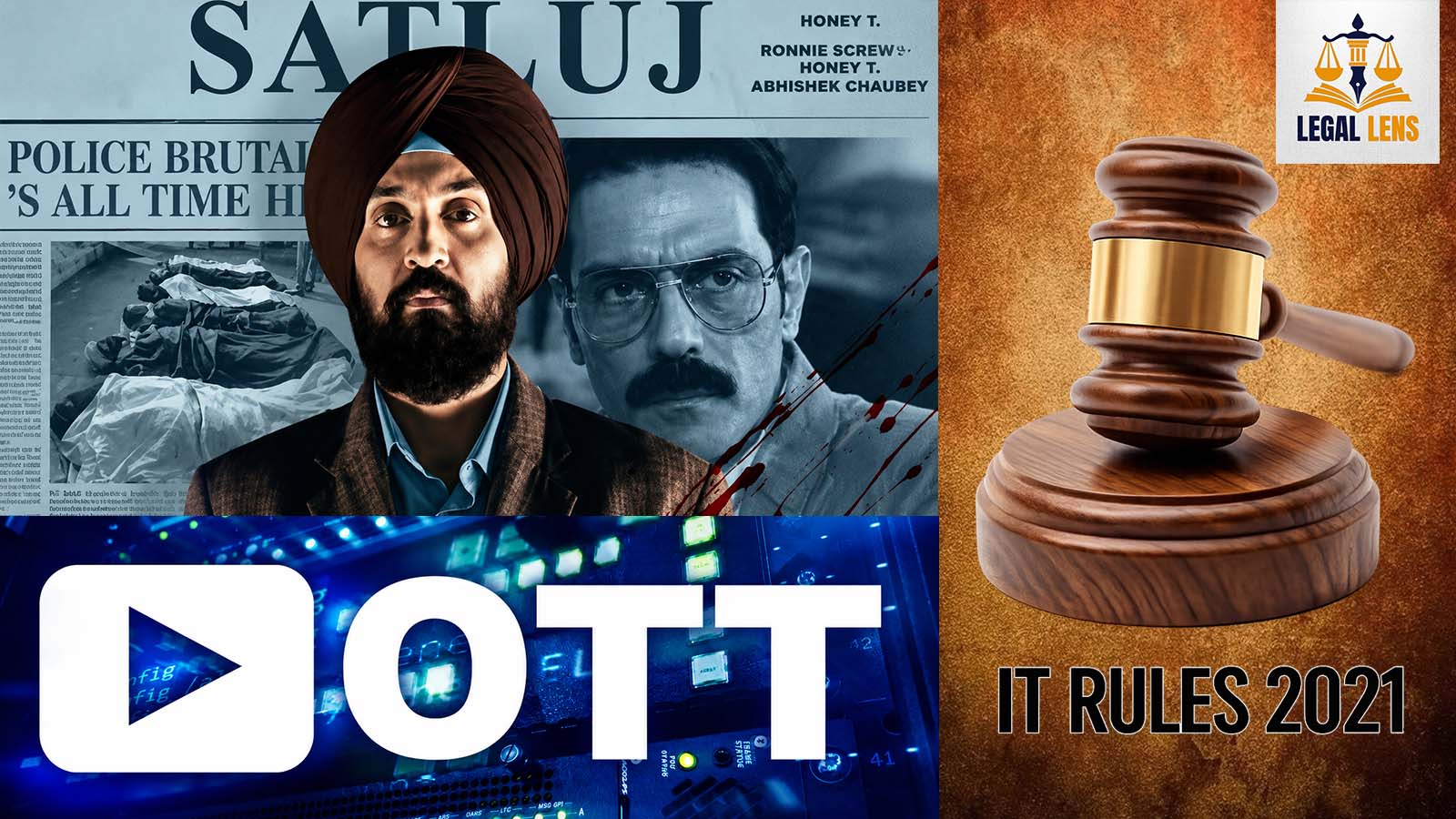

For four years, the Censor Board would not let Satluj into Indian theatres. Last week, the film found a lawful route around the Board. It lasted 48 hours.
Honey Trehan’s film on the human rights defender Jaswant Singh Khalra, with Diljit Dosanjh in the lead, dropped on ZEE5 on July 3. It arrived with a new title, no promotion and, its makers insisted, not a single cut. On the evening of July 5, it vanished from the platform’s Indian catalogue. It continues to stream abroad on ZEE5 Global.
ZEE5 announced that the film would be “unavailable in India until further notice” owing to unspecified current developments. It promised to pursue every lawful route to restore it, and pleaded with subscribers to shun piracy meanwhile.
The Centre’s explanation has come through unnamed officials rather than a published order. Government sources say the ministry directed the takedown, citing security concerns and the platform’s obligations under the Information Technology Rules of 2021. One official complained that the makers, having refused the Board’s cuts, “released the movie quietly on OTT with a new title”.
Reports added that the direction was issued under Section 69A of the Information Technology Act. The ministry, they say, constituted an inter-departmental committee on July 6 to examine the film. These explanations raise two distinct questions. Can an unfinished certification proceeding bar a streaming release? And did the Centre satisfy the statutory conditions for emergency blocking?
On the first, the law is clear. On the second, the absence of a public order leaves everything to inference.
Deleting history
Khalra, a bank employee in Amritsar, mined municipal cremation records. They exposed the Punjab Police’s secret disposal of thousands of bodies during the militancy years. His research pointed to some 25,000 illegal killings and cremations. On September 6, 1995, policemen abducted him from outside his home. He was never seen again.
A CBI court in Patiala convicted six policemen in November 2005, sentencing two of them to life imprisonment. The Punjab and Haryana High Court raised the seven-year terms of the other four to life in 2007. In November 2011, the Supreme Court dismissed the policemen’s appeals in Prithipal Singh v State of Punjab (2011). Tolerating such atrocities, it warned, would amount to a “systematic subversion and erosion of the rule of law”.
Also read: Why India keeps removing cartoons from textbooks, and getting it all wrong
The Censor Board nevertheless demanded 127 cuts before the film, submitted for certification in December 2022, could be shown. An Article 14 investigation catalogued the strictures. They included deleting Khalra’s name, scrubbing “Punjab” from mentions of the Punjab Police, and fictionalising Tarn Taran and Amritsar. The figure of 25,000 was to be avoided, no year specified, and the card saying the film drew on true events removed. The examining committee’s initial rejection, the investigation reported, was conveyed only verbally.
The makers refused. They challenged the Board’s objections in the Bombay High Court in 2023, but later withdrew the petition. The appellate tribunal that once heard such disputes swiftly and cheaply had been abolished in 2021. Pressure also ran beyond the written word. A Board representative informally asked the producers to withdraw the film from the Toronto International Film Festival. They complied. At one point, its sources said, they were asked to delay release until after the 2024 general election.
A scheduled worldwide release in February last year was also cancelled. The film shed two titles, I read itmeaning massacre, and Punjab ’95before reaching audiences as Satlujnamed for the river.
Censor Board not certifying OTT films
The Cinematograph Act of 1952 provides for the certification of films meant for public exhibition in cinemas. Streaming services answer to a separate framework, Part III of the IT Rules. There, publishers classify their own programmes by age, display ratings and descriptors, and provide parental controls. The Rules demand self-classification, not prior submission to the Board. The ministry itself told the Lok Sabha as recently as December that the Board’s writ does not run to streaming content.
Bypassing the Board for a streaming-only release therefore breaches nothing. A certificate sought for cinemas is not a licence that must also be obtained before the same work can be streamed. The unfinished proceeding may explain why the makers chose ZEE5. It cannot supply the legal authority for removing the film from ZEE5.
That authority, if it exists, must come from the IT Act and its Rules.
What rules actually permit
The rules are no charter of immunity.
Their Code of Ethics binds platforms to caution over content touching sovereignty, security, foreign relations and public order. Complaints travel through three tiers: the publisher, a self-regulating body, and an oversight mechanism run by the ministry. In the ordinary course, an inter-departmental committee recommends graded responses, from a warning or disclaimer to editing, deletion or blocking. The publisher is identified, notified and heard.
Also read: How Iranian filmmaker Jafar Panahi keeps reinventing against the state’s repression
Rule 16 carves an emergency route for cases where no delay is acceptable. An authorised officer must record why the content falls within the grounds of Section 69A. The Information and Broadcasting Secretary may then order interim blocking without hearing the publisher, for reasons recorded in writing. Within 48 hours, the matter must go before the committee, and a final order must follow or the block lapses. The safeguards are part of the power, not administrative garnish.
The reported sequence here, a takedown on July 5 and a committee constituted on July 6, mirrors that emergency route. If so, the government must show what emergency brooked no delay. It must identify the Section 69A ground invoked, the material supporting it, and the necessity of total removal.
The State’s duty is to protect lawful expression against threats, not to reward the threateners by removing the work.
One complication lurks. The Bombay High Court stayed the Code of Ethics’ enforcement in 2021, and the Madras High Court held that the stay operates nationwide. Whether the Centre’s direction leans on those stayed provisions is not known.
Security concerns
Section 69A permits blocking in the interests of sovereignty and integrity, defence, security of the State, friendly foreign relations or public order. Each expression has legal content. A loose invocation of “security concerns” identifies none of them.
Reports attributed to officials said they feared that the film could revive a diminishing pro-Khalistan movement or be used by anti-India forces. That may be the government’s assessment. The constitutional question is whether the danger is proximate or merely conjectural.
The Supreme Court drew that line in S. Rangarajan v P. Jagjivan Ram (1989), a case about a Tamil film on reservation. The anticipated danger, it held, cannot be remote, conjectural or far-fetched. It must bear a proximate and direct nexus to the expression, like a “spark in a powder keg”. The State’s duty is to protect lawful expression against threats, not to reward the threateners by removing the work.
The Supreme Court held that the State cannot act as a super-censor. Free expression, it said, imposes a positive duty of protection, and informal suppression leaves the victim nothing to challenge.
The court upheld Section 69A itself in Shreya Singhal v Union of India (2015) precisely because the power was narrow. Blocking was tied to constitutional grounds, reasons had to be recorded, and orders could be tested in court.
Judicial review turns theoretical when the filmmaker never receives the order. Confidentiality may shield sensitive material. It cannot reduce a statutory order to the silent disappearance of a film.
An earlier vanishing
The takedown recalls Indibily Creative v Government of West Bengal (2019). The Bengali satire Bhobishyoter Bhoot held a valid certificate, yet vanished from theatres after police calls and informal pressure.
The Supreme Court held that the State cannot act as a super-censor. Free expression, it said, imposes a positive duty of protection, and informal suppression leaves the victim nothing to challenge. Satluj never had a certificate, and the Centre claims a statutory mechanism. The concern is the same. A lawful block requires an identifiable order under an identifiable provision. Undefined “current developments” blur statutory power into executive pressure.
The government knows what such an order looks like. In March, the same ministry notified Telegram under Section 79(3)(b) of the IT Act to disable 3,142 identified piracy channels. Named content, a named provision, a written notification.
Satluj has received nothing comparable in public.
From scissors to switch
The pattern predates this film. SonyLIV volunteered Arun Karthick’s Nasir to the Board in 2022, though no certificate was required, and the film never surfaced.
Netflix streamed the censored theatrical cut of Anubhav Sinha’s Bheed under no legal compulsion. Zee itself pulled the Tamil film to Annapooran from streaming in January 2024 and apologised after Hindutva groups complained. Platforms behaved as though the Board’s writ already ran online. Satluj‘s makers relied on the truth that it does not.
The State then closed the route. The censor’s scissors were replaced by an executive switch.
The Internet Freedom Foundation, in a video posted on X, has asked the central question. Why remove a film that no law required to be certified for online release?
The takedown also lands amid a fortnight of opaque directions to platforms. Telegram was blocked for six days around the NEET-UG re-examination. Username notices went to WhatsApp, Telegram and Signal.
On July 4, an unpublished notice, known only through a press handout, ordered Telegram to build piracy-detection machinery and report within 15 days. Secrecy, the foundation said of that notice, is “an unfortunate hallmark of digital censorship”: the public gets source-briefed handouts, never the order itself.
The foundation warned during the Tandav controversy that the Rules’ oversight design invites a heckler’s veto, coordinated complaints pressuring platforms into cutting lawful material. It has also documented the secrecy of Section 69A orders, including the unpublished blocking of the BBC’s Modi documentary.
Proportionality deepens the doubt. The Rules themselves contemplate graded responses: a warning, a disclaimer, an adult rating, the deletion of specified scenes. Why did the whole film have to go? If the government holds material the public cannot see, it can place that material before a court under suitable confidentiality. What it cannot do is let the gravity of the word “security” dispense with the obligation of reasons.
Widespread condemnation
Punjab’s politics has meanwhile spoken in one voice. The Akali Dal called the removal an “assault on our collective memory”; the Congress and the ruling AAP condemned it; the SGPC demanded release.
The events the film depicts occurred under Congress governments at the Centre and in the state. Their suppression on a rival’s watch suggests the anxiety attaches to depictions of state violence, whoever presided over it.
The takedown’s legality will turn on documents nobody has seen. Was there a written recommendation, and on which ground? Did the committee review the block in time? Why was total removal necessary? Until those answers come, the removal of Satluj completes, by another route, the censorship the Board began four years ago. Its logic is circular: the film must be blocked because it was never certified, though no certificate was required.
The Supreme Court placed Khalra’s story on the judicial record nearly 15 years ago. Whether Indians may see on screen what their highest court has found as fact is now the only question left.

Comments are closed.